
Australian PM Albanese secures a second term, defeating Dutton`s coalition.
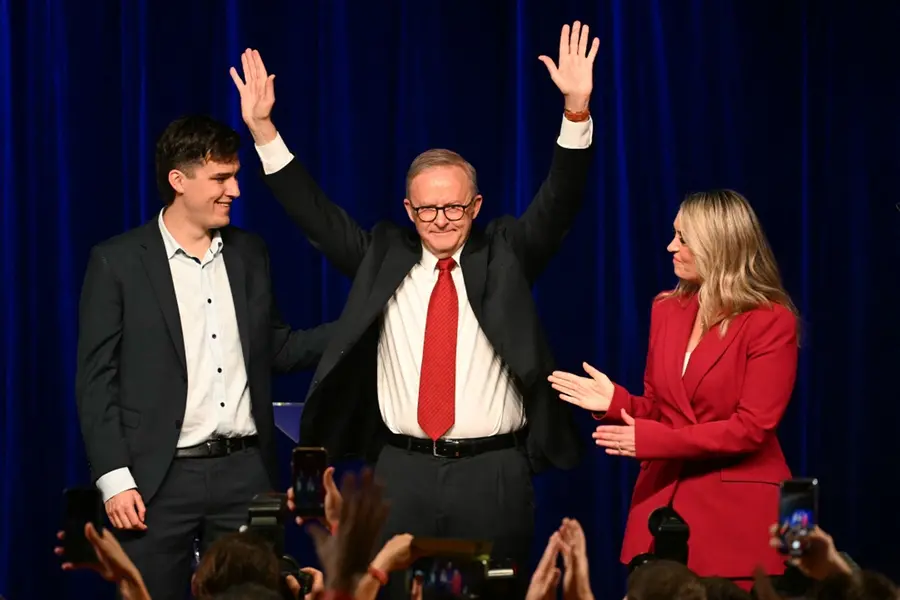
Melbourne: Prime Minister Anthony Albanese has become the first Australian Prime Minister in 21 years to win a second consecutive three-year term.
Opposition Leader Peter Dutton conceded defeat in Saturday’s election, stating, “We didn’t do well enough during this campaign, that much is obvious tonight, and I accept full responsibility for that.”
“Earlier on, I called the Prime Minister to congratulate him on his success tonight. It’s an historic occasion for the Labor Party and we recognise that,” he added.
Election results and projections
The Australian Electoral Commission’s projections awarded Albanese’s ruling centre-left Labor Party 70 seats and the conservative opposition coalition 24 seats in the 150-seat House of Representatives, where a majority is required to form government. Unaligned minor parties and independent candidates appeared likely to win 13 seats.
Respected Australian Broadcasting Corporation election analyst Antony Green predicted Labor would secure 76 seats, the coalition 36, and unaligned lawmakers 13. Green stated that Labor would form either a majority or a minority government, while the coalition had no hope of forming even a minority government.
Campaign issues: inflation, energy, and cost of living
Energy policy and inflation dominated the campaign, with both major parties agreeing that the country faces a cost of living crisis.
Dutton’s conservative Liberal Party blamed government waste for fuelling inflation and raising interest rates and pledged to axe more than one in five public service jobs to reduce government spending.
While both sides advocate for achieving net-zero greenhouse gas emissions by 2050, Dutton argued that greater reliance on nuclear energy, instead of renewables such as solar and wind, would provide more affordable electricity.
Political attacks and accusations
The ruling Labor Party branded Dutton as “DOGE-y Dutton” and accused his party of emulating former U.S. President Donald Trump’s divisive political style and his Department of Government Efficiency.
Labor argued that Dutton’s administration would slash services to fund its nuclear energy ambitions.
“We’ve seen the attempt to run American-style politics here of division and pitting Australians against each other and I think that’s not the Australian way,” Albanese said.
Improved relations with China
Albanese also highlighted his government’s success in improving relations with China, which had removed a series of official and unofficial trade barriers. These barriers had previously cost Australian exporters 20 billion Australian dollars ($13 billion) annually since Labor came to power in 2022.
Economic challenges and changing demographics
The election took place amid a backdrop of economic hardship, which both sides acknowledged as a cost of living crisis.
Foodbank Australia, the nation’s largest food relief charity, reported that 3.4 million households in the country of 27 million people experienced food insecurity last year. Many Australians were skipping meals, eating less, or worrying about running out of food before they could afford to buy more.
The central bank reduced its benchmark cash interest rate by a quarter percentage point in February to 4.1%, suggesting that the worst of the financial hardship had passed. The rate is widely expected to be cut again at the next board meeting on 20 May to encourage investment amid international economic uncertainty, partly driven by Trump’s tariff policies.
Both campaigns placed strong emphasis on Australia’s changing demographics. This election marks the first time that Baby Boomers, born between the end of World War II and 1964, are outnumbered by younger voters.
Both sides pledged policies aimed at assisting first-home buyers to enter an increasingly unaffordable property market.
Prospects for government formation
Before the election, Labor held a narrow majority of 78 seats in the 151-seat House of Representatives. Following redistributions, the next parliament will have 150 seats.
A loss of more than two seats could have forced Labor to attempt to form a minority government with the support of unaligned lawmakers.
The last minority government was formed after the 2010 election, and the previous one before that was during World War II. In 2010, it took 17 days after polls closed for key independent lawmakers to announce their support for a Labor administration.
AP inputs
Published: 03 May 2025, 06:30 pm IST
Related Topics
Disclaimer: Kindly avoid objectionable, derogatory, unlawful and lewd comments, while responding to reports. Such comments are punishable under cyber laws. Please keep away from personal attacks. The opinions expressed here are the personal opinions of readers and not that of Mathrubhumi.
