
Clashes erupt at `Unite the Kingdom` rally in London, injuring 26 officers and leading to 25 arrests. Far-right rhetoric fuels tensions over migration.
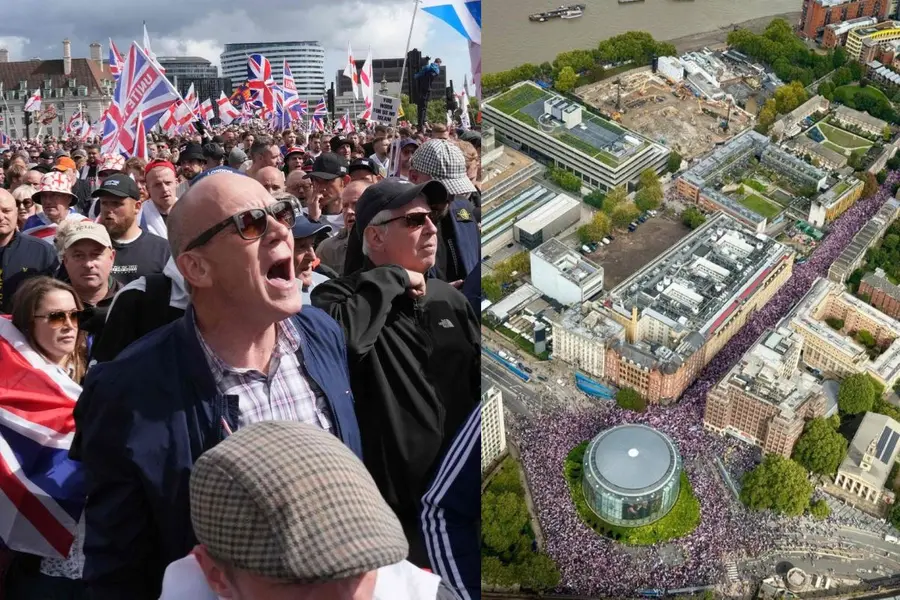
London: A large-scale march organised by far-right activist Tommy Robinson turned violent in central London on Saturday, leaving at least 26 police officers injured, including four seriously, as clashes broke out between his supporters and counterprotesters. The rally drew an estimated 110,000 to 150,000 people, according to police.
Who is Tommy Robinson?
Tommy Robinson, whose real name is Stephen Yaxley-Lennon, is a controversial British far-right figure and founder of the nationalist and anti-Islam English Defense League. He has been a regular figure at anti-migration demonstrations and has a history of legal convictions ranging from assault to contempt of court.
He was jailed for contempt of court for violating a 2021 High Court order barring him from repeating libellous allegations against a Syrian refugee who successfully sued him. He previously served jail time for assault and mortgage fraud.
Why was the rally held?
The march was billed as a demonstration in support of free speech, with much of the rhetoric by influencers and several far-right politicians from across Europe aimed largely at the perils of migration, a problem much of the continent is struggling to control.
“We are both subject to the same process of the great replacement of our European people by peoples coming from the south and of Muslim culture, you and we are being colonized by our former colonies,” far-right French politician Eric Zemmour said.
Elon Musk, the Tesla CEO and owner of the X platform who has waded into British politics several times this year, was beamed in by video and condemned the left-leaning U.K. government.
“There’s something beautiful about being British and what I see happening here is a destruction of Britain, initially a slow erosion, but rapidly increasing erosion of Britain with massive uncontrolled migration," he said.
The marches come at a time when the U.K. has been divided by debate over migrants crossing the English Channel in overcrowded inflatable boats to arrive on shore without authorization.
Numerous anti-migrant protests were held this summer outside hotels housing asylum-seekers following the arrest of an Ethiopian man who was later convicted of sexually assaulting a 14-year-old girl in a London suburb. Some of those protests became violent and led to arrests.
Participants in the “Unite the Kingdom” march carried the St. George’s red-and-white flag of England and the union jack, the state flag of the United Kingdom, and chanted “we want our country back.”
Supporters held signs saying “stop the boats,” “send them home,” and “enough is enough, save our children.”
Clashes with police and counterprotesters
Though the march remained peaceful for much of the day, tensions escalated by late afternoon. Metropolitan Police reported that a small group at the fringes of the rally threw bottles, punched officers, and tried to breach police barricades separating them from counterdemonstrators.
Police deployed reinforcements with riot shields and helmets to support the over 1,000 officers on duty. In total, 25 people were arrested for offences including violent disorder, assault, and criminal damage.
Twenty-six police officers were injured, four who were seriously hurt, including broken teeth and a concussion, a possible broken nose and a spinal injury.
Counterprotest: ‘Refugees welcome’ vs. ‘Send them home’
A rival protest, dubbed “March Against Fascism”, was organised by the group Stand Up To Racism and drew around 5,000 participants. They held signs reading “Refugees Welcome” and “Smash the Far Right,” chanting slogans like “Stand up, fight back.”
Clashes between the two sides were mostly contained by police, though one man from the Robinson march was seen bleeding from the head as he was escorted away. The cause of his injury was unclear.
Published: 14 Sept 2025, 10:23 am IST
Disclaimer: Kindly avoid objectionable, derogatory, unlawful and lewd comments, while responding to reports. Such comments are punishable under cyber laws. Please keep away from personal attacks. The opinions expressed here are the personal opinions of readers and not that of Mathrubhumi.
