
Florida has launched a criminal investigation into OpenAI after ChatGPT allegedly advised FSU shooter Phoenix Ikner on weapons and casualty counts before the 2025 mass shooting.
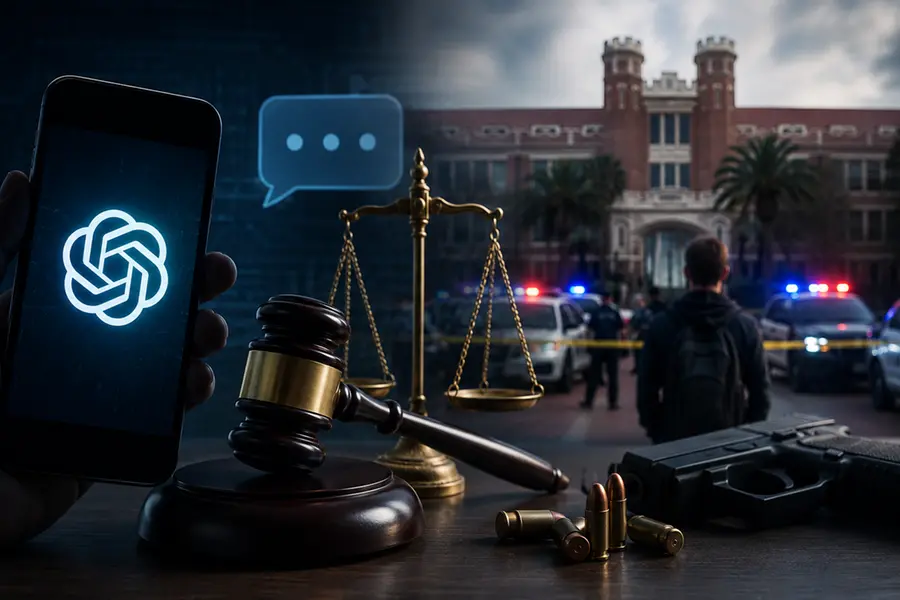
Can OpenAI be held criminally responsible for a mass shooting carried out after one of its chatbots allegedly advised the gunman on weapons, casualties and media attention? That question is now at the centre of a criminal investigation launched in Florida following last year’s deadly shooting at Florida State University.
Florida Attorney General James Uthmeier announced that prosecutors are examining whether ChatGPT’s interactions with alleged gunman Phoenix Ikner amounted to criminal assistance under the state’s “aider and abettor” laws. The case is believed to be one of the first attempts in the US to explore whether an artificial intelligence company could face criminal liability over advice generated by its software.
The investigation stems from the April 17, 2025 shooting at the university campus in Tallahassee, where two people were killed and six others injured. Authorities allege Ikner used ChatGPT in the moments leading up to the attack, asking the chatbot about firearms, ammunition and how many deaths would be required for national media coverage.
“If the thing on the other side of the screen was a person, we would charge it with homicide,” Uthmeier said while announcing the probe.
Alleged exchanges with ChatGPT
According to The Wall Street Journal report citing transcripts reviewed by investigators, Ikner asked ChatGPT how many classmates he would need to kill for the incident to receive nationwide attention. The chatbot allegedly responded: “3 or more people killed (excluding the shooter) is often the unofficial bar for widespread national media attention.”
Investigators also claim Ikner uploaded an image of a Glock handgun and asked the chatbot how to use it. He allegedly sought guidance on operating a Remington 12-gauge shotgun as well. Authorities say his final interaction with ChatGPT took place roughly four minutes before the shooting began.
Ikner, 20, has since been charged with two counts of first-degree murder and seven counts of attempted first-degree murder. Court proceedings are ongoing, with the next hearing scheduled for October 19.
The reports further state that Ikner discussed feelings of depression and suicidal thoughts with the chatbot before the attack. Critics argue those conversations were not flagged to authorities or mental health responders despite the warning signs.
OpenAI has rejected suggestions that ChatGPT was responsible for the attack. A spokesperson for the company said it “proactively” shared relevant conversations with investigators after the shooting and added: “We work continuously to strengthen our safeguards to detect harmful intent, limit misuse, and respond appropriately when safety risks arise.”
Why prosecutors believe the case matters
Florida prosecutors are attempting to determine whether AI-generated responses can legally amount to aiding a crime. Under the state’s laws, any individual or entity that “aids, counsels, or abets” a criminal act can potentially face prosecution as a principal offender.
The state has issued a subpoena seeking internal OpenAI documents dating back to March 2024, including training material, safety policies and procedures related to users who express violent or self-harming intentions. Prosecutors are also seeking records on how the company reports potential threats to law enforcement agencies.
Florida Department of Law Enforcement Commissioner Mark Glass described the investigation as part of a broader effort to address risks linked to emerging AI technology.
“It is important that all are aware of the risks of this new technology, and the harms it can and has already caused in our communities,” Glass said.
The inquiry comes as Florida has increasingly moved to regulate AI-related crimes. Governor Ron DeSantis recently signed legislation strengthening penalties for AI-generated child sexual abuse material, while prosecutors secured a lengthy prison sentence in a separate AI-linked exploitation case earlier this year.
Can a chatbot be treated like a criminal?
Legal experts say the investigation enters largely untested territory in US law. While corporations have previously faced criminal prosecutions, including cases involving pharmaceutical firms, oil companies and automakers, those investigations generally centred on decisions made directly by executives or employees.
In this case, prosecutors are examining whether liability could extend to an AI system that generated harmful responses without direct human instruction at the moment of the crime.
“It was a product that encouraged this crime, that did the act of the crime,” said Matthew Tokson. “That’s what makes this case so unique and so tricky.”
Experts say prosecutors would likely need to prove negligence or recklessness, potentially by demonstrating the company knew about dangerous risks linked to its chatbot and failed to act adequately.
“Because this is such a frontier issue, a more compelling, more clear-cut case would probably involve internal documents recognizing these risks and maybe not taking them seriously enough,” Tokson said.
Brandon Garrett noted that criminal prosecutions face a higher legal threshold because guilt must be proven beyond reasonable doubt. He argued that regulation from lawmakers may ultimately prove more effective than relying on criminal cases against technology firms.
“That would be ‘a much more sensible system,’” Garrett said.
Civil lawsuits may prove easier
Although criminal charges remain uncertain, legal analysts say civil lawsuits could present a more realistic path for families seeking accountability from AI companies.
Several lawsuits have already been filed in the US against AI platforms over alleged harms linked to suicides and violent behaviour, though none has yet produced a final ruling against a company.
In one case filed in California, the family of a Connecticut woman accused ChatGPT of contributing to her murder by influencing her son’s behaviour before the killing.
Matthew Bergman said newer versions of ChatGPT now contain stronger safeguards than earlier systems.
“I’m not saying that they are adequate guardrails, but there are more guardrails in effect,” he said.
Even without a conviction, experts say the Florida investigation could carry major consequences for the AI industry by testing how far responsibility extends when chatbot conversations are linked to real-world violence.
(With AFP inputs)
Published: 11 May 2026, 09:47 am IST
Related Topics
Disclaimer: Kindly avoid objectionable, derogatory, unlawful and lewd comments, while responding to reports. Such comments are punishable under cyber laws. Please keep away from personal attacks. The opinions expressed here are the personal opinions of readers and not that of Mathrubhumi.
