
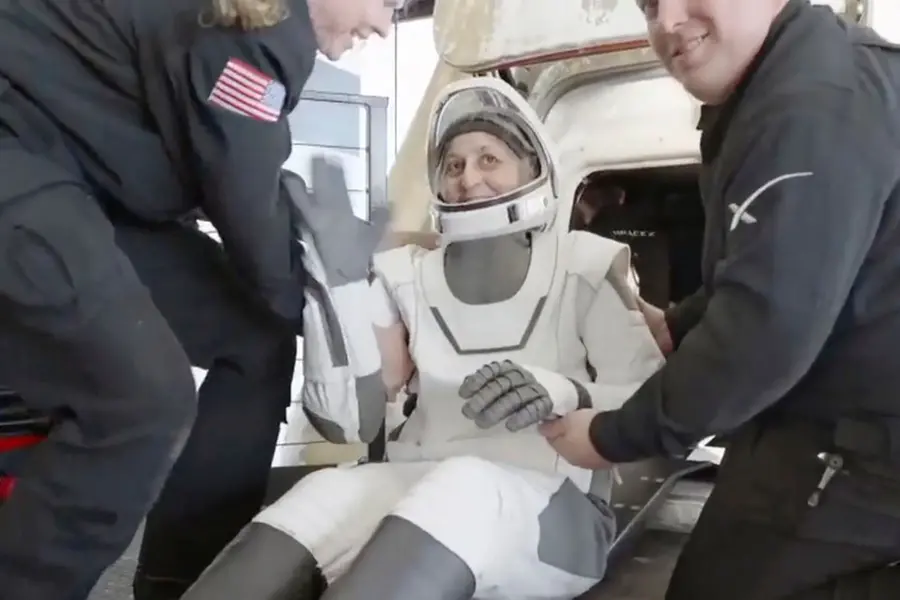
An anticipated mission turns into an unexpected crisis. An eight-day journey stretches into over eight months. Finally, rescuers from Earth arrive to safely bring back those stranded. The experiences of NASA astronauts Sunita Williams and Barry ‘Butch’ Wilmore over the past nine months have been nothing short of dramatic, surpassing the suspense of any Hollywood thriller.
Sunita and Wilmore had arrived at the International Space Station (ISS) aboard the Boeing-built Starliner spacecraft on June 5, 2024. This was Starliner's first crewed mission and the third space journey for both astronauts. However, an unforeseen helium leak and subsequent technical failures in the spacecraft delayed their return. As concern spread globally, NASA’s explanations only heightened the suspense. Now, their long-awaited return has finally happened.
In late September 2024, the two astronauts made their journey back aboard Crew Dragon, a spacecraft launched by SpaceX, along with two other passengers. This situation highlights an intriguing reality—NASA had simultaneously contracted both SpaceX and Boeing, leading to the coexistence of both the Crew Dragon and Starliner spacecraft.
Life on ISS
What was supposed to be an eight-day mission turned into a 286-day stay. However, for Sunita Williams, this was not entirely unfamiliar—she had previously spent a total of 322 days in space across two missions.
Moreover, contrary to how media reports might portray them as two stranded individuals, Sunita and Wilmore were far from helpless. Since last September, they have been active members of Expedition 72 on the ISS, carrying out scientific experiments and operational duties like any other space researcher.
Some may think that Sunita is fortunate to spend these many days in space. While a prolonged space stay might sound like a dream to many, the reality is far from comfortable.
Consider the ISS itself: it orbits Earth at an altitude of 408 kilometres, travelling at a staggering speed of approximately 28,000 kilometres per hour! To put this into perspective, an average bullet moves at only about 3,000 kilometres per hour—making the station’s velocity truly mind-boggling.
Sixteen sunrises in a day
Due to its rapid orbit, the ISS circles Earth 16 times a day. This means that while those on Earth experience one sunrise and one sunset daily, astronauts aboard the ISS witness this cycle 16 times within 24 hours.
The human body operates on a natural 24-hour biological clock. However, experiencing 16 sunrises in a single day can severely disrupt this rhythm. Fortunately, astronauts undergo rigorous training to adapt to such conditions. Even then, tasks that seem trivial on Earth become incredibly complex in space due to microgravity. Walking and moving around as we do on Earth is impossible—astronauts must float from place to place. Performing even the most routine activities requires extraordinary effort.
Some may ask why astronauts like Sunita Williams willingly endure such hardships. The truth is, their sacrifices and dedication serve as invaluable investments for future generations. While aboard the ISS, even their bodies become subjects of scientific study, offering crucial insights for the advancement of future space missions.
Published: 19 Mar 2025, 07:39 am IST
ABOUT THE AUTHOR

Disclaimer: Kindly avoid objectionable, derogatory, unlawful and lewd comments, while responding to reports. Such comments are punishable under cyber laws. Please keep away from personal attacks. The opinions expressed here are the personal opinions of readers and not that of Mathrubhumi.