
Apollo 13 commander Jim Lovell, renowned for his leadership during NASA’s near-disastrous lunar mission, has died at age 97.
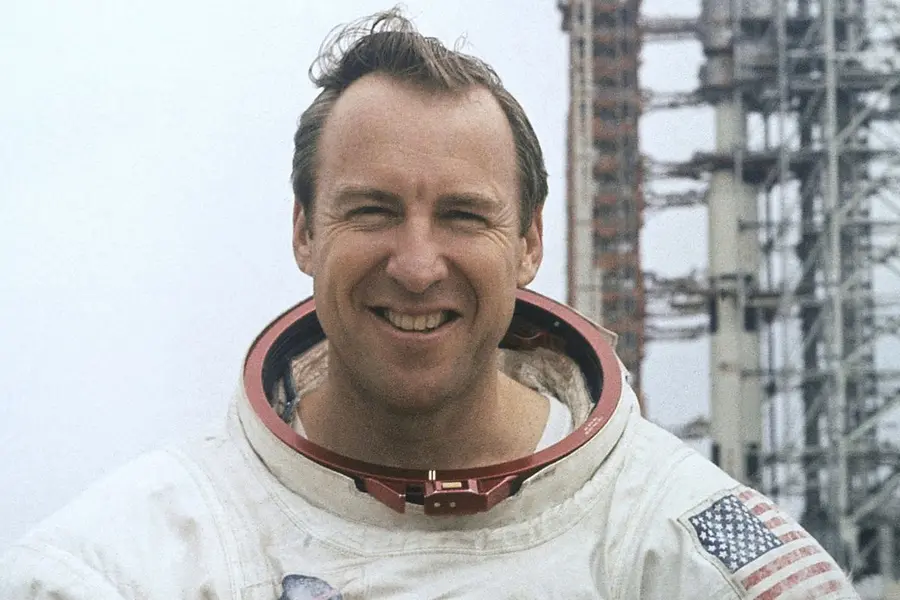
Chicago: Jim Lovell, the commander who led the Apollo 13 mission and turned a near disaster into a historic rescue, died Thursday in Lake Forest, Illinois, at age 97, NASA announced Friday.
“Jim’s character and steadfast courage helped our nation reach the Moon and turned a potential tragedy into a success from which we learned an enormous amount,” NASA said. “We mourn his passing even as we celebrate his achievements.”
Lovell was one of NASA’s most experienced astronauts in its early years, flying on four missions: Gemini 7, Gemini 12, Apollo 8, and Apollo 13. His Apollo flights, in particular, captured public attention worldwide.
Pioneering Apollo 8
In 1968, Lovell, along with Frank Borman and William Anders, became the first crew to leave Earth orbit and orbit the moon during the Apollo 8 mission. Although they did not land, their flight helped the US take the lead in the space race with the Soviet Union. The crew’s iconic “pale blue dot” photo of Earth and their Christmas Eve reading from Genesis provided hope during a turbulent year.
The Apollo 13 ordeal
Lovell’s defining moment came during Apollo 13 in 1970. Intended to be the fifth man to walk on the moon, his mission was cut short when an oxygen tank exploded aboard the service module, 200,000 miles from Earth. Lovell and his crewmates Jack Swigert and Fred Haise spent four tense days confined to the cramped lunar module, which served as a lifeboat as they struggled to survive and return home.
“The thing that I want most people to remember is (that) in some sense it was very much of a success,” Lovell said in a 1994 interview. “Not that we accomplished anything, but a success in that we demonstrated the capability of (NASA) personnel.”
Known for his quiet confidence and steady leadership, Lovell told a NASA historian in 1999 that his close call changed how he viewed crises. “I don’t worry about crises any longer,” he said. “Whenever I have a problem, I say, ‘I could have been gone back in 1970. I’m still here. I’m still breathing.’ So, I don’t worry about crises.”
Smithsonian historian Roger Launius described Lovell as “a very personable, very down-to-earth type of person, who says ‘This is what I do. Yes, there’s risk involved. I measure risk.’”
Record-breaking astronaut
Before Skylab missions in the 1970s, Lovell held the world record for longest time in space, clocking 715 hours, 4 minutes and 57 seconds across his four flights.
Bruce McClintock of RAND Corporation praised Lovell as “a member of really the first generation of American astronauts and went on to inspire multiple generations of Americans to look at the stars and want to explore.”
During Apollo 8, Lovell famously reflected on Earth from lunar orbit, imagining what an alien traveller might think upon seeing the planet.
Gene Kranz, NASA’s legendary flight director, once called Lovell “one of the pillars of the early space flight program.”
The Apollo 13 mission remains Lovell’s most iconic legacy. He recalled “the most frightening moment in this whole thing” when oxygen began escaping and “we didn’t have solutions to get home.” With the mission aborted, NASA focused entirely on bringing the astronauts safely back. The crew survived by moving into the lunar module, rationing resources, and carefully navigating back to Earth.
Launius said the mission “demonstrated to the world they could handle truly horrific problems and bring them back alive.”
Though Lovell never walked on the moon, he expressed gratitude for the mission’s outcome. “The loss of the opportunity to walk on the moon is my one regret,” he told The Associated Press in 1995.
President Bill Clinton awarded Lovell the Congressional Space Medal of Honor that year, noting that while he “may have lost the moon ... you gained something that is far more important perhaps: the abiding respect and gratitude of the American people.”
Lovell explained the mission’s fame: “Going to the moon, if everything works right, it’s like following a cookbook. It’s not that big a deal,” he said in 2004. “If something goes wrong, that’s what separates the men from the boys.”
Life and career
Born March 25, 1928, in Cleveland, Lovell attended the University of Wisconsin before transferring to the U.S. Naval Academy in Annapolis, Maryland. He married Marilyn on the day he graduated in 1952.
A Navy test pilot, Lovell was selected as an astronaut by NASA in 1962. He retired from both the Navy and the space program in 1973 and later entered private business.
In 1994, Lovell co-wrote Lost Moon with Jeff Kluger, the book that inspired the 1995 film Apollo 13. Lovell made a cameo appearance in the movie as a Navy captain.
He and his family operated Lovell’s of Lake Forest, a now-closed restaurant in suburban Chicago. His wife Marilyn died in 2023. Lovell is survived by four children.
In a statement, the family hailed him as their “hero,” adding, “We will miss his unshakeable optimism, his sense of humor, and the way he made each of us feel we could do the impossible. He was truly one of a kind.”
(With inputs from AP)
Published: 09 Aug 2025, 08:27 am IST
Related Topics
Disclaimer: Kindly avoid objectionable, derogatory, unlawful and lewd comments, while responding to reports. Such comments are punishable under cyber laws. Please keep away from personal attacks. The opinions expressed here are the personal opinions of readers and not that of Mathrubhumi.
