
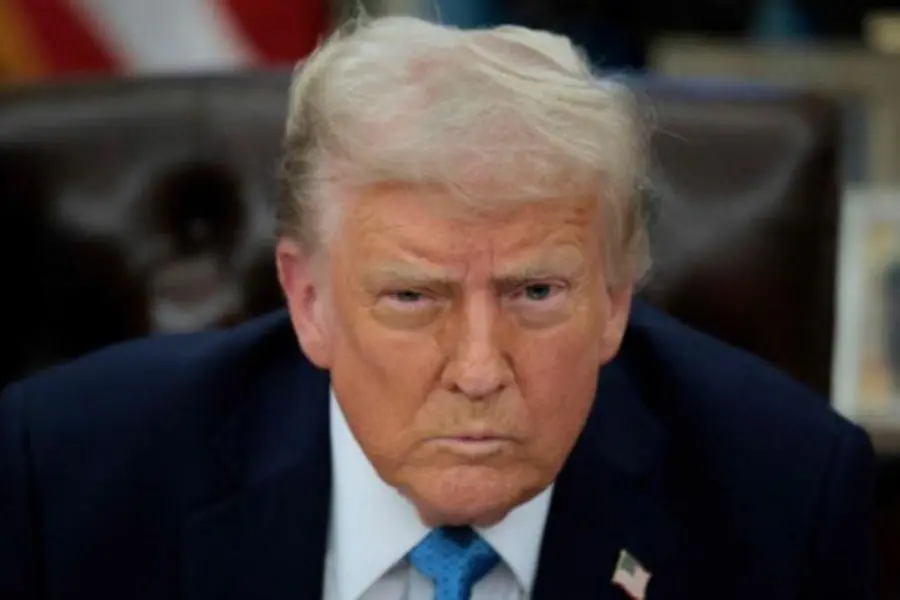
Washington DC: President Donald Trump has confirmed that he will hold discussions with Canadian Prime Minister Justin Trudeau and Mexican President Claudia Sheinbaum on Monday regarding the sweeping tariffs he has imposed on both countries. Speaking to reporters after returning from Florida, Trump stated that while he does not anticipate any dramatic developments, he remains firm on his stance that the economic "pain" caused by tariffs will be "worth the price."
Trump's administration has levied a 25 percent tariff on Canadian and Mexican goods, alongside a 10 percent tariff on China, which is in addition to previous levies. While he has long insisted that such tariffs would primarily affect foreign exporters, economic analysts warn that they are likely to increase costs for American consumers and businesses.
Despite acknowledging the potential economic impact in a series of posts on Truth Social, Trump argued that the measures were necessary to address trade deficits and secure US interests. "Will there be some pain? Yes, maybe (and maybe not!)," he wrote, adding that these steps were crucial for his broader vision to "Make America Great Again."
Retaliation from Canada and Mexico
The tariffs, which take effect on Tuesday, have drawn swift backlash from Canada and Mexico. Trudeau has announced retaliatory tariffs of 25 percent on select US goods worth Can$155 billion (US$106.6 billion). Additionally, several Canadian provinces have implemented measures such as halting US liquor purchases, reflecting mounting tensions between the two nations.
In Mexico, President Claudia Sheinbaum has instructed her economy minister to implement "Plan B," which includes unspecified "tariff and non-tariff measures." She is expected to outline Mexico's countermeasures in detail on Monday.
Trump has justified the tariffs not only on economic grounds but also by citing illegal immigration and the trafficking of fentanyl as reasons for imposing what he calls "emergency measures." However, he has set a lower 10 percent tariff on Canadian energy imports to prevent a sharp spike in US fuel prices.

Trump’s expansionist remark on Canada
Further straining relations, Trump made a provocative statement suggesting that Canada should become the 51st US state. "The USA has major deficits with Canada, Mexico, and China (and almost all countries!), owes 36 Trillion Dollars, and we're not going to be the 'Stupid Country' any longer," he wrote. He went on to claim that the US provides "hundreds of billions of dollars" to subsidise Canada and that without this support, Canada "ceases to exist as a viable country."
The comments have sparked outrage in Canada, with videos circulating of fans at a Toronto Raptors game booing during the US national anthem. Canadian officials have strongly condemned Trump's remarks, calling them "irresponsible and insulting."
Global trade tensions rise as EU threatens response
Trump's trade war is not limited to North America and China. On Sunday, he indicated that the European Union would soon face tariffs as well, prompting EU officials to warn of a "firm response" if such measures are imposed. The escalating trade tensions have raised concerns about global economic instability, with analysts predicting a slowdown in US growth and increased inflationary pressures.
Amid economic upheaval, US faces government shake-up
The tariff dispute comes amid significant upheaval within the US government, as Trump moves aggressively to reshape federal agencies. Reports indicate that Tesla CEO Elon Musk, a close Trump ally, is leading a newly created Department of Government Efficiency, which is reportedly examining federal payment and email systems.
Additionally, the country is grappling with its worst aviation disaster in years after an army helicopter collided with an airliner in Washington, D.C., killing 67 people. Trump controversially blamed diversity programs for the crash, drawing widespread criticism.
With trade talks set for Monday, the coming days will determine whether any concessions are made or if the tariffs will fuel further retaliatory measures from America's closest trading partners.
Published: 03 Feb 2025, 08:28 am IST
Related Topics
Disclaimer: Kindly avoid objectionable, derogatory, unlawful and lewd comments, while responding to reports. Such comments are punishable under cyber laws. Please keep away from personal attacks. The opinions expressed here are the personal opinions of readers and not that of Mathrubhumi.
