
Asian markets presented a mixed picture, with South Korea’s Kospi and Shanghai’s SSE Composite rising, while Japan’s Nikkei 225 and Hong Kong’s Hang Seng slipped.
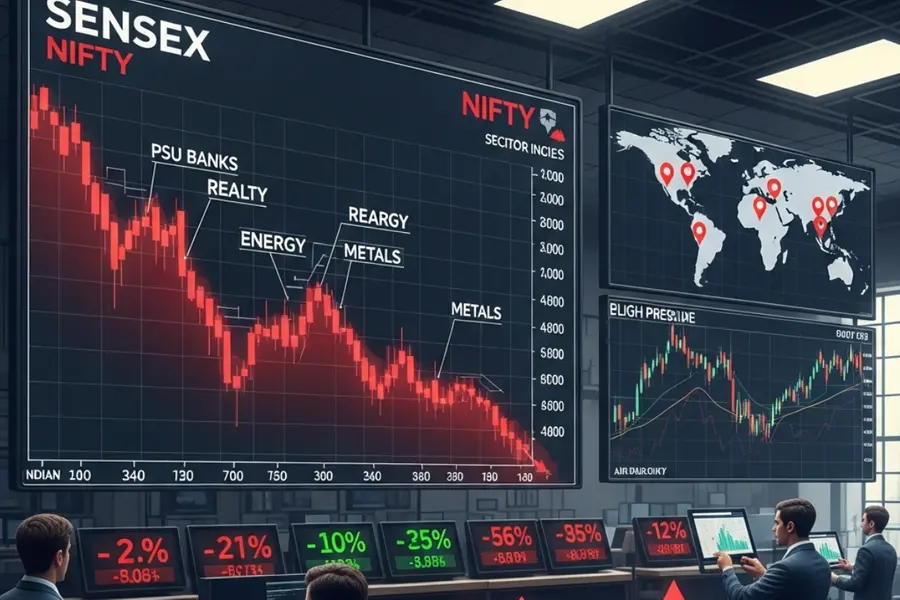
Indian equity markets opened lower on Thursday, January 8, 2026, as persistent foreign fund outflows and looming U.S. tariff concerns weighed on investor sentiment. The 30-share BSE Sensex fell 255.86 points to 84,705.28, while the 50-share NSE Nifty slipped 65.9 points to 26,074.85 in early trade.
Mixed performance among top stocks
Among the Sensex companies, Tata Consultancy Services, Asian Paints, Maruti, Tech Mahindra, Infosys, and UltraTech Cement led the losses. In contrast, ICICI Bank, Adani Ports, Bharat Electronics, and Hindustan Unilever managed modest gains.
Foreign investors continue to exit
Foreign institutional investors (FIIs) sold equities worth ₹1,527.71 crore on Wednesday, January 7, while domestic investors bought shares worth ₹2,889.32 crore, according to exchange data. Analysts say FII selling, coupled with delays in the anticipated U.S.-India trade deal, is limiting market recovery despite strong economic fundamentals.
Economy shows resilience
The Ministry of Statistics and Programme Implementation’s first advance estimates suggest India’s GDP will grow 7.4% in 2025–26, maintaining its position as the world’s fastest-growing major economy. This exceeds both the Reserve Bank of India’s 7.3% forecast and the government’s initial 6.3–6.8% projection.
Global cues add caution
Asian markets presented a mixed picture, with South Korea’s Kospi and Shanghai’s SSE Composite rising, while Japan’s Nikkei 225 and Hong Kong’s Hang Seng slipped. U.S. stocks mostly declined on Wednesday, dragged down by financial shares even as tech names supported Nasdaq. Brent crude rose slightly to $60.20 per barrel.
Outlook: consolidation likely
With GIFT Nifty signalling a negative start and India VIX easing to 9.95, analysts expect the market to remain in a consolidation phase. Nifty may trade between 26,000 and 26,300, with a break below 26,000 potentially triggering further weakness, while gains above 26,300 are needed for a sustained upward trend.
Published: 08 Jan 2026, 12:24 pm IST
Related Topics
Disclaimer: Kindly avoid objectionable, derogatory, unlawful and lewd comments, while responding to reports. Such comments are punishable under cyber laws. Please keep away from personal attacks. The opinions expressed here are the personal opinions of readers and not that of Mathrubhumi.
