
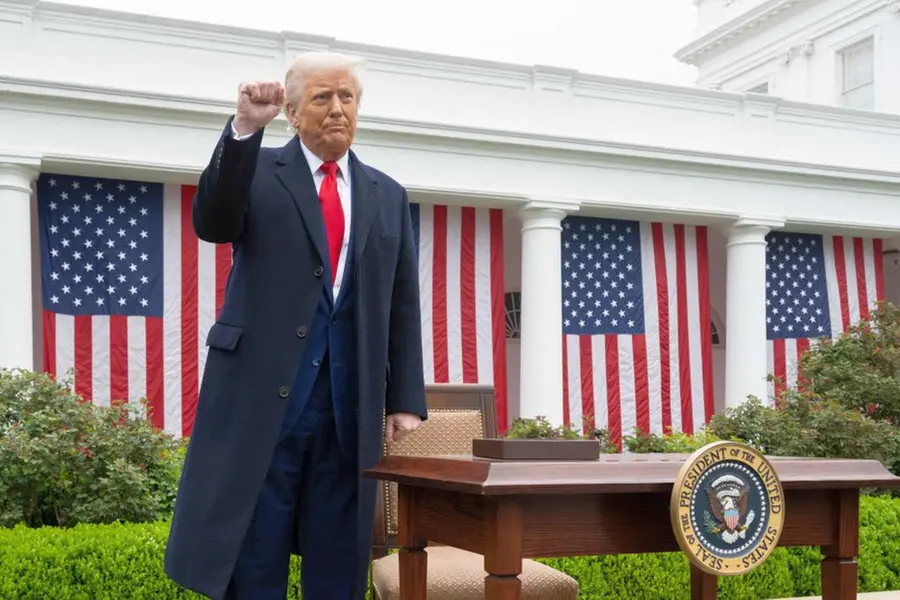
If United States President Donald Trump's proposed 10 per cent flat tariff and country-specific tariffs -- including a 26 per cent rate for India -- are implemented, several sectors in the Indian stock market could be significantly impacted.
Private wealth management firm Bernstein noted that the 26 per cent tariffs imposed on India are higher than the duties India applies to most US goods. However, key sectors such as IT services and pharmaceuticals remain unaffected by the announcement. While apparel and auto parts have faced significant tariff hikes, India appears to be relatively shielded from competitive disadvantages.
IT & Software Services
According to experts, the IT & Software Services sector, which includes companies like Infosys, TCS, Wipro, HCL Tech, and Tech Mahindra, could experience corrections. Although IT services are not directly tariffed, the US is the largest client for Indian IT firms, contributing around 50-60% of their revenues. A slowdown in US businesses due to increased import costs could lead to reduced outsourcing demand, negatively affecting IT stocks.
Pharmaceuticals
The pharmaceutical industry, represented by companies such as Sun Pharma, Dr Reddy's, Cipla, Biocon, and Lupin, is another vulnerable sector, say experts. New York-based investment bank and financial services company Jefferies reported that the US tariffs on India do not pose an immediate threat to the pharmaceutical sector, as broad reciprocal tariffs have exempted the industry for now.
However, the possibility of a future pharma-specific tariff order cannot be entirely ruled out. At present, the impact on India's pharmaceutical industry appears minimal. Meanwhile, US-focused generic pharmaceutical stocks are likely to see a rally, given the industry's significant role in lowering drug costs in the US. There is also a chance that the generic pharma sector may ultimately be spared from tariffs altogether.
India exports nearly $8 billion worth of generic drugs to the US annually, and higher tariffs could make Indian pharmaceuticals more expensive, potentially reducing export volumes and squeezing profit margins.
Textiles and apparel
Experts believe textiles and apparel, including firms like Raymond, KPR Mills, Welspun India, Trident, and Arvind, could face immediate setbacks. India exports a substantial volume of textiles to the US, and a 26% tariff would make Indian garments less competitive compared to alternatives like Bangladesh and Vietnam, leading to a potential decline in textile stock prices.
Auto and auto parts
The auto and auto parts sector, which includes Bharat Forge, Motherson Sumi, Bosch, Mahindra & Mahindra, and Tata Motors, could also suffer, experts said. India exports auto components and vehicles to the US, and higher tariffs would make these exports less attractive, potentially slowing revenue growth for companies with high US exposure.
Chemicals
Chemicals and specialty chemicals, with key players such as Aarti Industries, SRF, Deepak Nitrite, and PI Industries, may also see moderate effects. India is a major exporter of specialty chemicals to the US, and higher tariffs could shift demand toward domestic US suppliers or lower-tariff Chinese competitors.
Overall, IT, pharmaceuticals, and textiles are expected to be the worst-hit sectors. While IT may experience a gradual decline due to reduced US spending, pharma and textiles could face immediate setbacks from higher costs. Auto and chemicals may suffer moderately. However, if India successfully negotiates a trade deal with the US, these risks could be significantly mitigated.
Published: 03 Apr 2025, 10:11 am IST
Related Topics
Disclaimer: Kindly avoid objectionable, derogatory, unlawful and lewd comments, while responding to reports. Such comments are punishable under cyber laws. Please keep away from personal attacks. The opinions expressed here are the personal opinions of readers and not that of Mathrubhumi.
