
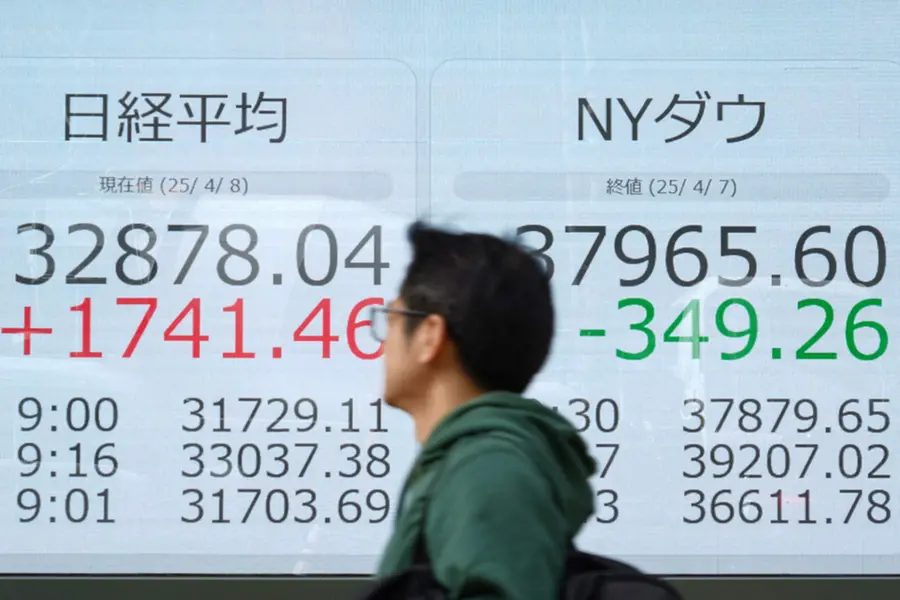
Bangkok: Asian markets opened higher on Tuesday, recovering from a turbulent day as Japan's Nikkei 225 surged 5.5% following a nearly 8% drop the day before. The rebound came after a wild session on Wall Street, where U.S. stocks swung dramatically in response to President Donald Trump's threat to escalate tariffs.
The Nikkei 225 quickly rose to 32,819.08 just half an hour after the Tokyo market opened. South Korea's Kospi also gained 2%, while markets in New Zealand and Australia followed suit with positive movements.
On Monday, Asian markets experienced a sharp decline, with Hong Kong’s stocks plummeting 13.2%, marking their worst day since the 1997 Asian financial crisis. In the U.S., the S&P 500 closed down 0.2%, while the Dow Jones Industrial Average fell 349 points, or 0.9%. The Nasdaq composite managed a small gain of 0.1%.
The dramatic market swings were driven by uncertainty over Trump's trade war with other nations. Investors are keenly awaiting the outcome of his tariff strategies. If Trump moves toward trade deals with other countries, tariffs could decrease, potentially averting a recession. However, prolonged tariff hikes could weigh on market performance, leading to further declines in stock prices.
Despite a sharp decline earlier in the day, U.S. markets made an unexpected turnaround. The Dow, which initially plunged as much as 1,700 points, surged nearly 900 points by the late morning. The S&P 500 experienced a remarkable recovery, climbing 3.4%, marking one of its biggest jumps in years.
The sudden rise followed a false rumor that Trump was considering a 90-day pause on his tariffs, one that a White House account on X quickly labeled as “fake news.” That a rumor could move trillions of dollars' worth of investments shows how much investors are hoping to see signs that Trump may let up on tariffs.
Stocks quickly turned back down, and shortly afterward, Trump dug in further and said he may raise tariffs more against China after the world's second-largest economy retaliated last week with its own set of tariffs on U.S. products.
Trump's tariffs are an attack on the globalization that's remade the world's economy, which helped bring down prices for products on the shelves of U.S. stores but also caused production jobs to leave for other countries.
He has given several reasons for his stiff tariffs, including to bring manufacturing jobs back to the United States, which is a process that could take years. Trump on Sunday said he wanted to bring down the numbers for how much more the United States imports from other countries versus how much it sends to them.
Indexes nevertheless did keep swinging between losses and gains Monday after Trump's latest tariff threat, in part because investors are still hoping negotiations may forestall actual implementation of the stiff duties on all imports.
All that seemed certain Monday was the financial pain hammering investments around the world for a third day after Trump announced tariffs in his “Liberation Day.”
A barrel of benchmark U.S. crude oil dipped below $60 during the morning for the first time since 2021, hurt by worries that a global economy weakened by trade barriers will burn less fuel. Bitcoin sank below $79,000, down from its record above $100,000 set in January, after holding steadier than other markets last week. (AP)
Published: 08 Apr 2025, 07:47 am IST
Related Topics
Disclaimer: Kindly avoid objectionable, derogatory, unlawful and lewd comments, while responding to reports. Such comments are punishable under cyber laws. Please keep away from personal attacks. The opinions expressed here are the personal opinions of readers and not that of Mathrubhumi.
