
MSC’s move to take a 49 per cent stake in Adani’s Vizhinjam International Seaport marks one of the most consequential foreign private investments in India’s port sector, positioning the Kerala deep-water hub as a key node on global container trade routes and reshaping the country’s shipping and logistics landscape.
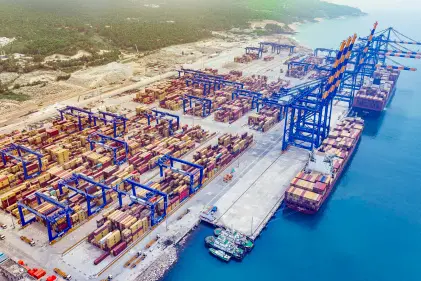
Adani Ports and Special Economic Zone Ltd (APSEZ) is in advanced talks with Mediterranean Shipping Company (MSC), the world’s largest container carrier, for MSC’s terminal arm to acquire up to a 49 per cent equity stake in the Vizhinjam International Seaport near Thiruvananthapuram.
Reports indicate the stake would be held through MSC Group’s terminal subsidiary, Terminal Investment Limited (TiL), under a transaction size cited around the multi‑billion‑dollar mark, making it one of the biggest foreign private investments in Indian port infrastructure.
Also Read

MSC is already Vizhinjam’s biggest customer, and the port has received several of its ultra‑large container vessels, including MSC Irina and MSC Verona, underscoring the depth of the existing commercial relationship.
Why the deal is significant
Vizhinjam has been conceived as India’s first dedicated deep‑water container transshipment hub, designed to capture cargo currently routed through hubs such as Colombo, Singapore and Dubai. A strategic equity partnership with MSC turns the line from a major customer into a co‑owner, giving it a direct stake in capacity expansion, service design and long‑term volume commitments at the port.
Industry reports suggest that a significant share of Vizhinjam’s early traffic has already been generated by MSC’s mainline services, so locking in the carrier as shareholder is expected to stabilise throughput and attract alliances and feeder operators looking to plug into MSC’s global network.
The transaction also signals growing confidence in India’s maritime infrastructure story, especially along the southern coastline, at a time when global shipping lines are re‑evaluating supply chains, fuel costs and port calls.
For Adani Ports, partnering with the world’s largest container line strengthens the port’s competitive positioning and mirrors earlier tie‑ups with MSC at other Indian terminals, such as Ennore, where TiL has already taken a 49 per cent stake.
Impact on Indian shipping and logistics
From a shipping and logistics standpoint, MSC’s entry as co‑owner at Vizhinjam is expected to deliver several structural changes:
- Transshipment share and routing: As Vizhinjam ramps up, more Indian export–import boxes and regional cargo from the Arabian Sea and Bay of Bengal could be transshipped domestically rather than at foreign hubs, reducing transit times and potentially lowering costs for Indian shippers.
- Mainline connectivity: With MSC controlling close to one‑fifth of global container capacity and operating hundreds of vessels worldwide, its stake in Vizhinjam raises the likelihood of regular mainline calls by large ships, integrating the port into high‑frequency East–West and North–South routes.
- Logistics ecosystem: Increased mainline volumes usually trigger investments in hinterland connectivity—rail, road and inland container depots—as well as warehousing, cold chain and third‑party logistics, which can transform regional trade flows in southern India.
Analysts note that as MSC’s services deepen at Vizhinjam, cargo owners may benefit from more predictable sailing schedules, greater competition among feeders and enhanced digital tools such as smart container tracking, areas where MSC has been active in setting industry standards.
The presence of a global carrier as equity partner can also improve operational benchmarks on turnaround times, crane productivity and digitalisation, which are critical for India’s ambition to become a serious transshipment alternative to established hubs.
Who is MSC?
Mediterranean Shipping Company (MSC) is a privately owned global shipping and logistics group headquartered in Geneva, Switzerland, and is widely recognised as the world’s largest container shipping company by fleet size and carrying capacity.
Founded in 1970 by Italian shipping entrepreneur Gianluigi Aponte, MSC has grown from a single‑vessel operation into a global carrier present in more than 150–155 countries, connecting hundreds of ports across hundreds of trade routes.
The group operates a fleet of several hundred container ships -- sources variously cite figures from over 570 to about 900 vessels -- serving more than 500 ports worldwide and carrying tens of millions of containers annually. MSC’s activities span ocean container shipping, inland logistics, intermodal solutions and a terminal portfolio managed through Terminal Investment Limited (TiL), which co‑owns and operates terminals in key global gateways.
The company has also invested in digital shipping technologies, including smart containers and advanced tracking solutions, giving it a strong imprint on how global liner shipping integrates with modern logistics and data‑driven supply chains.
Vizhinjam’s strategic position
Vizhinjam’s location off Kerala’s coast places it close to major east–west shipping lanes, giving it a geographical advantage for transshipment compared with some existing Indian ports. As a deep‑water facility capable of handling ultra‑large container vessels, Vizhinjam is designed to compete with regional hubs by offering sufficient draft, modern infrastructure and a fast approach channel that reduce time at sea for carriers.
The port’s early ability to receive mega‑ships like MSC Irina and MSC Verona has already showcased its physical capabilities, and with MSC moving from customer to partner, the hub is likely to see greater integration with global schedules, alliance networks and long‑term deployment plans.
For India, this strengthens the case for building domestic transshipment capacity and reducing reliance on foreign ports for Indian cargo redistribution.
Potential challenges and considerations
While the proposed stake sale has been welcomed as a vote of confidence, sector observers point out that actual gains will depend on how quickly supporting infrastructure -- rail links, road corridors and logistics parks -- is scaled up around Vizhinjam.
Regulatory clearances, environmental considerations along the Kerala coast and competitive responses from existing regional hubs will also shape how rapidly the port realises its transshipment ambitions.
Nonetheless, the partnership structure -- bringing together a major Indian port operator and the world’s largest container line -- aligns with global trends in port governance, where shipping lines seek deeper terminal access to secure capacity and influence service quality.
If executed as reported, the deal could mark a turning point for India’s port logistics, anchoring the country more firmly on global container routes and giving shippers a home‑grown transshipment alternative backed by a top‑tier global carrier.
Published: 30 Jun 2026, 03:38 pm IST
Disclaimer: Kindly avoid objectionable, derogatory, unlawful and lewd comments, while responding to reports. Such comments are punishable under cyber laws. Please keep away from personal attacks. The opinions expressed here are the personal opinions of readers and not that of Mathrubhumi.