
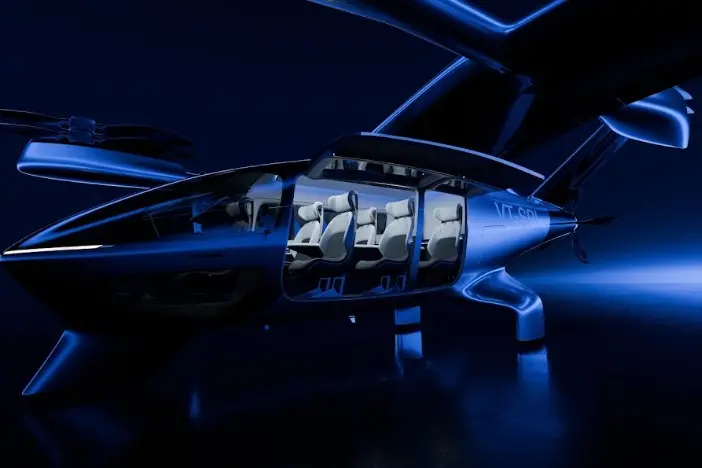
India is currently undergoing a major undercurrent in terms of urban air mobility, air Taxis and eVTOL (electric vertical take-off and land) aircrafts. Within a week, Indian UAM market saw a new spring in its step with the unveiling of Shunya – Sarla aviation’s prototype, the very first eVTOL company gaining DGCA certification- the ePlane Company, JetSetGo – a regional charter firm signing a sting of contracts with international partners to launch air taxis in India and much more. Let’s dive deeper.
The atmosphere was almost palpable at the Bharat Mobility Expo in Karnataka where Sarla Aviations’ much-talked-about prototype was about to be unveiled. And as the sparkling model came to light, everyone was left in awe. “The swanky 6-seater aircraft will very soon take to air and solve the ever-increasing traffic woes in Indian metros,” claims Sarla founders.
Designed for short-distance commute, up to 20-30 km trips with a speed of 250km/hr, Shunya has a six-passenger capacity and comes with 680kgs payload, touted as the eVTOL with the highest payload in its category. Sarla Aviation plans to offer air taxi services at competitive prices, aiming to match those of high-end taxi services in India.
Within days of ‘Shunya’ unveiling another Indian eVTOL start-up Aerospace Industries Limited, unveiled the ‘aerWing’. The eVTOL is powered by a hybrid of electricity and hydrogen fuel, representing a huge leap forward in sustainable transportation and redefining global mobility.
Interestingly India is being viewed as one of the largest markets for electric air taxis in the world. Just last year, Archer Aviation’s chief commercial officer Nikhil Goel claimed that air taxis will fly in India by 2026. Archer Aviation last year entered into a memorandum of understanding (MoU) with InterGlobe Enterprises, the parent company of IndiGo, to introduce electric air taxis in India, subject to appropriate regulatory approvals and clearances.
The partnership will, in a joint venture, own and operate 200 of Archer’s 'Midnight' aircraft, valued at $1 billion.
Electric vertical take-off and landing (eVTOL) aircraft, commonly known as air taxis, utilise electric power to hover, take off and land vertically, much like a conventional helicopter. However, being electric, they produce fewer emissions and operate much more quietly.
Archer’s Midnight aircraft, a piloted eVTOL designed to carry four passengers, is engineered for rapid, consecutive flights with minimal charging time between journeys.
Archer plans to replicate IndiGo’s successful model in India by focusing on increasing trip volume and reducing costs through economies of scale. India is set to become the third market, following the US and UAE, where Archer will introduce its air taxi services.
Speaking of international companies eyeing India as potential eVTOL market, Brazil-based Eve Air Mobility inked a deal with Indian private airline JetSetGo. Eve’s agnostic UATM software called Vector aims to improve the safety and efficiency of eVTOL operations, targeting air navigation service providers, urban authorities, fleet and vertiport operators, as well as other stakeholders.
JetSetGo, which recently finalised a non-binding Letter of Intent for the pre-order of up to 50 electric multicopters from Japan-based SkyDrive, aims to integrate Vector into its future eVTOL operations.
JetSetGo’s contract with SkyDrive for 50 eVTOLs is to explore new business structures, initially in the state of Gujarat and potentially in other locations across India.
Meanwhile, Hunch Mobility signed a MoU with aerospace company Electra.aero (Electra) for the use of its EL9 Ultra Short hybrid-electric aircraft for on-demand, regional air travel in India. The partnership looks to combine Electra’s EL9 aircraft with Hunch Mobility’s advanced software platform, aircraft operator network and key infrastructure in order to provide direct-to-destination passenger flights within major urban areas. With the capacity to carry up to 9 passengers, the EL9 is capable of taking off and landing in less than 150 feet, and comes equipped with in-flight battery charging technology.
The regulations and more
In September 2024, DGCA issued a comprehensive advisory circular outlining the airworthiness certification requirements for eVTOLs streamlining the certification process.
The advisory is aimed at ensuring the safety, reliability, and operational standards of emerging eVTOL technologies, which are rapidly gaining attention as a futuristic mode of air transportation. It provides detailed guidelines on various safety aspects that are critical for the type certification of eVTOL aircraft. These include criteria for design, construction, structural integrity, flight performance, equipment standards, powerplant installation, and flight crew interface. By addressing these key elements, the DGCA is working to establish a robust regulatory framework that will allow eVTOL aircraft to operate safely in Indian airspace.
The DGCA also issued a set of guidelines for the establishment of vertiports—specialised landing and take-off sites for eVTOL aircraft. These guidelines further indicate India’s commitment to embracing advanced air mobility solutions, which have the potential to revolutionize transportation in crowded urban areas and beyond. By adopting these significant steps, DGCA is laying the foundation stone for a new era in aviation, one that could see electric-powered aircraft playing a central role in the future of urban and regional transportation.
And just within four months of DGCA circular, the ePlane Company became the first private Indian company to receive formal acceptance DGCA for Type Certification of its eVTOL aircraft, the e200X. The company aims to launch its eVTOL services by 2026 and is targeting the movement of over 500,000 people daily within three years.
In another milestone of India-based eVTOL company, Hyderabad-based BluJ Aero successfully completed its first full-scale live flight demonstration in October 2024, showcasing a vertical take-off and landing exercise at the Nadergul airfield on the outskirts of the city. BluJ is developing long-range autonomous eVTOL aircraft powered by hydrogen-electric propulsion, designed for both cargo and passenger transport.
Although eVTOL start-ups are mushrooming left-right and centre in India marking the beginning of a new eVTOL start-up era, it’s a long time for an actual air taxi to take off in Indian skies. After German air-taxi maker Lilium, filed for insolvency as their efforts to solve its cash-crisis failed to yield results, it brought to light many unseen challenges faced by the air taxi start-ups in an industry that is capital intensive and has high entry barriers.
Another challenge faced by the air-taxi makers is developing batteries powerful enough for their aircraft to carry people safely to their desired destinations all the while dealing with various regulatory mazes, besides of course one of the most common challenges- will the prototype actually fly?
All of us are eagerly waiting for the day when the first air-taxi will take off in Indian skies relieving us of the traffic and pollution woes while commuting to and from work every day. But will it be commercially viable for the working class in India? Will it be safe enough and will the experience be as magical as the eVTOL companies claim, remains to be seen. Only time will tell, if the actual eVTOL will ever fly.
Published: 28 Jan 2025, 08:03 pm IST
Related Topics
Disclaimer: Kindly avoid objectionable, derogatory, unlawful and lewd comments, while responding to reports. Such comments are punishable under cyber laws. Please keep away from personal attacks. The opinions expressed here are the personal opinions of readers and not that of Mathrubhumi.
