
From connecting smaller Indian cities to strengthening defence capabilities and building an MRO ecosystem, Brazil's Embraer is positioning itself for a much bigger role in India's aviation future.
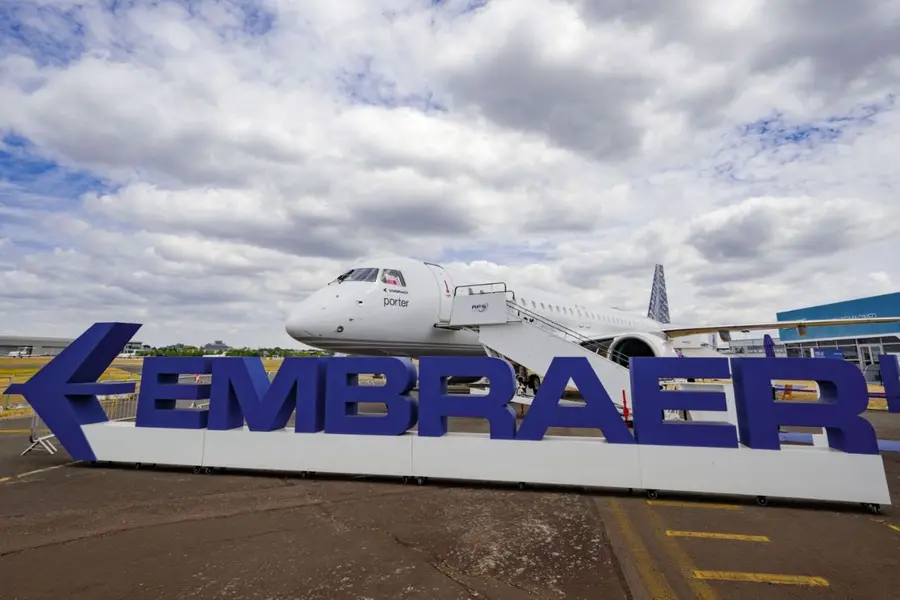
As Embraer celebrates 57 years of aerospace innovation, the Brazilian aircraft manufacturer finds itself at an interesting point in its India journey. The company is no longer looking at India simply as another market where its aircraft can be sold or operated. It is increasingly looking at the country as a potential regional aviation, manufacturing, defence, supply-chain and MRO hub.
That ambition is significant because India's aviation story is changing rapidly. The country's major airlines are expanding their fleets, passenger traffic continues to grow, airports are being developed beyond the traditional metropolitan centres and the government's regional connectivity programme has opened the door to a new generation of routes.
Yet there is one part of India's aviation story that remains unfinished, how to connect the cities that are too small for conventional narrowbody aircraft but too important to remain disconnected.
This is precisely where Embraer believes its aircraft can make a difference.
India has cities and Embraer has the aircraft
India's aviation boom has largely been built around aircraft carrying 150-200 or more passengers. That model works extremely well on high-density routes between Mumbai, Delhi, Bengaluru, Hyderabad, Chennai and other major centres.
But India has hundreds of smaller cities that do not necessarily generate enough daily demand for a larger narrowbody aircraft. That does not mean these markets lack potential. It means they require the right-sized aircraft. This is where Embraer's E-Jet family enters the picture.
The E175, with capacity of up to 88 passengers, sits in a segment that can potentially connect smaller cities while allowing airlines to operate more frequent services without having to fill a much larger aircraft.
Embraer has identified more than 1,800 potential routes in India that could be served by the E175-E1, according to comments made by CEO Francisco Gomes Neto. The company has also indicated that an Indian assembly line for the E175 could become possible if it secures at least 200 aircraft orders. That number alone illustrates the opportunity Embraer sees in India.
Star Air leads the way…
The strongest argument for Embraer's regional-aircraft strategy in India is not theoretical. It is already flying. Star Air has built its commercial operation around Embraer's aircraft, operating E175s and ERJ145s on domestic routes.
The airline's E175 fleet has allowed it to operate routes where the economics and capacity requirements can be different from those of a conventional 180-seat narrowbody aircraft. Embraer says Star Air is the country's all-Embraer commercial operator, and the airline has been using the aircraft to expand its regional network. That experience provides an important lesson for India's regional aviation market.
The success of regional connectivity will not depend simply on opening more routes. It will depend on finding an aircraft that matches capacity with demand.
If an aircraft is too large, airlines may struggle to achieve sustainable load factors. If it is too small, the economics may not work. A regional jet in the 70-100-seat category can potentially occupy the middle ground. That is the space Embraer knows extremely well.
Why Embraer could work in India
India is a particularly interesting market for regional jets because of its geography. The country has enormous distances between major population centres, but it also has a large number of emerging economic centres that are not traditional aviation hubs.
Cities such as Tier-II and Tier-III centres are becoming increasingly important to India's economic growth. Better connectivity can support tourism, trade, education, healthcare and business activity. The question is whether airlines can serve these markets profitably. This is where frequency can sometimes matter more than capacity.
A smaller aircraft operating multiple flights a week may provide a better service proposition than a larger aircraft operating less frequently. Embraer's philosophy is built around this concept of “right-sized” capacity.
The E175 can provide a bridge between regional connectivity and mainstream jet travel, while the larger E190, E195 and E2 family can address markets where demand has already developed.
India's recent regulatory developments have also strengthened the opportunity. In July 2026, the Directorate General of Civil Aviation granted type certification to the E190, E195 and E195-E2, while the E175 was already type certified and operating with Indian airlines.
That gives Embraer a broader portfolio to address different stages of India's regional aviation market.
From regional jets to manufacturing ecosystem
Perhaps the most interesting development is that Embraer is no longer talking only about selling aircraft to India. It is talking about building aircraft in India. In January 2026, Embraer and Adani Defence & Aerospace announced a strategic partnership to explore an integrated regional transport aircraft ecosystem covering aircraft manufacturing, supply chains, aftermarket services and pilot training.
The partnership was strengthened in February, when the companies exchanged an enhanced MoU concerning a proposed Final Assembly Line for the E175 in India as part of the country's Regional Transport Aircraft programme. The proposed ecosystem is intended to support domestic demand while gradually increasing localisation.
This is where the Embraer story becomes much bigger than one aircraft. A manufacturing programme creates demand for suppliers. Suppliers create demand for engineering. Aircraft create demand for maintenance. And a growing fleet creates demand for components, training, logistics and aftermarket services.
In other words, the aircraft could become the centre of an entire regional aviation ecosystem.
The MRO opportunity behind every Embraer aircraft
For India's MRO industry, this may ultimately be the most important part of the story. Aircraft manufacturing gets the headlines, but keeping those aircraft flying creates the long-term economic opportunity.
Every E175, E190, E195 or E2 aircraft operating in India will require line maintenance, component support, spare parts, technical services, inspections, modifications and eventually heavier maintenance. If the Indian Embraer fleet grows substantially, the country could potentially develop specialised MRO capabilities around the platform.
The proposed Embraer-Adani ecosystem explicitly includes aftermarket services, while Adani brings an existing presence across airports, aerospace manufacturing, MRO and aviation training. That combination could become important as India tries to retain more aircraft maintenance work within the country.
And then comes defence
Embraer's India story is not limited to commercial aviation. The company already has a significant defence footprint in the country.
The Indian Air Force's Netra Airborne Early Warning and Control aircraft is based on the Embraer ERJ145 platform. Embraer aircraft are also used for VIP and government transportation by Indian government agencies, the IAF and the Border Security Force. Embraer says nearly 50 of its aircraft across 11 types are currently operating in India across commercial, defence and business aviation. But the next potential chapter could be considerably bigger. It is called the C-390 Millennium.
C-390: Embraer's big defence bet on India
The C-390 Millennium is Embraer's new-generation multi-mission military transport aircraft. It can carry up to 26 tonnes and is designed for missions ranging from troop and cargo transport to medical evacuation, search and rescue, firefighting and aerial refuelling. The aircraft can also operate from temporary or unpaved runways.
India is considering the aircraft for its Medium Transport Aircraft programme, and Embraer has been increasingly positioning the C-390 as a potential solution for the Indian Air Force. The company is not simply offering an aircraft. It is offering an industrial proposition.
Embraer and Mahindra Group signed a strategic cooperation agreement covering the potential industrialisation of the C-390 in India, including local manufacturing, assembly, supply-chain development and MRO. In June 2026, Embraer also indicated that it was prepared to establish a C-390 assembly capability in India if selected for the IAF requirement. That changes the equation considerably.
In February 2026, Embraer and Mahindra went one step further by announcing plans to establish C-390 Millennium MRO capability in India, subject to selection of the aircraft under the IAF's MTA programme. The proposed facility could cover base and heavy maintenance, structural inspections, component repair and overhaul, avionics support and training.
Even more importantly, Embraer and Mahindra are evaluating the possibility of using India as a regional MRO hub for other C-390 operators in the future.
A growing supply chain
Embraer's India strategy also extends into the supply chain. The company has been actively evaluating Indian suppliers for aerostructures, machining, composites, metal forming, wiring systems and other capabilities.
In May 2026, Embraer and Bharat Forge announced a contract for forged raw materials, the company's first forged raw-material supply contract with an Indian supplier. Embraer said the agreement supports its global supply-chain diversification strategy.
This is important because it shows that India's opportunity with Embraer is not restricted to aircraft assembly. Indian companies can potentially participate in the global Embraer supply chain. That could create opportunities for manufacturers, engineering companies, MRO providers and technology firms.
Why India matters to Embraer
Embraer's increasing commitment to India is not accidental. India offers something few other aviation markets can match; scale combined with an enormous underserved regional market.
The company has already established a fully owned Indian subsidiary and opened its New Delhi office, signalling a much deeper long-term commitment to the country. Embraer says its Indian operations are focused across commercial aviation, defence, business aviation, services and support, procurement, supply chain and engineering. The company has also described India as a strategic market for all its business segments. That is a notable shift. India is no longer simply a customer market; it is becoming a potential industrial partner.
57 years on…
Embraer's 57th anniversary therefore arrives at an interesting moment. For more than five decades, the company has built its reputation around understanding aircraft markets that larger manufacturers sometimes overlook. Its regional jets helped demonstrate that there was a viable market between turboprops and large narrowbodies. India may now offer Embraer another opportunity to prove that philosophy.
The country does not need every city to be connected by a 180- or 200-seat aircraft. It needs the right aircraft for the right route, more regional airports, stronger MRO capabilities outside the traditional metropolitan centres, local manufacturing and supply chains and increasingly, it needs an aviation ecosystem that creates value beyond ticket sales.
Embraer's proposition touches all of those areas.
India's regional aviation moment
The real test, however, will be execution. Regional aviation is notoriously difficult. Opening a route is easy compared with making it economically sustainable.
Airlines need viable yields, appropriate frequencies, reliable aircraft and competitive operating costs. Airports need sufficient traffic. Maintenance infrastructure needs to be available. Pilots and technicians need to be trained. And passengers need a reason to travel.
That is why the development of an integrated ecosystem matter. An aircraft manufacturing programme without an airline market will struggle. An airline fleet without an MRO ecosystem will face support challenges. And regional routes without the right aircraft economics may not survive. The opportunity lies in connecting all these pieces.
From aircraft to ecosystem
This may ultimately be the most important part of Embraer's India story. The company arrived in India with aircraft. It now appears to be building relationships across the entire aviation value chain.
Airlines can create the demand. Regional jets can provide the right capacity. Manufacturing can create industrial capability. MRO can keep the fleet flying. Defence can strengthen strategic cooperation. And Indian suppliers can become part of a global aerospace supply chain.
That is a much bigger proposition than selling regional aircraft.
As Embraer celebrates 57 years, India could become one of the most important chapters in its next phase not simply because of the number of aircraft it might sell, but because of the ecosystem it could help create.
And if India succeeds in turning its regional connectivity ambitions into a sustainable aviation network, Embraer could find that the country is not merely another destination on its global map.
It could become one of the places where the next 57 years of Embraer's story are built.
Published: 20 Aug 2026, 06:05 pm IST
ABOUT THE AUTHOR

Related Topics
Disclaimer: Kindly avoid objectionable, derogatory, unlawful and lewd comments, while responding to reports. Such comments are punishable under cyber laws. Please keep away from personal attacks. The opinions expressed here are the personal opinions of readers and not that of Mathrubhumi.