
Finance Minister Nirmala Sitharaman hailed GST rate rationalisation as a key driver for economic activity during the festive season, citing surges in consumer spending and price reductions.
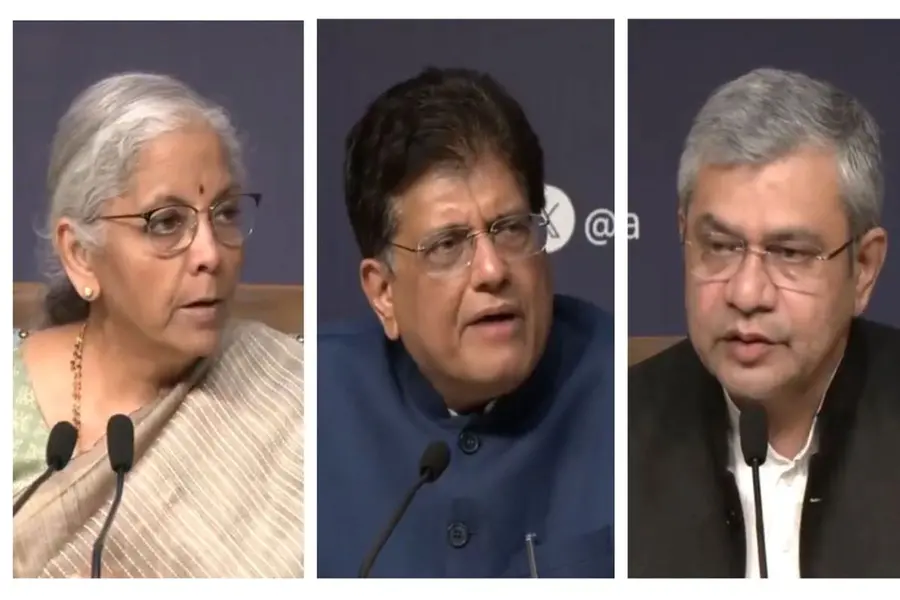
New Delhi: Union Finance Minister Nirmala Sitharaman, along with Commerce Minister Piyush Goyal and Electronics & IT Minister Ashwini Vaishnaw, on Saturday hailed the recent Goods and Services Tax (GST) rate rationalisation as a major catalyst for economic activity during this year’s festive season.
Implemented on September 22, just ahead of Navratri, the GST rate changes have already shown visible positive outcomes in consumer spending, price reductions, and sectoral growth.
“It was launched on the first day of Navratri, I feel the people of India have received it well,” said Sitharaman at a joint press conference in New Delhi.
Consumer spending surges
The Finance Minister revealed that the last nine days of September witnessed a surge in consumer purchases:
Passenger vehicle dispatches: 3.72 lakh units
Two-wheeler sales: 21.60 lakh units
Three-wheeler sales: Up 5.5% YoY
She further noted that TV sales surged 30–35%, and air conditioner sales doubled on the first day of the festive season.
FMCG and electronics see strong growth
The GST cuts have notably benefited the FMCG and electronics sectors. Companies like LG India reported exponential sales growth, while overall electronics sales rose by 20–25% compared to last Navratri.
Minister Ashwini Vaishnaw emphasised that this surge has had a direct impact on manufacturing and employment.
“Electronics manufacturing is booming, and the sector now directly employs 25 lakh people,” he said.
Price benefits reaching consumers
Sitharaman stressed that the government has closely monitored 54 essential items to ensure tax benefits were passed on. The result: price drops across key categories, with Vaishnaw adding that food inflation reduced by 2%, and prices have seen deflation for four consecutive months.
Commerce Minister Piyush Goyal stated that the GST rate rationalisation had been over a year in the making, guided by Prime Minister Narendra Modi. He described the reform as part of the broader #NextGenGST vision aimed at making the tax structure more efficient and growth-oriented.
“This is why India remains one of the fastest-growing economies globally. The IMF has revised our GDP growth forecast to 6.6 per cent,” Goyal said.
All three ministers agreed that the GST reform has not only boosted affordability and demand but also contributed to a larger vision of inclusive and sustainable growth. The government sees this as a turning point in 2025, as the economy gears up for a “Viksit Bharat” (Developed India) by 2047.
Published: 18 Oct 2025, 03:05 pm IST
Disclaimer: Kindly avoid objectionable, derogatory, unlawful and lewd comments, while responding to reports. Such comments are punishable under cyber laws. Please keep away from personal attacks. The opinions expressed here are the personal opinions of readers and not that of Mathrubhumi.
