
He made the long, difficult journey to Munnar not to claim credit or make political noise, but to stand beside the women who had dared to rise. There was no grand announcement, no posturing. He moved slowly through the crowd, his presence commanding but never imposing.
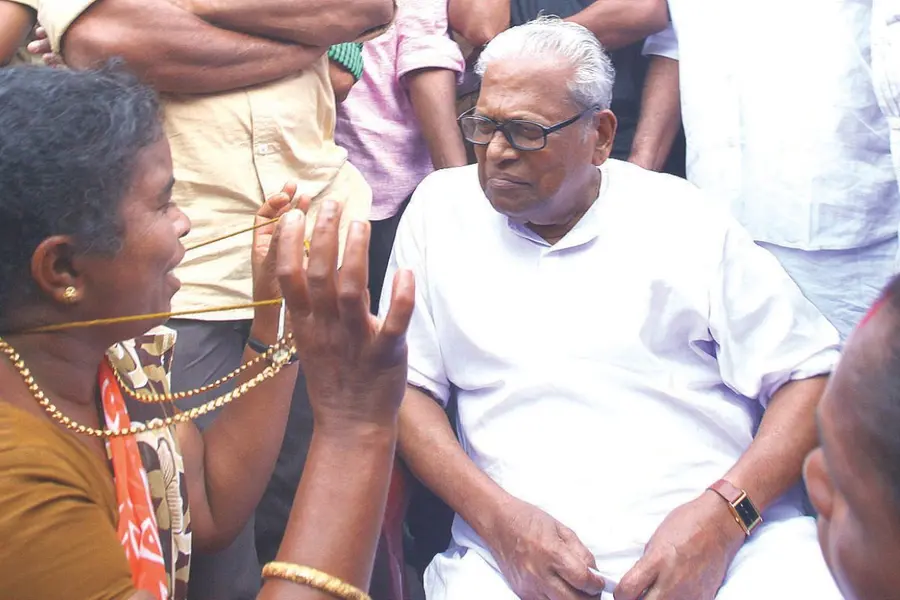
Looking back, there are moments that leave an imprint far deeper than most—not just as stories covered, but as quiet turning points. Witnessing V S Achuthanandan walk into the midst of the historic Pembilai Orumai protest in Munnar remains one such memory—etched with emotion, resolve and a rare kind of political grace.
It was September 2015. The women plantation labourers of Kannan Devan Hills had stunned Kerala by rising in spontaneous rebellion—no political party backing them, no union flags, just raw determination. Their demands were simple but searing: fair wages, a bonus they rightfully deserved and dignity at the workplace. The hills of Munnar had never seen such a sight—hundreds of women standing their ground, refusing to be silenced, refusing to be sidelined.
The protest, which lasted over a month and a half, eventually drew to a close with what many considered a mixed outcome. While the management might have viewed it as a tactical victory—securing the workers’ acceptance of a 30 per cent wage hike against their initial demand for a 100 per cent raise—the agitation had already achieved something far greater. For the women of the plantations, it was not merely about numbers, but about voice, visibility, and dignity. The movement, despite ending in a compromise, had shattered decades of silence and set a powerful precedent for grassroots resistance led by marginalised women.
And it was into this charged and unprecedented landscape that V S Achuthanandan quietly walked—then the Leader of the Opposition, in his nineties. He made the long, difficult journey to Munnar not to claim credit or make political noise, but to stand beside the women who had dared to rise. There was no grand announcement, no posturing. He moved slowly through the crowd, his presence commanding but never imposing. I remember the hush that fell as he reached the front—a silence full of emotion and respect. He listened. He nodded. And when he finally spoke, it was not to deliver a speech, but to share in their struggle.
It was overwhelming to witness that moment—not just because of the gravity of the protest, but because it brought together two legacies of resistance: the fiery resolve of ordinary women workers and the moral strength of a veteran leader who had spent his life standing with the voiceless. The people’s leader, who embodied quiet conviction and unwavering political integrity, passed away on Monday at the age of 101—leaving behind a legacy etched in the everyday struggles of those he chose to stand with.
That day taught me something journalism schools never do—that the most powerful stories are those where dignity meets struggle and someone in power pauses—not to preach, but simply to stand beside them.
Published: 22 Jul 2025, 09:48 am IST
ABOUT THE AUTHOR

Disclaimer: Kindly avoid objectionable, derogatory, unlawful and lewd comments, while responding to reports. Such comments are punishable under cyber laws. Please keep away from personal attacks. The opinions expressed here are the personal opinions of readers and not that of Mathrubhumi.