
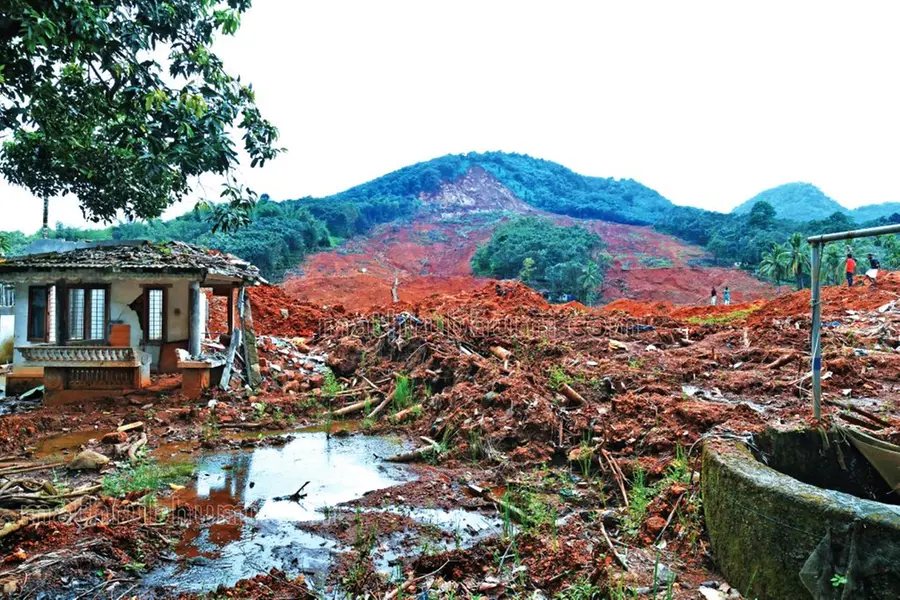
Nilambur: Even as the Kavalappara tragedy kept haunting the minds of the people of Chaliyar region, once again they had to witness disaster when dead bodies of the victims of Wayanad landslides were washed ashore.
On August 8, 2019, the landslide at Pothukal, Kavalappara claimed the lives of 59 people. By 8 pm, Kavalappara was engulfed by rocks and torrents of water, destroying about 45 homes in Muthappankunnu valley. After a 20-day search, 49 bodies were found, while ten are still missing.
Also Read

Now, nearly five years later, the people have faced another blow on Tuesday morning. Bodies and body parts of the victims of landslides at Mundakkai and Chooralmala in Wayanad were carried downstream by the Chaliyar River.
Responding with unity reminiscent of the Kavalappara tragedy, locals rushed to Chaliyar armed with ropes, hoping to rescue any survivors. Authorities, including police, Fire Force and disaster management teams, joined efforts.
In the Kavalappara tragedy, most families lost four or five members, shattering their hopes and dreams. Despite their grief, they accepted government aid and relocated to safer areas, starting anew. Approximately 190 affected families received rehabilitation support, with 33 Scheduled Tribe families resettled in Anakkallu following advice from the Geology Department. Yet, many families still live in fear near the disaster site, unable to forget the horrors they endured.
During heavy monsoons, they seek refuge in relief camps or with relatives, returning to their homes only when the rains subside. For them, leaving the resting place of their loved ones remains an unbearable thought.
Why do landslides happen in Kerala?
Most landslides in Kerala occur in the Western Ghats region, including areas like Puthumala, Kavalappara and Pettimudi. Tuesday’s Wayanad landslides as well highlight ongoing challenges. The weakening of the Western Ghats combined with heavy rains has led to frequent landslides since 2019.
There are two main causes of landslides – conditioning factors and triggering factors. Conditioning factors include slope steepness and soil characteristics. Triggering factors, such as heavy rainfall, worsen these conditions.
In Kerala, slopes exceeding 20 degrees are particularly susceptible to landslides, especially after continuous rainfall exceeding 100 mm.
The rocks in Kerala are ancient, dating back to 220 to 300 crore years, but the thin layer of soil covering them is only about 10,000 years old. This makes the soil highly vulnerable to erosion during heavy rains.
Earth phenomena observed in Kerala
Land degradation: Rocks, decomposed rock or topsoil fall from higher areas due to gravity.
Valley erosion: Topsoil erodes to a depth of up to two metres.
Landslides: Soil, decomposed rock underneath the soil, trees and water converge and fall with force.
Soil piping: An entire terrain collapses. There are clay-filled areas beneath fractured stones underground. Water infiltrates these clay pockets via the roots of fallen trees. Consequently, the clay erodes, causing the overlying fractured stone to collapse.
(Information Credit: Dr S Sreekumar, Former Director, IRTC (Integrated Rural Technology Centre); K. S. Sajinkumar, Assistant Prof, Department of Geology, University of Kerala. Prepared by: Alphonsa P George)
Published: 31 Jul 2024, 09:06 am IST
Disclaimer: Kindly avoid objectionable, derogatory, unlawful and lewd comments, while responding to reports. Such comments are punishable under cyber laws. Please keep away from personal attacks. The opinions expressed here are the personal opinions of readers and not that of Mathrubhumi.