
VS Achuthanandan’s visit to KK Rema after TP’s murder remains a defining political image.
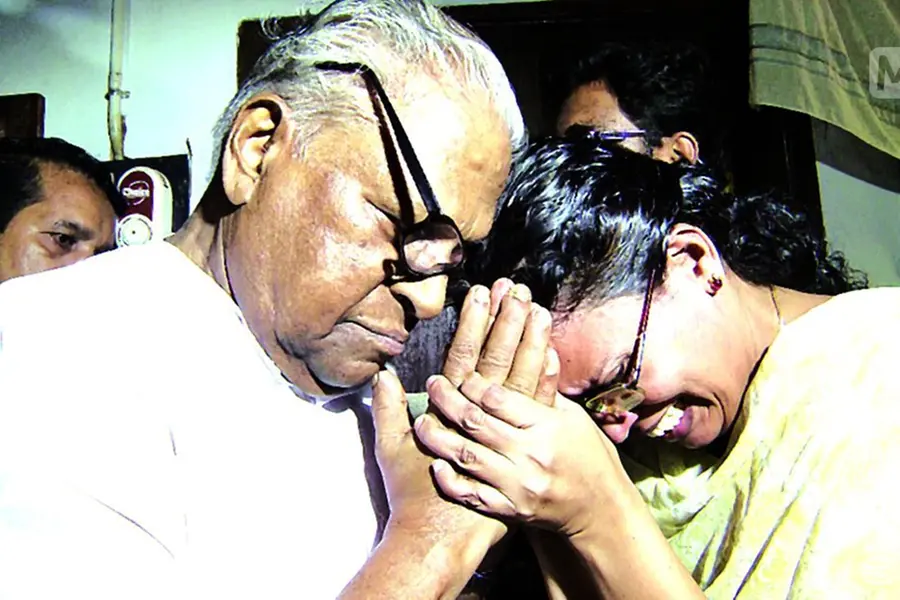
As Kerala mourns the passing of former Chief Minister VS Achuthanandan on Monday evening, one image from his long, eventful political life continues to stir memories and emotions. It is not a photo from the Assembly, nor from a party rally—but a quiet, deeply symbolic moment: VS consoling KK Rema, widow of slain Revolutionary Marxist Party (RMP) leader TP Chandrasekharan.
Captured during his visit in 2012, shortly after TP’s brutal murder, the photograph shows an ageing Achuthanandan reaching out to a grieving Rema—an act that spoke volumes in its silence. At a time when the CPM was under fire, VS had stood apart from the party line and openly asked, “How can a man cut another human being into pieces?”
The rebel within the party
That visit was not just an act of personal compassion—it became a defining political statement. TP Chandrasekharan, once a CPM insider, had formed the RMP in 2010 after leaving the party. His murder on May 4, 2012—allegedly by CPM cadres—sparked public outrage and exposed the deep fractures within the Left in Kerala.
Achuthanandan’s presence at Rema’s home, at a time when the party was reeling under accusations, cemented his image as a principled rebel who placed morality over party loyalty. For Rema, the moment brought strength. For many watching, it was a rare instance of conscience in politics.
Verdict brings closure, but the fight continues
In 2024, the Kerala High Court sentenced nine people to life imprisonment without remission in connection with TP’s killing. Rema, now an MLA, welcomed the verdict and vowed to keep fighting until all those responsible are brought to justice.
During her nomination from Vadakara, she had declared her campaign as a battle against the “anti-people policies of the LDF government led by the CPM.” Her win by 7,014 votes was widely seen as a political reply to the forces behind her husband’s death. After the result, she said, “The victory is being dedicated to TP and this is a response to his cold-blooded murder.”
A political journey fuelled by dissent
The journey of TP Chandrasekharan—from CPM leader to founder of the RMP—was rooted in ideological differences. His murder shocked Kerala’s political landscape, prompting introspection and criticism. Some CPM workers crossed over to the RMP in protest.
The RMP contested the 2016 Assembly elections independently. By 2021, the Congress-led UDF backed Rema's candidacy in Vadakara, ensuring the party retained relevance. Her victory came just two days before TP’s death anniversary—adding symbolic weight to the win.
Rema’s tribute
In a heartfelt Malayalam tribute on VS’s 100th birthday, Rema reflected on his political legacy, placing him among Kerala’s historic Communist icons: P Krishna Pillai, EMS, AKG, and MN Govindan Nair.
She described him as a leader who rose from poverty—“drinking bitter water”—to lead agricultural labourers in Alappuzha, opposing casteism and fighting for social reform. Though he made enemies in the 1980s and ’90s, Rema wrote that it was his moral clarity in the 2000s that earned lasting respect.
“VS clashed with the CPM leadership—what history calls the VS-Pinarayi factional war. But at its heart was the protest of an old Communist against global capital,” she observed.
Rema’s tribute also recalled how VS often stood alone, challenging the CPM's official machinery, exposing corruption, and speaking out when others remained silent. His resistance, even after being sidelined, inspired many and, in Rema’s words, revealed “the CPM’s distorted image.”
On TP, she wrote: “The movement led by VS that included leaders like TP didn’t achieve final victory. The flip-flops and betrayals of his colleagues hindered that struggle, which history now views as VS’s political vulnerability.”
She remembered how his condolence visit, shortly after her husband’s death, became a moment of courage and compassion: “When TP was eliminated by the Pinarayi faction, it was VS who rushed to console me and my family. That moment gave us strength. We can never forget it.”
In her final words, Rema reflected that VS’s political life was marked by both victory and defeat—but it was his commitment to people-centred politics that would define him. His setbacks, she noted, laid bare the cracks in Kerala’s Left movement—and his moral legacy, captured in that one unforgettable photograph, still speaks louder than most words ever could.
Published: 21 Jul 2025, 05:17 pm IST
Related Topics
Disclaimer: Kindly avoid objectionable, derogatory, unlawful and lewd comments, while responding to reports. Such comments are punishable under cyber laws. Please keep away from personal attacks. The opinions expressed here are the personal opinions of readers and not that of Mathrubhumi.
