
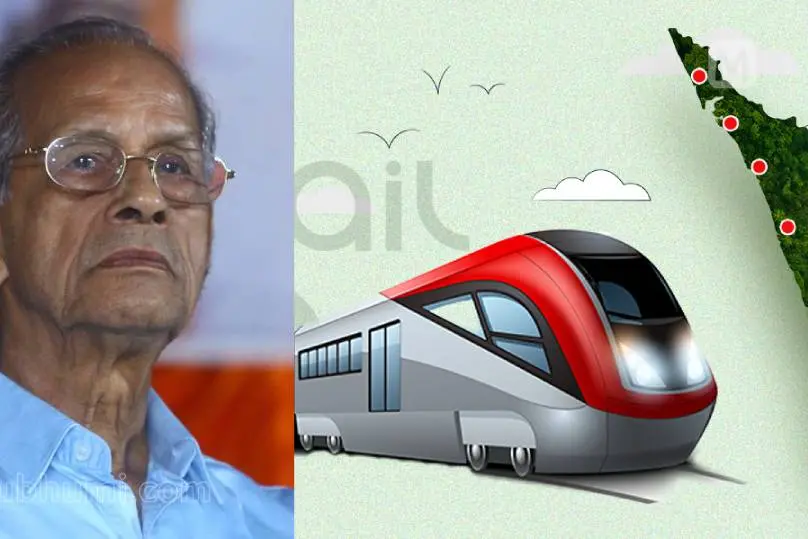
Thiruvananthapuram: Even though the center turned its back on the Kerala government's Silver Line project, it will likely cooperate with the high-speed railway line proposal put forward by metroman E. Sreedharan.
During the past assembly elections, Sreedharan was the BJP's candidate in the Palakkad constituency. The state government believes roping in Sreedharan may come in handy in getting support from BJP-led Centre. It may be helpful in removing political and technical obstacles to the project.
As directed by Chief Minister Pinarayi Vijayan, the state government’s special representative in Delhi, Prof. K.V Thomas met with the metro man.
The Ministry of Railways had earlier sought an explanation from the Southern Railway division regarding the Silver Line project proposal. Thiruvananthapuram railway division will respond to this after discussions with the state government.
In this scenario, the government could go with the proposed high-speed railway line project as an alternative to the Silver Line. The government is ready to make a compromise by adopting the high-speed rail project instead of holding on to the Silver Line which was riddled with protests and controversies since its inception.
The idea behind designing separate high-speed lines is motivated by the fact that the current railway lines do not have the capacity to facilitate high-speed trains. Even Vande Bharat was able to achieve only a speed of 73.5 kmph in Kerala.
According to reports on the interaction between the Ministry of Railways and K.V Thomas, the Central government is not opposed to high-speed rail. It is also learnt that he has informed the same to the Chief Minister.
Since the alternative rail line is similar to a plan that emerged during Oommen Chandy's government, it is hoped that the opposition will not come with too many objections.
Thus by removing two major obstacles in its path, the government hopes to speed up the project’s implementation.
SilverLine was envisaged as a Rs 63,000 crore project of which half the amount target was through international loans and 10% central participation through stock purchase and tax relief. Sreedharan and others argued that the financial structure of this project was not feasible.
The current high-speed rail project is envisaged as a Rs 1 lakh crore project. Half of this will be sought through international loans while the other half would be met by a central-state partnership. Kerala will need to procure Rs 3000 crores for the same.
DMRC (Delhi Metro Rail Corporation) taking charge of the DPR (Detailed Project Report) is expected to ease the procurement of central aid and international loans.
Published: 13 Jul 2023, 09:59 am IST
Related Topics
Disclaimer: Kindly avoid objectionable, derogatory, unlawful and lewd comments, while responding to reports. Such comments are punishable under cyber laws. Please keep away from personal attacks. The opinions expressed here are the personal opinions of readers and not that of Mathrubhumi.
