

Without proper auditing, the politically managed Devaswom Boards will continue to face allegations of corruption.
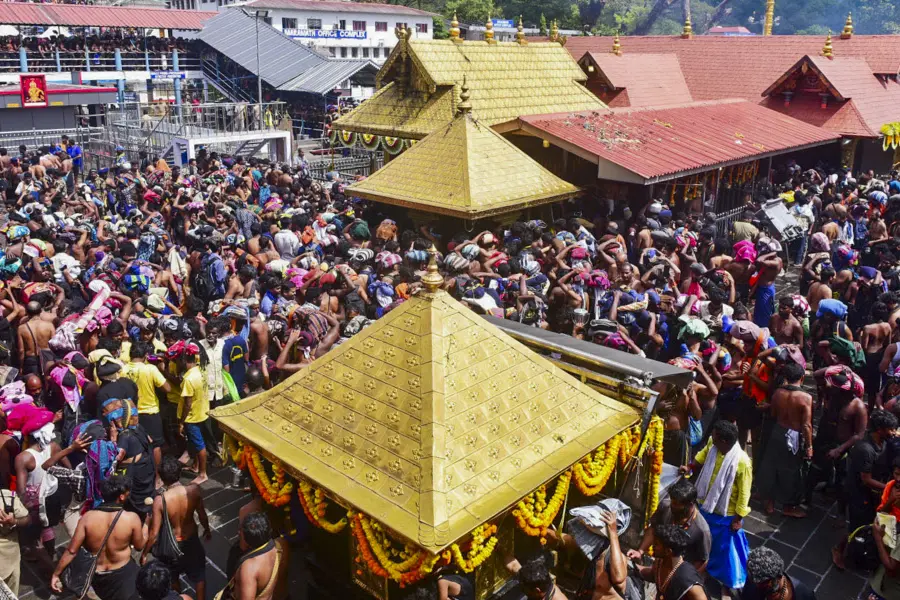
On September 18th 2025, when the Kerala High Court ordered a vigilance inquiry into the unexplained loss of gold from the gold-cladded copper plates of the Dwarapalaka (guardian deity) idols at the Sabarimala temple, it was a confirmation of what devotees had been suspecting for long-large-scale corruption, in every activity is happening brazenly. When the plates were removed for fresh gold-plating in 2019, they weighed 42.8 kg, but only 38.258 kg was produced before the Chennai-based firm engaged for the work, meaning an unexplained shortfall of about 4.54 kg.
The Dwarapalaka idols were originally installed in 1999 based on official sanction and came with a 40-year warranty. However, defects had developed in the plating within just six years, prompting the repair works. The suspicious developments began when the Travancore Devaswom Board (TDB) removed the gold-plated copper plates covering the Dwarapalaka idols in 2019 for repair and re-gilding without prior intimation or approval from the Special Commissioner or the Court.
Devotee-sponsor Unnikrishnan Potti took the plates to Chennai-based Smart Creations more than a month after removal. When the company received them, their weight had dropped from 42.8 kg to 38.25 kg. After re-plating, the weight increased slightly to 38.65 kg, but there was an unexplained loss.
The court ordered the TDB’s Chief Vigilance and Security Officer, an officer of the rank of Superintendent of Police, to conduct a comprehensive probe, examine all records, and file a report within three weeks. The court also ordered that all registers be handed over to the vigilance officer and instructed the TDB to extend full cooperation.
The Chief Vigilance Officer (CVO) of the Travancore Devaswom Board (TDB) reports to the Sabarimala Special Commissioner, who supervises their work, particularly regarding cases of malpractice and irregularities in TDB activities. The TDB also submits its vigilance reports to the President of the TDB, as evidenced by the Chief Vigilance Officer’s investigation report into a similar gold pilferage that occurred at the Ettumanur Mahadeva Temple.
Presently, the vigilance wing has been functioning with only a Chief Vigilance Officer (CVO), who is a Superintendent of Police, and just one officer of the rank of Sub-Inspector, the court noted and said, "If the state or the Board think they can have a system without any vigilance, that cannot be permitted."
The question uppermost in the minds of all devotees is as to why the High Court did not order a CBI enquiry or by the Kerala Vigilance and Anti-Corruption (KVAC) establishment? What can a Vigilance officer assisted by a sub-inspector do to unravel the corruption marvel indulged in by unaccountable politicians? Will these same politicians not bulldoze the timid bureaucrats by threatening them with transfers and dud postings? The confidence of the public can be ensured only if a CBI enquiry is ordered.
In the judgment in State of West Bengal & others versus The Committee for Protection of Democratic Rights West Bengal & others, Hon'ble Supreme Court dealt with the power of the constitutional courts for considering the question which arose before the Hon'ble Supreme Court was whether High Court in exercise of jurisdiction under Article 226 of the Constitution could direct Central Bureau of Investigation to investigate a cognizable offence which was alleged to have taken place within the territorial jurisdiction of the State without consent of the State Government. It was answered as follows: - “(vii) When the Special Police Act itself provides that subject to the consent by the State, the CBI can take up investigation in relation to the crime which was otherwise within the jurisdiction of the State Police, the court can also exercise its constitutional power of judicial review and direct the CBI to take up the investigation within the jurisdiction of the State. The power of the High Court under Article 226 of the Constitution cannot be taken away, curtailed or diluted by Section 6 of the Special Police Act. Irrespective of there being any statutory provision acting as a restriction on the powers of the Courts, the restriction imposed by Section 6 of the Special Police Act on the powers of the Union cannot be read as restriction on the powers of the Constitutional Courts. Therefore, exercise of power of judicial review by the High Court, in our opinion, would not amount to infringement of either the doctrine of separation of power or the federal structure. 45. In the final analysis, our answer to the question referred is that a direction by the High Court, in exercise of its jurisdiction under Article 226 of the Constitution, to the CBI to investigate a cognizable offence alleged to have been committed within the territory of a State without the consent of that State will neither impinge upon the federal structure of the Constitution nor violate the doctrine of separation of power and shall be valid in law. Being the protectors of civil liberties of the citizens, this court and the High Courts have not only the power and jurisdiction but also an obligation to protect the fundamental rights, guaranteed by Part III in general and under Article 21 of the Constitution in particular, zealously and vigilantly”.
The 2024-25 annual Sabarimala pilgrimage season generated over Rs 357 crores in revenue for the Temple. The four Devaswom Boards in Kerala together collect a whopping Rs 1000/ crores approximately. The 42 public sector undertakings in the state together make only a measly Rs 200 crores in a year.
Devotees have long suspected that all four Devaswom Boards are embroiled in corruption from head to toe, as complaints are galore of irregularities in the procurement of raw materials, irregular appointments for various posts, sale of ‘Prasadams’, poor quality constructions, lapses in tenders, and counting of Hundi money.
Hundi collections, being cash collections, are most prone to irregularities. The number of Hundis in major Temples across Kerala, managed by the Devaswom Boards, is mind-boggling. In many temples, the access to the sanctum sanctorum is itself difficult, due to the sheer number of large Hundis and their placement at vantage positions. In this digital age, when even small vendors make efficient use of online payment facilities, is it not time to order the removal of all Hundis, and switch over only to online payments? The political party managed Devaswom Boards and their employees would not be able to fudge collections, records and auditing, in a digitally monitored accounting system. Though a few temples have e-payment facilities, the real corruption occurs in the Hundi collections, hence the need to switch over to a fully automated e-payment system.
Due to the coming Sabarimala season, many TDB-managed Temples have set up special Hundis to collect money for gold plating of Dhwajastambhams (Kodimaram), or for erecting new ones. This is just another modus operandi to knock off funds. It is high time that the High Court orders a set of protocols for fund collection, accounting and utilization of funds for various Temple related projects. Unless and until there is a proper audit mechanism in place, the politically controlled and managed Devaswom Boards will keep reeking of corruption. The High Court should also consider bringing an Indian Audit & Accounts Service (IAAS) officer on deputation to ensure proper accounting and utilization of funds in all four Devaswom Boards.
Temple funds misuse by governments and consequent corruption is a national problem that is not being addressed. Till a decision is taken for divesting government control on temples, the Court should order an interim comprehensive set of guidelines for temple management and utilization of funds donated by devotees.
The author is former Director General of National Academy of Customs, Indirect Taxes & Narcotics
Published: 20 Sept 2025, 02:42 pm IST
ABOUT THE AUTHOR
Related Topics
Disclaimer: Kindly avoid objectionable, derogatory, unlawful and lewd comments, while responding to reports. Such comments are punishable under cyber laws. Please keep away from personal attacks. The opinions expressed here are the personal opinions of readers and not that of Mathrubhumi.