
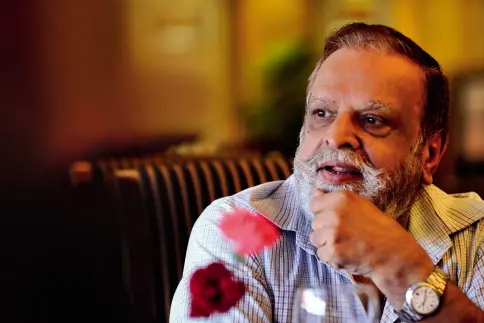
Born into the cradle of richness, this child was welcomed into a world of musical blessings. At Chendamangalam, little Paliyath Jayachandran roamed through the courtyards and eight-pillared halls, captivated by the beats of the chenda (drum) and the chime of cymbals. He still remembers standing with fear before the serpent grove when he ran there once to retrieve a stray ball. The mesmerising ambience of the grove, with its unheard sounds and unseen flowers, left a lasting impression. Years later, while singing about the goddess of a grove in a recording studio, those vivid memories returned to him.
This romantic singer’s life has been a journey through dreams and reality, driven by the memories of melodies and rhythms bestowed by time. “I never studied music to become a singer,” he says. “I lived in a world filled with music, rhythm, instruments, and cinema. I preserved everything I heard from movie halls as treasures. At Chendamangalam, Aluva and Irinjalakuda, I was entranced by the pulsating beats of the chenda and the deep reverberations of the timila drum. Chendamangalam and Irinjalakuda’s Koodalmanikyam temple, along with its theaters, became my musical training grounds. As a child, I dreamed of experiencing the Koodalmanikyam festival for a lifetime.”
As he grew older, he climbed onto the stages of Kalanilayam and the Aattakkalari arenas at Ammannoor. The Panchaari melam during temple festivals stirred a profound awakening in him.
During the three years he spent on the banks of the Periyar River, Varghese Chettan, the organiser of the church’s choir, would visit daily. Jayachandran’s first public performance was at one of Varghese Chettan’s music events. At the age of eleven, he sang Susheela Amma’s songs. When studying at Aluva St. Mary’s School, he began learning mridangam under the guidance of Ramasubbayyar. It was the younger brother of his father wanted him to learn mridangam. He frequently traveled to listen to the great stalwarts of carnatic music, Jayachandran used to say.
Jayachandran’s elder brother, Sudhakaran, was also a singer. Once, he sang the song Nenjam Marakkathillai with Sudhakaran at a musical event. At that time, he was in the eighth grade at Irinjalakuda National School. Somehow, the school got wind of this. K V Ramanathan Mash (teacher) called him to the staff room and asked him to sing Varayo Vennilave. From that day, Mash became his mentor, teaching him how to enunciate lyrics properly.
In 1958, Mash accompanied him to Ernakulam for the school youth festival. Jayachandran participated in the mridangam and light music competitions. He won first prize in mridangam and secured second place in light music, right behind Yesudas. On the final day, Yesudas, Jayachandran, and Thrissur P. Govindakutty performed a concert together.
During his school years, he often sang the songs of Susheela and Janaki. However, his voice gradually deepened. While studying at Christ College, he became a regular singer in the musical events of Irinjalakuda. He mostly sang Rafi Sahib’s songs, with Main Apni Awaaz Sunta Hoon being a personal favourite that often moved him to tears.
Around this time, Bhargavi Nilayam was released at the Konni Theater. Jayachandran recalls watching the movie about 25 times just to listen to the songs Thamasamenthe Varuvan and Vasanthapanchami Naalil.
Published: 10 Jan 2025, 08:25 am IST
Related Topics
Disclaimer: Kindly avoid objectionable, derogatory, unlawful and lewd comments, while responding to reports. Such comments are punishable under cyber laws. Please keep away from personal attacks. The opinions expressed here are the personal opinions of readers and not that of Mathrubhumi.
