
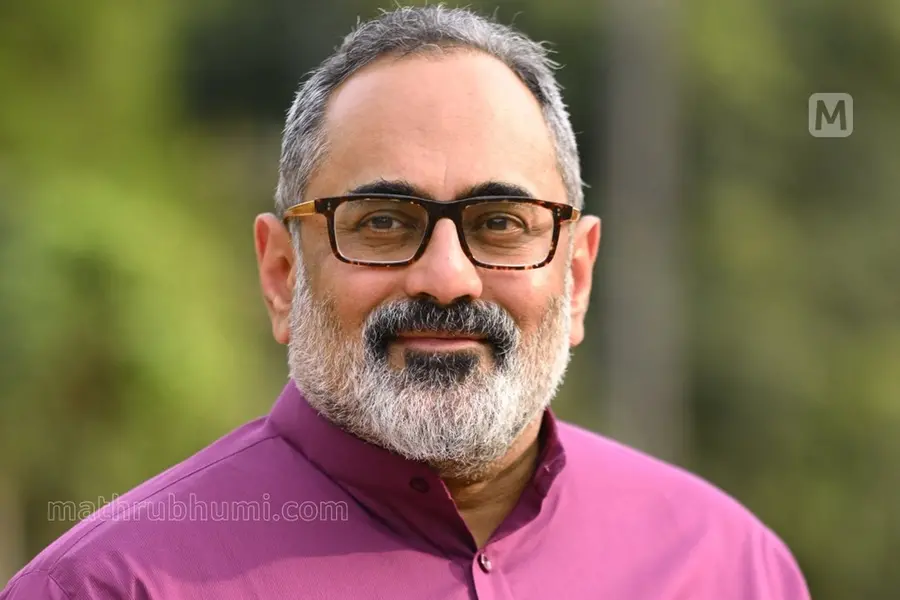
The Bharatiya Janata Party (BJP) has officially appointed Rajeev Chandrasekhar as the new president of Kerala unit. The decision was finalised during a meeting in Delhi, chaired by BJP central observer Pralhad Joshi. The formal announcement is set to take place on Monday at the state council meeting at Uday Palace Convention Centre in Thiruvananthapuram, as confirmed by BJP leader Prakash Javadekar.
Chandrasekhar will be succeeding K Surendran, who has led the state unit for five years—serving two years as interim president and three years in a full-term capacity.
Businessman turned politician
Rajeev Chandrasekhar is an Indian entrepreneur and politician. He was born on 31 May 1964, in Ahmedabad, Gujarat, into a Malayali Nair family. His father, M K Chandrasekhar, served as an Air Commodore in the Indian Air Force and was also a trainer for Rajesh Pilot. The family's ancestral home is in Desamangalam, a village in Thrissur district of Kerala.
He pursued his education in electrical engineering at the Manipal Institute of Technology and later earned a master’s degree in computer science from the Illinois Institute of Technology, Chicago, in 1988.
Rajeev Chandrasekhar is married to Anju Chandrasekhar, daughter of T.P.G. Nambiar, the founder of BPL Group. The couple lives in Koramangala, Bengaluru, along with their son Ved and daughter Devika. His parents, M K Chandrasekhar and Anandavalli Amma, also reside in Bengaluru.
Before entering politics, he was a successful businessman and is the founder and Advisor to the Board of Jupiter Capital Pvt. Ltd.

Political career
In 2006, Rajeev Chandrasekhar was elected to the Rajya Sabha, representing Urban Bengaluru, Karnataka. During his first term in the Upper House, he actively advocated for governance reforms, institutional development, national security, and the welfare of armed forces personnel, particularly veterans and their families. His interventions inside and outside Parliament played a crucial role in shaping government decisions on several key national issues.
In 2008 and 2009, he became the youngest president of the Federation of Indian Chambers of Commerce and Industry (FICCI), a leading organisation representing Indian businesses.
In 2012, he was unanimously re-elected for a second term in the Rajya Sabha. That same year, he launched ‘ASK’ (Ask, Seek, Know), an online campaign that provided citizens with a direct platform to voice their concerns in Parliament.
In March 2014, his persistent efforts to secure voting rights for armed forces personnel resulted in a Supreme Court ruling that granted them the right to vote.
In March 2015, he played a key role in protecting freedom of speech and expression on the internet, contributing to the Supreme Court’s decision to strike down Article 66A of the Information Technology Act.
In July 2015, his intervention led to action against establishments that served alcohol to underage patrons.
In September 2015, after years of advocating for the welfare of military personnel, the government formally announced the implementation of the One Rank One Pension (OROP) scheme, a cause he had supported since 2006.
Towards the end of 2015, he called for a comprehensive plan to combat child sexual abuse and formed the National Coalition to Protect Our Children (NCPOC).
In 2018, he was elected as a BJP Member of Parliament for Karnataka, marking the beginning of his third term in the Rajya Sabha.
In September 2020, he was appointed as the national spokesperson for the BJP, and in February 2021, he was given the role of election co-in-charge for Puducherry.
Ministerial role in the Modi government
Following a cabinet reshuffle in July 2021, Rajeev Chandrasekhar was appointed as the Minister of State for the Ministry of Electronics and Information Technology, the Ministry of Skill Development and Entrepreneurship, and the Ministry of Jal Shakti. Prior to this, he had served as a national spokesperson for the BJP.
During his tenure, he contributed significantly to digital governance, data security policies, and initiatives promoting entrepreneurship and skill development.
2024 Lok Sabha elections
In 2024, the BJP announced him as its candidate from the Thiruvananthapuram constituency in Kerala for the Lok Sabha elections. However, he lost the election to the incumbent MP, Shashi Tharoor, by a margin of 16,077 votes.
Contributions and recognition
Rajeev Chandrasekhar is widely recognised as one of the most well-informed and proactive parliamentarians in areas related to Digital India, internet governance, technology policies, and regulatory matters. He has consistently worked on issues requiring urgent attention and policy reforms.
In 2013, he was nominated for the prestigious UK-based Index on Censorship’s Freedom of Expression Award in the category of Digital Freedom, for his efforts in opposing internet censorship in India and challenging legislation that could curb digital freedom.
Throughout his political career, he has been part of several parliamentary standing and select committees, including those on defence, finance, telecom, urban development, the Goods and Services Tax (GST), the Real Estate Regulatory Bill, coal, and the National Cadet Corps (NCC) Advisory Board.
Before entering politics, he was a member of the Prime Minister’s Council on Trade and Development, chairman of the Karnataka government’s Infrastructure Task Force, and a member of the Parliamentary Standing Committee on Information Technology and the Parliamentary Forum on Youth.
Published: 23 Mar 2025, 12:26 pm IST
Related Topics
Disclaimer: Kindly avoid objectionable, derogatory, unlawful and lewd comments, while responding to reports. Such comments are punishable under cyber laws. Please keep away from personal attacks. The opinions expressed here are the personal opinions of readers and not that of Mathrubhumi.