
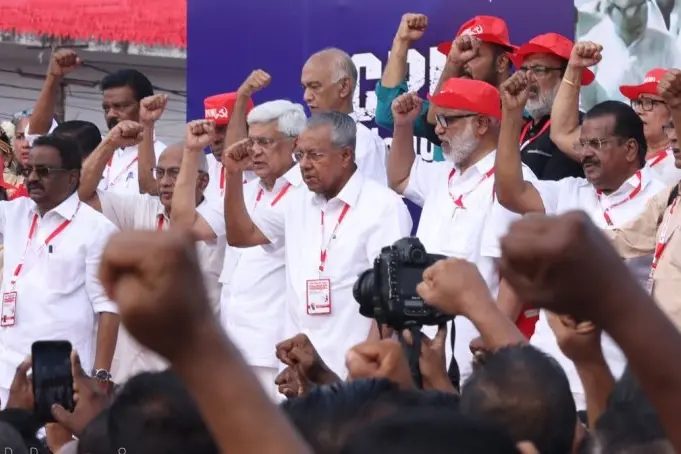
Kollam: The CPM organisational report states that there is a declining connection between the party leaders and the people of Kerala. The report noted that some party members have failed to follow the party's instructions regarding vigilance, purity, and transparency in financial transactions. The national political situation, influenced by the RSS, is slowly spreading to Kerala as well, it added.
The organisational report, presented by state secretary M.V. Govindan at the state conference being held in Kollam, mentions that the RSS has both long-term and short-term plans to eliminate the CPM.
The preface of the report includes self-criticism, acknowledging that while the party’s membership has increased and its governance remains popular, some weaknesses persist. The report highlights the weaknesses of branches that directly interact with the public. Some comrades lack transparency in financial dealings, with some even accepting large sums from institutions without issuing receipts. Others are accused of mediating financial transactions in exchange for money.
Party votes drifting
The report also mentions that CPM votes are drifting toward the BJP. The BJP has managed to penetrate and influence sections of the population that have traditionally supported the CPM. The report states that the BJP has both long-term plans and short-term interventions designed to weaken the CPM's mass base. It suggests that the CPM should expose the leadership stance of various communities that welcome the Sangh Parivar.
While the work of the women's wing has improved, the report notes that the RSS has intensified its focus on women. Women's groups centered around religious institutions are part of this strategy. The BJP is also working to bring central government services to women in an attempt to gain political advantage through this.
Pension for housewives
The report outlines the government’s policies under the "Navakerala" (New Kerala) roadmap. Efforts will continue to implement the Silver Line project. A pension will be provided for housewives. The Sabarimala Airport project will be made a reality, and a high-speed, multi-modal public transport system will be introduced, combining railway, metro, road, and water transport systems. These systems will be linked with industrial corridors.
Higher education institutions will be established in the private sector. The policy also emphasizes social justice in the higher education sector. A governance policy for research and pharmaceutical development will be created, and welfare pensions will be increased and distributed efficiently according to the policy.
Published: 07 Mar 2025, 08:02 am IST
ABOUT THE AUTHOR

Related Topics
Disclaimer: Kindly avoid objectionable, derogatory, unlawful and lewd comments, while responding to reports. Such comments are punishable under cyber laws. Please keep away from personal attacks. The opinions expressed here are the personal opinions of readers and not that of Mathrubhumi.