
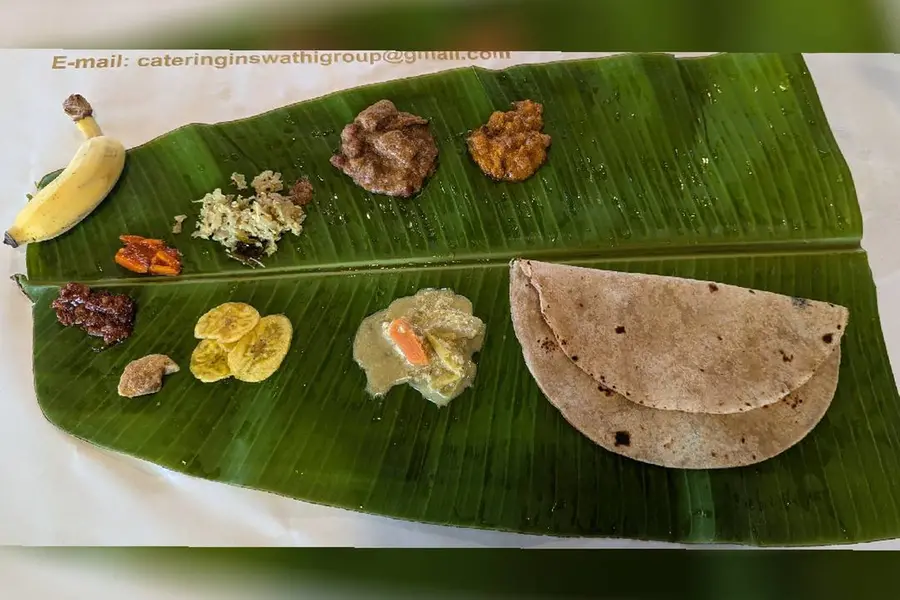
From internet forums to social media platforms, sadya has divided netizens into two different camps during the time of Onam for many years. One camp claims Onam is purely vegetarian, while the other camp opposes this idea and argues that Onam sadya can include both vegetarian and non-vegetarian dishes. This year's Onam witnessed an interesting debate – can chapati be part of Onam sadya?
Why the Chapati debate?
Recently, Tarun S Mehta, CEO of Ather Energy, an electric scooter company, shared images of Onam celebrations at his office. One of the photos featured a chapati on the banana leaf traditionally used to serve the Onam sadya. Several Malayalis on X responded, criticising the inclusion of chapati, noting that it was not traditionally part of the sadya. Some users also felt that the meal appeared to have fewer dishes than expected. Others expressed that while it was fine for them to enjoy a meal on a banana leaf, it shouldn't be referred to as sadya. Many perceived this as cultural misrepresentation, with some feeling it reflected an imposition of North Indian culture on a South Indian festival. Meanwhile, some netizens supported inclusion of chapati.
Ather Energy had to issue a statement on the matter. According to the company, chapati was an option for colleagues who respect personal choices. "Thankfully, no Malayalees were hurt in this incident... All items in the sadya were made by Malayalee chefs at a facility in Bengaluru and served by Malayalee colleagues,” it noted.
Interestingly, the clarification concluded in a witty manner: "We’d like to admit that some extra papadams were damaged while being relished with payasam. This was a rare lapse of judgment on our end, and we have since conducted numerous cultural sensitivity workshops to prevent any such occurrences," it read.
Paradox of the debate on Onam sadya
Culinary anthropologist and chef Oneal Sabu believes there is no need for Malayalis to feel offended over the inclusion of chapati. "It was a sadya in a private space. Being a corporate office, there will be people from different states. Many may find the dishes in the sadya not to their taste or preference. So, there is nothing wrong with including chapati."
"We do not need to validate the comments and reactions of netizens who find chapati odd in a sadya. Instead, we must appreciate the effort and acceptance of people who were ready to host in a different state," he said.
However, he criticised chefs and restaurant brands who misuse the ignorance of customers by offering their own version of traditional Sadya devoid of tradition. "Why blame others? Even our household sadya will have cabbage thoran. Who doesn’t know that cabbage wasn’t a traditional vegetable of Kerala? Sadya is evolving, and it’s bound to reflect terrain, cost, and perishability factors.” He also pointed out how some people derive caste pride and religiosity by branding Onam as a Hindu festival, even though it is a harvest festival. "There are PR companies who intentionally do this," he added.
Dr Deepa G, a history assistant professor at CAS College in Kannur, who did her PhD on the politics of food in colonial Malabar, explained the paradox in finding identity in sadya. According to Deepa, the word sadya became part of the mainstream narrative after it appeared in the food literature of the Travancore Kingdom. "If we look back to history, we can see that Tamil Brahmins were brought here for cooking and the dishes have non-native roots. Even sambar, which rules Kerala sadya now, has its origins in the cuisines of Maharashtra and Tamil Nadu," she said.
Similarly, sadya was once something limited to Brahminical circles, and seclusion was one of the core ideas it subtly propagated, she pointed out. "Sadya was ritualistic and maintained class-caste differences to uphold the constructs of purity and esteem. We can see that there were different panthis (rows in which food is served) based on caste-class differences. Pappadam was a luxury then, and only a special class was served with it," she added.
According to Deepa, the present vegetarian cult of sadya is another format by which Onam becomes ritualistic. "The media portrayal of the present has also normalised the idea that sadya is intrinsically vegetarian. However, Onam is a harvest festival, and a harvest can include both vegetarian and non-vegetarian items," she said.
Published: 15 Sept 2024, 02:38 pm IST
ABOUT THE AUTHOR

Related Topics
Disclaimer: Kindly avoid objectionable, derogatory, unlawful and lewd comments, while responding to reports. Such comments are punishable under cyber laws. Please keep away from personal attacks. The opinions expressed here are the personal opinions of readers and not that of Mathrubhumi.