
Kerala High Court calls Sabarimala gold loss part of a “larger and well-orchestrated scheme” and expands probe into top Devaswom Board officials.
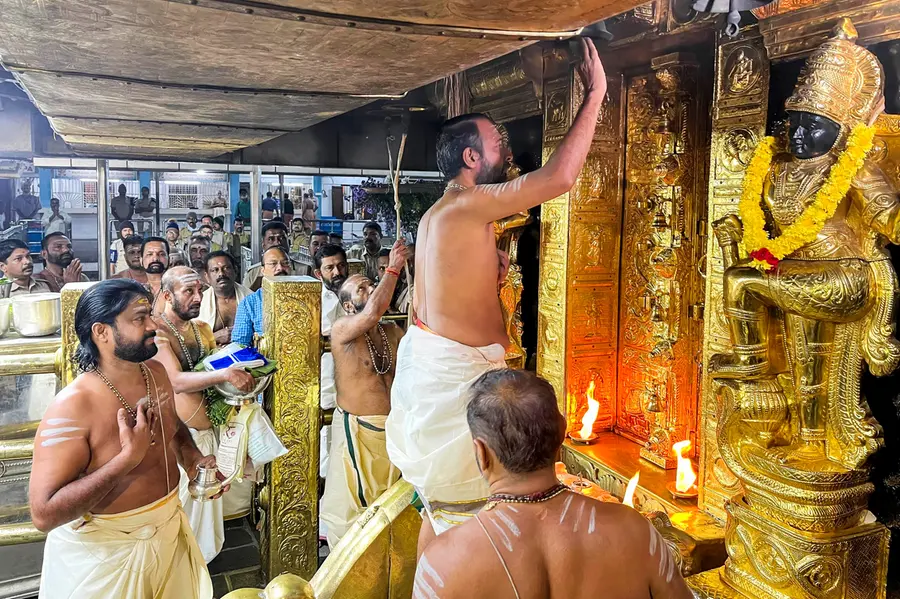
Kochi: The Kerala High Court has broadened the scope of the Special Investigation Team (SIT) inquiry into the alleged misappropriation of gold from Sabarimala Temple, directing investigators to explore the possibility of a wider conspiracy and examine the role of officials from the Travancore Devaswom Board (TDB).
The decision was issued by a division bench comprising Justices Raja Vijayaraghavan V and K V Jayakumar, following the submission of the SIT’s preliminary report in a sealed envelope during in-camera proceedings held on Tuesday. Lawyers were not present during the session due to the sensitive nature of the case.
The SIT, formed by the court earlier this month, is tasked with probing the suspected siphoning of gold from the gold-plated dwarapalaka (guardian deity) idols and the ornamental frames of the sreekovil (sanctum sanctorum).
The court, citing the SIT’s report, flagged “serious irregularities” in how the gold and idols were handled, particularly by officials entrusted with their care. It clarified that its oversight was “not to direct or dictate the mode or manner of investigation, but to ensure that it proceeds in a proper, effective and lawful course,” emphasising that its goal was to “sustain and reinforce public confidence in the impartiality and integrity of the inquiry”.
Two FIRs—Crime Nos. 3700 and 3701 of 2025—have been registered under Sections 403, 406, 409, 466 and 467 of the Indian Penal Code, covering offences such as criminal breach of trust and forgery.
The first case pertains to the entrustment of gold-plated idols and peedam (pedestal) to Bengaluru-based sponsor Unnikrishnan Potti in July 2019. The second involves 409 grams of gold allegedly retained by Potti after extracting it from the decorative side frames, reportedly with the knowledge of TDB officials.
The court also highlighted an email from Potti to the Devaswom Board, in which he sought permission to use a portion of the gold “for the marriage of a girl known to him”. The bench observed that this demonstrated “wilful silence and concealment” by those responsible for safeguarding the items.
Calling the sequence of events “part of a larger and well-orchestrated scheme”, the court instructed the SIT to investigate the full scope of the suspected conspiracy, including transactions from both 2019 and 2025.
Despite existing regulations requiring that restoration work on temple ornaments be conducted within the sannidhanam (temple premises), the court noted that TDB officials had violated this rule by handing the items over to Potti, a person with “dubious antecedents”.
Inspection reports and internal communications from 2024 and 2025 had already flagged damage and missing gold, yet the same sponsor was re-engaged without transparency or accountability. “It is a distinct possibility that the TDB officials secretly re-entrusted the idols to Unnikrishnan Potti in 2025 in an apparent attempt to conceal the pilferage of 2019,” the bench stated.
The court cited conflicting statements from the Devaswom Commissioner. On July 30, 2025, the Commissioner said Chennai-based contractor Smart Creations lacked the technical qualifications to carry out the gold-plating work, and traditional methods should be used instead. However, just days later, this stance was reversed. On August 21, 2025, the Thiruvabharanam Commissioner referenced instructions from the Board’s president to speed up the project according to the sponsor’s proposal.
On September 3, the Board officially handed over the dwarapalakas and thaangu peedams (supporting pedestals) to the sponsor, after Potti had earlier recommended using a spare set of idols kept in the strong room to reduce costs.
"The sequence of events unmistakably indicates that the TDB officials consciously attempted to hand over the gold-clad dwarapalakas secretly to Unnikrishnan Potti in 2025 to suppress the earlier gold pilferage. This explains why the permission of the Special Commissioner was not sought, despite a binding order of this Court in SSCR No. 13 of 2023," the bench said.
Despite prior objections regarding Potti’s capabilities, the court noted that officials eventually approved the plan “under pressure” to fast-track the work.
The High Court reiterated that it will continue to oversee the investigation to ensure it remains fair, transparent and timely. A suo motu writ petition has been ordered to be registered to facilitate ongoing judicial supervision.
In addition, the SIT has been directed to seize the TDB’s minutes book and all relevant registers and documents, with copies to be handed over to the Registrar General for secure custody.
The case will be reviewed again on November 5, with SIT officers required to appear in person. Further proceedings will remain confidential.
According to court sources, the SIT’s sealed report outlines the current status of its inquiry, which is expected to conclude within six weeks. As of now, 10 individuals—including Unnikrishnan Potti and several TDB officials—have been named as accused.
Potti, who had sponsored the gold-plating work on the temple’s idols and doors in 2019, was arrested after gold was found missing from the sacred ornaments.
PTI
Published: 21 Oct 2025, 09:34 pm IST
Disclaimer: Kindly avoid objectionable, derogatory, unlawful and lewd comments, while responding to reports. Such comments are punishable under cyber laws. Please keep away from personal attacks. The opinions expressed here are the personal opinions of readers and not that of Mathrubhumi.
