
The Coconut Development Board has significantly enhanced financial assistance for new plantations and nurseries, aiming to bring 8,000 hectares under fresh coconut cultivation while expanding the crop beyond its traditional growing regions.
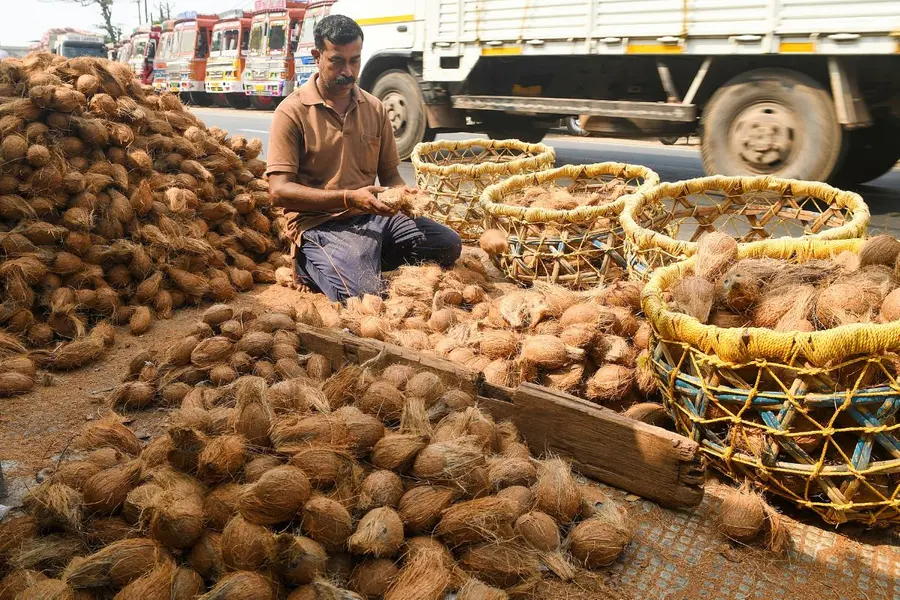
For generations, coconut trees have been synonymous with Kerala's landscape and economy.
Now, the Coconut Development Board (CDB) wants that story to extend far beyond the country's traditional coastal belt, backing a nationwide expansion drive with significantly higher financial assistance for new plantations and certified nurseries.
The Board has revamped its New Coconut Planting Scheme, increasing financial support from the earlier subsidy of around Rs 40 per seedling to nearly Rs 350 per seedling under the revised programme introduced in the last financial year.
Under the Area Expansion Programme, farmers planting coconut on one hectare are eligible for financial assistance of Rs 56,000, released in two equal instalments of Rs 28,000 each over two years.
The benefit is available for plantations covering up to two hectares. According to a senior Coconut Development Board official, around 160 to 170 coconut seedlings can be planted on one hectare depending on the recommended spacing, taking the effective support to roughly Rs 350 per seedling.
The scheme also extends proportionate financial assistance to farmers owning at least 20 cents of land who plant a minimum of 10 seedlings. However, the programme excludes replanting and gap-filling in existing coconut plantations.
The revised initiative has already recorded encouraging participation. During its first year, 5,430 farmers received financial assistance covering 2,271 hectares across the country.
'Some applications reached us late, so we could not extend financial assistance to all eligible applicants during the last financial year. But this is a continuing scheme and farmers can apply every year,' the official said.
Applications are invited annually. In Kerala, farmers must apply through their local Krishi Bhavan, while applicants in other states can submit forms through their respective Agriculture or Horticulture Departments.
Before the subsidy is released through the Direct Benefit Transfer (DBT) system, the Board conducts random field inspections to verify plantation details.
Officials also send reminders and application forms to beneficiaries when they become eligible for the second instalment.
The Board has now set a target of bringing nearly 8,000 hectares under fresh coconut cultivation during the current financial year.
'The programme is being implemented across all states, including traditional and non-traditional coconut-growing areas. The same scheme is also being extended to the northeastern states,' the official said.
Alongside expanding plantations, the Board is also strengthening the supply of quality planting material by promoting certified coconut nurseries.
Officials believe the shortage of quality seedlings has remained a major hurdle in non-traditional coconut-growing regions.
To bridge that gap, entrepreneurs and farmers setting up Board-approved nurseries are eligible for financial assistance under the Coconut Nursery Scheme.
'The nursery scheme supports the new planting programme. If quality seedlings are produced locally through the Board-assisted nurseries, farmers will have easier access to planting material and we can expand coconut cultivation in non-traditional areas much faster,' the official said.
The initiative has already gained traction in states such as West Bengal, where authorised nurseries collect seed nuts from approved mother palms and raise seedlings locally.
Under the nursery scheme, a traditional coconut-growing region can establish a nursery on 25 cents of land by sowing 10,000 seed nuts to produce around 6,250 seedlings.
In non-traditional regions, however, the minimum production requirement has been reduced to 3,125 seedlings to encourage wider participation.
'We have relaxed the norms in non-traditional regions to encourage more nurseries. Similar concessions have also been provided under the new planting scheme,' the official added.
Eligibility norms for farmers have also been eased in emerging coconut-growing states. While farmers in traditional producing states such as Kerala must plant at least 10 seedlings on a minimum of 20 cents of land to qualify, growers in West Bengal, Bihar, Jharkhand and the northeastern states need to plant only five seedlings.
Under the nursery scheme, financial assistance of Rs 45 per seedling is provided in two equal instalments after inspection and verification.
The support covers nearly half of the estimated production cost, including transportation of seed nuts, nursery establishment, polybags, shade-net structures and other essential infrastructure.
Every nursery is inspected by a joint committee comprising officials from the Coconut Development Board and the concerned state department before assistance is released.
With higher financial incentives, relaxed eligibility norms and a parallel push to strengthen nursery infrastructure, the Board hopes to expand coconut cultivation into newer regions while creating additional income opportunities for farmers across the country.
Published: 05 Aug 2026, 11:14 am IST
ABOUT THE AUTHOR

Related Topics
Disclaimer: Kindly avoid objectionable, derogatory, unlawful and lewd comments, while responding to reports. Such comments are punishable under cyber laws. Please keep away from personal attacks. The opinions expressed here are the personal opinions of readers and not that of Mathrubhumi.