
A Kerala woman has approached the Supreme Court, saying its highway safety directions could restrict the use of her residual land.
New Delhi: Fousiya Meethale Edakkatt, a 50-year-old woman from Kerala, has approached the Supreme Court seeking to protect the rights of private landowners whose properties, she claims, have been adversely affected by the court's recent interim directions aimed at addressing the causes of highway fatalities.
Fousiya has sought to be impleaded in the suo motu proceedings initiated by the Supreme Court on road safety, or alternatively, be permitted to intervene in the case. She has also sought permission to place a detailed counter-affidavit before the court on behalf of similarly placed private landowners.
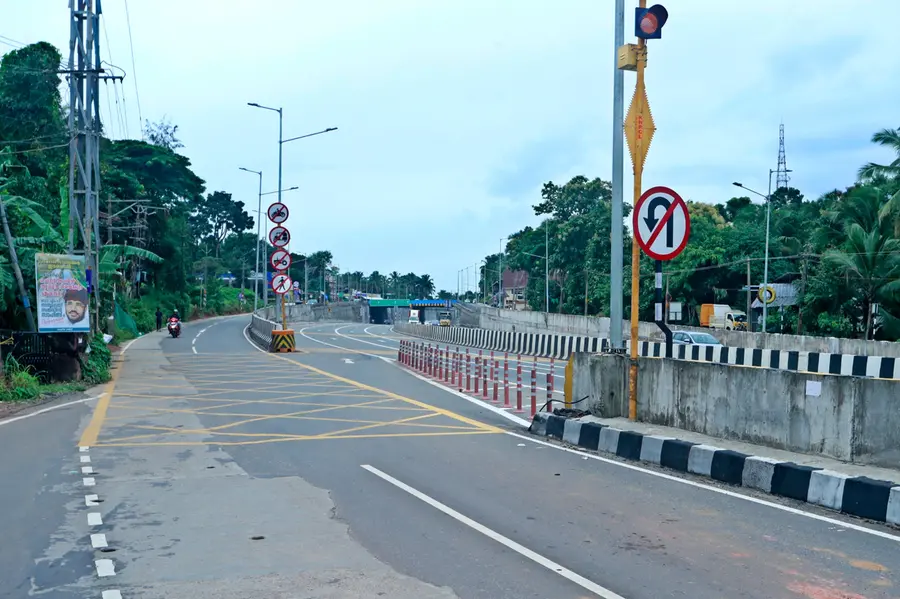
The applicant owns land in Kadikkad Village, Chavakkad Taluk, Thrissur district, whose western boundary directly abuts National Highway 66, formerly NH-17. Her title to the property measuring 4.04 ares was acquired through a registered gift deed executed by her mother in January 2021. The land records and acquisition proceedings also recognise her ownership.
A portion of her property measuring 0.0124 hectares was subsequently acquired for the four-laning of NH-66 along the Kappirikkad–Edappally section. The acquisition was carried out under the National Highways Act, 1956, and compensation of ₹16,04,537.04 was determined, followed by an additional compensation of ₹1,15,800 towards structures, agricultural improvements and trees. Possession of the acquired portion was also surrendered.
According to the application, the acquisition has left Fousiya's remaining property immediately contiguous to the notified Right of Way of the highway. She contends that, when the distance is measured from the midpoint of the National Highway in terms of the Supreme Court's direction dated April 13, 2026, virtually the entire residual property falls within the prescribed 40-metre zone for residential use and 75-metre zone for commercial use, within the Indian Roads Congress (IRC) norms.
The Supreme Court, in its April 13 order in the suo motu proceedings, had issued a series of interim directions concerning highway safety. Among other measures, the court directed states to issue notifications prohibiting change of land use within 40 metres for residential purposes and 75 metres for commercial purposes from the midpoint of a National Highway, consistent with IRC norms.
The applicant argues that these directions have a direct bearing on privately owned land situated beyond the notified Right of Way. She has particularly raised concerns over directions relating to highway safety zones, licensing and land-use restrictions, contending that their implementation could affect lawfully held private properties outside the notified Right of Way. The application has been filed through advocate Deepak Prakash, who is representing Fousiya before the Supreme Court.
She has argued that she was not a party to the original proceedings and had no opportunity to be heard, despite her civil and property rights being directly affected by the implementation of the interim directions. The application therefore urges the Supreme Court to allow her to intervene or be impleaded as a party in the suo motu writ petition and permit her to file a detailed counter-affidavit placing before the court the grievances of affected private landowners.
Published: 17 Aug 2026, 10:20 am IST
ABOUT THE AUTHOR

Related Topics
Disclaimer: Kindly avoid objectionable, derogatory, unlawful and lewd comments, while responding to reports. Such comments are punishable under cyber laws. Please keep away from personal attacks. The opinions expressed here are the personal opinions of readers and not that of Mathrubhumi.