
Kerala’s new net metering regulations restrict how much solar energy consumers can use from the grid at night, affecting rooftop solar producers across the state.
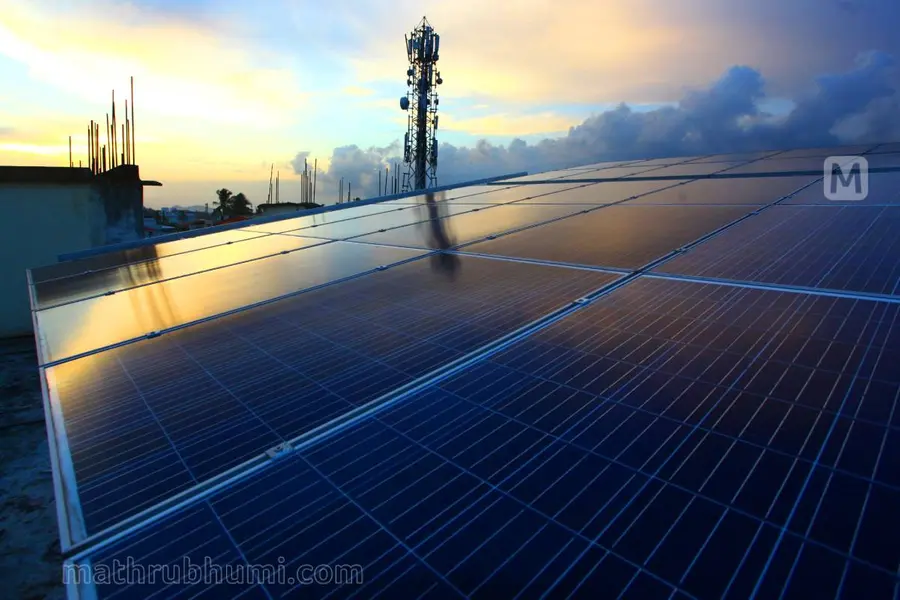
Thiruvananthapuram: Although households can continue using the net metering system for rooftop solar power plants up to 10 kW without battery storage, new regulations limiting electricity consumption during nighttime are expected to affect consumers. Under the revised rules, consumers will no longer be able to use the entire amount of solar energy fed into the grid during the day for nighttime consumption. If nighttime usage is not restricted, the balance power by the end of the year will be less, and bills may increase.
Until now, consumers could use at night the same amount of solar power they had supplied to the grid during the day. Under the new regulations, however, households will be allowed to draw back only 75% of that amount during peak hours — from 6 p.m. to 11:30 p.m. For non-domestic connections, the limit will be 85%..
During off-peak hours, from 11:30 p. to 8 am, the recovery limit will be 85 per cent for all categories. The new billing system applies to all solar power plants with a capacity above 2 kW, both domestic and non-domestic.
The State Electricity Regulatory Commission recently issued the updated guidelines governing power generation from renewable sources, including rooftop solar.
However, the rule that prevents consumers from drawing back the entire amount of power supplied to the grid during the day from plants with a capacity of more than two kilowatts will affect most consumers. Most rooftop solar plants in the state exceed 2 kW, and the change is expected to impact households that operate multiple air conditioners or charge electric vehicles at night.
How will it be impacted
Let us assume a solar plant generates 300 units per month and 90 units are consumed during the day, the remaining 210 units are sent to the grid. Under the old regulations, these 210 units could be fully adjusted against nighttime consumption, with any surplus carried forward to subsequent months. At the end of the year, the leftover energy was compensated at ₹3.08 per unit for old consumers and ₹2.79 per unit for new ones.
Under the new rules, however, due to peak-hour restrictions, only about 80 per cent of the exported power can be reclaimed, meaning roughly 168 of the 210 units will be available for night-time use.
Previously, solar producers paid fixed charges and meter rent directly, with solar generation deducted from their consumption bill. Under the revised system, these fixed costs will now be deducted from the value of the month’s surplus electricity first. Only the remaining balance, if any, will be carried forward to offset future bills or settled at the end of the year.
Published: 09 Nov 2025, 11:11 am IST
Disclaimer: Kindly avoid objectionable, derogatory, unlawful and lewd comments, while responding to reports. Such comments are punishable under cyber laws. Please keep away from personal attacks. The opinions expressed here are the personal opinions of readers and not that of Mathrubhumi.
