
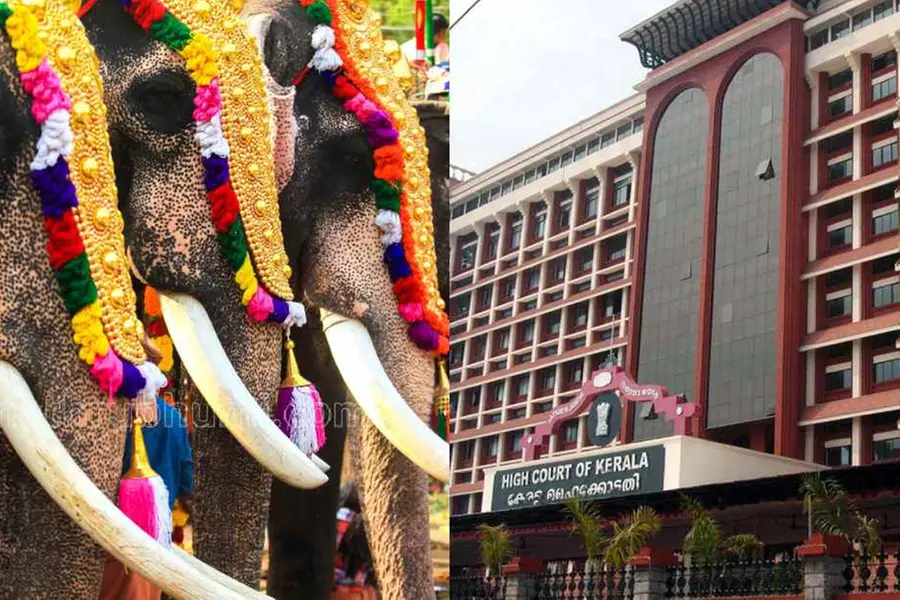
Kochi: The Kerala High Court has sharply criticised the treatment of captive elephants, describing their lives as an "eternal Treblinka" — a reference to the Nazi extermination camp. Observing the extensive use of elephants in Kerala’s religious festivals, the court condemned the practice as a form of commercial exploitation, veiled under the guise of tradition and religious customs, with little regard for the animals' welfare.
“We do not believe that there is any essential religious practice of any religion that mandates the use of elephants in festivals,” said a bench comprising Justices A K Jayasankaran Nambiar and Gopinath P.
Concerns Over Ownership and Mortality Rates
The court noted with concern that captive elephants are often treated as mere "tradeable commodities," with owners focusing on profit rather than animal welfare. Highlighting this exploitation, the bench cited the high mortality rate, with 160 of the 509 elephants recorded in 2018 having died between 2018 and 2024. An updated list from the forest department in August reveals that 388 elephants are still in captivity, with 349 owned by private individuals.
The bench pointed out inconsistencies in ownership documents, with many elephants lacking proper certification. The court urged the government to verify the legality of such possessions, noting that for several elephants, the names of custodians and owners listed on certificates do not match, suggesting possible illegal ownership.
Strict Conditions for Festival Parades
In a bid to protect the welfare of these elephants, the High Court stipulated specific conditions for granting permissions to parade elephants in festivals and other public events:
- Elephants must have fitness certificates issued solely by government veterinarians.
- A model feeding schedule should be followed, along with shaded, clean shelters and a requirement for at least eight hours of daily rest.
Further restrictions were applied to transportation. The court ruled that elephants must not be walked for more than 30 km per day; if the distance exceeds this, up to a maximum of 125 km, transportation must be by vehicle. Additional guidelines include:
- A prohibition on elephant movement between 10 pm and 4 am
- No processions permitted on public roads from 9 am to 5 pm
- Exhibition periods for elephants must not exceed three continuous hours.
Ban on Inhumane Festival Practices
The court also banned certain festival practices, including forcing elephants to lift their heads, salute, shower flowers, or stand on their hind legs to salute, as recently introduced at the ‘Thirunakkara Pooram’ festival. The High Court further prohibited the use of so-called 'elephant squads' or 'capture belts,' methods employed to capture or restrain elephants that misbehave or run amok.
Government Criticised for Non-Compliance
The court expressed dismay over the Kerala government’s failure to implement the Supreme Court's instructions to enforce the Kerala Captive Elephants (Management and Maintenance) Rules, 2012. The bench alleged that officials have disregarded these directives, possibly due to pressure from groups, including associations of elephant owners, which advocate for a dilution of the 2012 Rules. The court lamented that despite nearly 18 months of assurances that the rules would be strengthened, progress has stalled.
The High Court has sought an affidavit from the forest and wildlife department, clarifying whether the Supreme Court's orders have been followed and, if not, the reasons for non-compliance.
With PTI inputs
Published: 15 Nov 2024, 06:10 am IST
Related Topics
Disclaimer: Kindly avoid objectionable, derogatory, unlawful and lewd comments, while responding to reports. Such comments are punishable under cyber laws. Please keep away from personal attacks. The opinions expressed here are the personal opinions of readers and not that of Mathrubhumi.
