
The latest landslide occurred within a few kilometres of the area devastated in 2024.
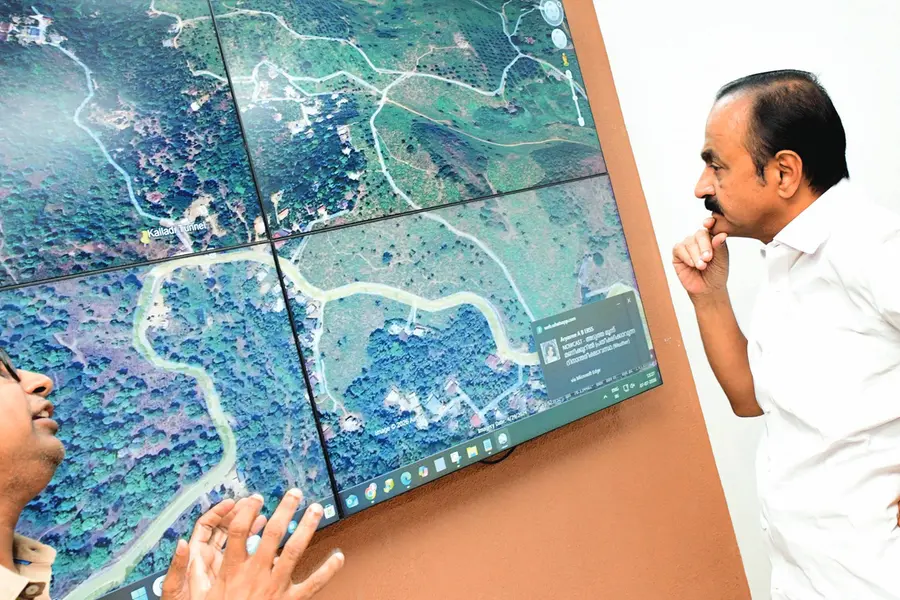
Thiruvananthapuram: Kerala Chief Minister V.D. Satheesan will visit the landslide-hit Kalladi area in Wayanad on Wednesday to oversee rescue and relief operations, as questions mount over whether repeated safety warnings issued before the disaster were ignored.
The Chief Minister is scheduled to leave Thiruvananthapuram Airport by helicopter at 11.30 am and reach the affected area around 1 pm to review the rescue effort and coordinate the government's response.
Speaking to reporters, Satheesan alleged that contractors failed to remove excavated soil despite repeated directions from the authorities.
He said both the District Collector and the State Disaster Management Authority had instructed that the accumulated soil be cleared immediately. The matter was also discussed at a meeting chaired by the Public Works Minister, but the directions were not implemented.
The Chief Minister also said the government had received complaints that prescribed safety standards were not being followed during National Highway construction works.
According to him, rescue operations and relief measures are being coordinated jointly by the Chief Minister's Office, the Chief Secretary's Office and the State Disaster Management Authority.
Meanwhile, Dilip Buildcon Limited, the contractor executing the tunnel project, described the incident as a deeply tragic accident and expressed support for those affected and their families.
In a statement, Company Secretary Abhishek Shrivastava said efforts were continuing to trace workers and gather information about those involved.
The company maintained that the project was being executed after obtaining all required engineering, environmental and statutory approvals and in compliance with prescribed safety standards.
It also said the project, located in an ecologically sensitive region, is monitored at multiple levels, including the Supreme Court-appointed Central Empowered Committee. According to the company, all excavated material has been handled in accordance with approved procedures, minimising the possibility of technical failures.
Officials flagged risks weeks before landslide
Officials and technical experts had reportedly raised concerns at multiple levels months before the tunnel-related landslide, but the warnings were allegedly not acted upon.
The Public Works Department, geology experts and the district administration had warned about the dangers posed by stockpiled excavated soil, unstable hill slopes, local soil conditions and heavy rainfall.
These concerns were communicated by project implementing agency Konkan Railway to Dilip Buildcon Limited. However, officials said no effective follow-up action was taken beyond forwarding the files.
On June 25, a team led by Public Works Department Special Secretary Adeela Abdullah inspected the project site and issued a series of safety recommendations.
The authorities directed that rainfall should be monitored daily and that all work should be suspended if rainfall exceeded 250 mm. During a departmental meeting, the contractor reportedly pointed out that there was insufficient space to store the excavated soil.
A joint inspection involving the Geological Survey of India, TUMAS and Dilip Buildcon also identified the possibility of slope failure ( movement of rock, soil, or debris down a slope). The inspection report warned that cracks could develop on the slopes and recommended regular inspections throughout the monsoon season.
The inspections were carried out between June 3 and June 11. Dilip Buildcon submitted its findings to Konkan Railway on June 14, but according to the information available, no further action followed.
Scientific study highlights recurring landslide threat
A study by the National Centre for Earth Science Studies (NCESS), Thiruvananthapuram, has warned that Wayanad's geological conditions and intense rainfall could trigger landslides similar to the Mundakkai-Chooralmala disaster of 2024.
Conducted after last year's disaster, the study found that prolonged heavy rainfall over vulnerable stretches of the Western Ghats could repeatedly trigger major landslides.
According to the report, the Mundakkai-Chooralmala region received 572 mm of rainfall in the two days preceding the 2024 landslide. Continuous rain allowed water to seep deep into fractures in the hill slopes, weakening the stability of soil and rock before triggering the massive landslide at Vellarimala.
The study also noted that natural fractures and fault lines enable rainwater to penetrate rapidly beneath the surface, increasing landslide risk. Experts further observed that construction activities could contribute to the formation of cracks in rock formations.
The latest landslide occurred within a few kilometres of the area devastated in 2024. However, the exact scientific cause of the latest incident near Meenakshi Bridge in Kalladi has not yet been established.
Although Wayanad has recorded 59 per cent below-normal rainfall during the current monsoon season, the district has experienced intense rainfall over the past few days.
During the 24 hours ending on Tuesday morning, 204 mm of rain was recorded across the district, while Meppadi received the highest rainfall at 226 mm. According to the India Meteorological Department (IMD), Anakampoyil recorded 140 mm during the same period.
Despite rainfall in Meppadi reaching the threshold typically associated with a red alert, only a yellow alert had been issued for Wayanad because rainfall levels were lower across other parts of the district. A red alert was issued only after the landslide occurred.
It may be noted that rainfall can vary significantly over short distances and that these localised variations may not have been fully reflected in the warning system. Wayanad has witnessed several major landslides in recent years, including Puthumala and Mundakkai-Chooralmala, both triggered by prolonged heavy rainfall.
Published: 08 Jul 2026, 09:53 am IST
Related Topics
Disclaimer: Kindly avoid objectionable, derogatory, unlawful and lewd comments, while responding to reports. Such comments are punishable under cyber laws. Please keep away from personal attacks. The opinions expressed here are the personal opinions of readers and not that of Mathrubhumi.
