

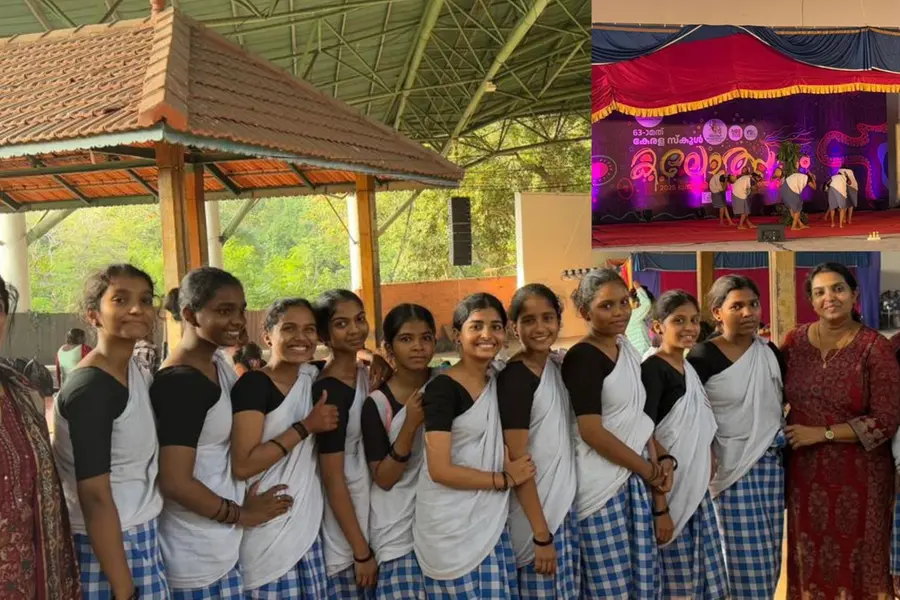
The 63rd Kerala State Arts Festival, currently unfolding in Thiruvananthapuram, is celebrating not only the grandeur of classical dance forms but also the essence of rich traditions of Kerala’s indigenous art forms.
Among the most remarkable performances at the festival were Irular Nritham and Mangalamkali, both deeply connected to Kerala’s tribal cultures, showcasing a blend of history, energy, and cultural pride.
This year marks the first time that tribal art forms have been included in the festival. Mangalamkali, Paniya dance, Malapulayattam, Irula Nritham, and Paliya Nritham are among the indigenous performances featured. This inclusion follows longstanding requests from tribal communities across the state, who have long advocated for the recognition of their cultural traditions within the event.
One of the standout moments of the festival was the performance of Irular Nritham by a group of students from Marayoor MSK at the inaugural function of the Kalolsavam 2025.
The children, including Kalyani R, Parashakti P, and Ammu, were both excited and nervous as they took the stage to present Irular Nritham, a dance form rooted in the traditions of the Irular tribal community. Irular Nritham is a traditional dance form performed by the Irula tribe of Kerala and Tamil Nadu. It is a celebration of the tribe’s culture and traditions and is performed during festivals, ceremonies and rituals.
“We were a bit tensed, but we are delighted to have performed here,” said Kalyani, one of the performers. The dance was part of the inaugural ceremony of the festival, which saw a stunning array of classical performances including Bharatanatyam, Kuchipudi, Mohiniyattam, Kathakali, and Oppana. Amidst these well-established art forms, Irular Nritham stood as a symbol of Kerala’s cultural diversity and the vitality of its indigenous traditions.
The students, under the guidance of teacher Vidya, are part of the Mahila Samakhya Society, which has long been working to empower women and children through education and cultural expression. The collaboration with Kalamandalam, a prominent institution for the arts, helped bring this performance to fruition. "Three students from our school and three from Kalamandalam were taught this dance, and together they performed it," Vidya explained. The dance, characterized by energetic movements and symbolic gestures, narrates stories of nature, community, and spiritual beliefs.
Mangalamkali, an art from Kasaragod
Meanwhile, at the Nishagandhi Auditorium in Kanakakunnu Palace, another group of young dancers from Malappuram showcased their performance of Mangalamkali, a traditional dance form that originates from the Mavilan tribes of North Kerala. The dance, also known as the "wedding dance," is performed during marriage celebrations and has strong cultural ties to the Dravidian traditions of the Gothra community of Kasaragod.
The stage for Mangalamkali was set with a symbolic panamaram (a tree) at the center, around which the children performed. Dressed in makeshift bamboo caps and traditional attire, the performers danced in a circle, moving with grace yet requiring immense physical effort. The choreography involved backward movements and head-bent postures, a demanding routine that tested the endurance of the young performers. “The dance requires intense energy and concentration, but we’re proud of what we’ve accomplished,” said a member of the team.
The children’s performance marked a revival of this once-popular art form, which was performed widely until the 1970s. The dance, known for its vigorous and repetitive movements, requires physical stamina and strength, particularly as the dancers maintain bent postures and perform backward motions for prolonged periods.
“The children learned the dance quickly because it’s based on natural movements rather than the rigid, structured forms of classical dances like Kuchipudi or Mohiniyattam,” said Udayan Master, the choreographer for the performance. Udayan, who has received the Sahitya Akademi Award for his work with Mangalamkali, explained that the simplicity of the movements made it easier for the children to pick up the steps in a short amount of time.
However, the physical toll on the young performers was evident. "The dance is extremely strenuous," said teacher Bindiya. “The children have to continuously bend and move in the same direction for over 15 minutes, which leads to exhaustion, back pain, and even difficulty with ear balance due to the constant head movement.” The children, despite the physical strain, pushed through to deliver a powerful performance. “We were tired, but it was an amazing experience,” said one of the dancers. “The singing also added an extra challenge, but it was all worth it.”
For teachers Bindiya and Shamitha, the opportunity to bring their students to perform at the state-level festival was an unexpected honor. “We didn’t expect to make it to the state level, but we are extremely proud of how far the children have come,” said Shamitha. “This experience has been transformative, not just for the students but for us as educators. It’s been an incredible journey of growth and learning especially to have this opportunity to know more about our own art forms.”
Preserving traditions
As the Kalolsavam 2025 progresses, the inclusion of indigenous art forms like Irular Nritham and Mangalamkali serves as a powerful reminder of Kerala’s cultural diversity. These art forms are not merely performances; they are living traditions that continue to connect young generations to the history, culture, and stories of their ancestors. By showcasing these dances at the state festival, the event has become a celebration not only of Kerala’s classical arts but also of its indigenous heritage, ensuring that these unique traditions are preserved and passed on to future generations.
Through the dedication of students, teachers, and artists, these ancient dance traditions are being revived and reimagined for a new era, ensuring that the rich cultural tapestry of Kerala remains vibrant and alive.
Published: 04 Jan 2025, 07:43 pm IST
ABOUT THE AUTHOR
Related Topics
Subscribe to our Newsletter
Disclaimer: Kindly avoid objectionable, derogatory, unlawful and lewd comments, while responding to reports. Such comments are punishable under cyber laws. Please keep away from personal attacks. The opinions expressed here are the personal opinions of readers and not that of Mathrubhumi.