

Eighteen vehicles traversed from Kuttanad to Umling La, setting a record for the largest convoy from India’s lowest to the world’s highest motorable road.
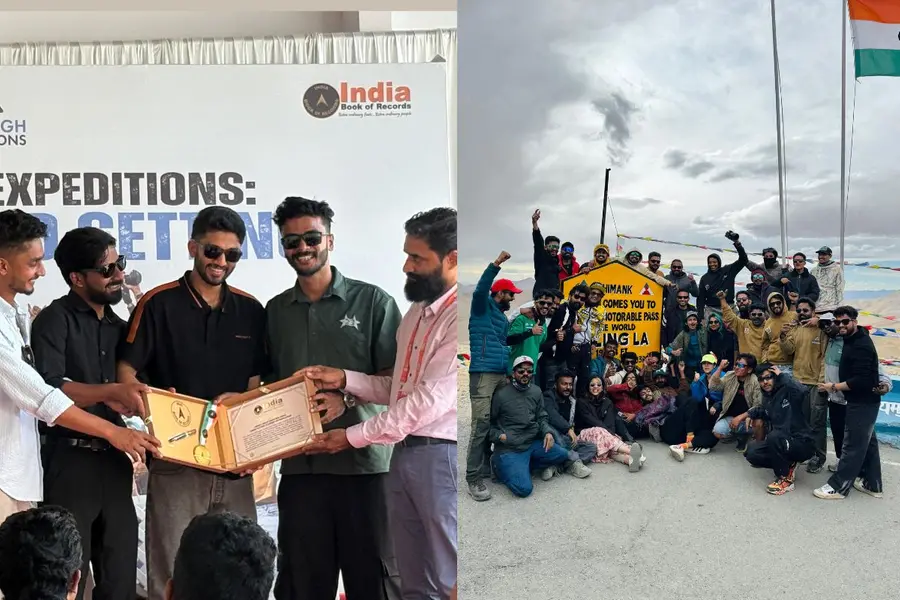
What started as an idea between four travel-loving friends turned into a journey of a lifetime and now, a place in the India Book of Records and the Asia Book of Records.
Earlier this year, a convoy of 18 off-road vehicles set out from the quiet backwaters of Kuttanad in Kerala, which sits 2.2 metres below sea level. Their destination? Umling La in Ladakh, the highest motorable road in the world, sitting at a dizzying 19,024 feet. The goal was simple but bold, to become the largest convoy to ever drive from India’s lowest point to the world’s highest drivable altitude.
And they did it.
The team behind this incredible journey, Real High Expeditions, was officially recognised at an award ceremony in Kozhikode, where the founders -- Adnan Mansoor, Shegin CK, Shakeel Maloof, and Ajmal Hakkim -- were presented with certificates for setting this one-of-a-kind record.
“The idea started off as just a trip to Umling La,” shared Aparna Gopan, the expedition’s marketing head and one of the adventurer. “Then someone asked, ‘Why not do it from the country’s lowest point to the highest road in the world?’ That’s when we realised we could make history.”
Setting out in mid-June, the team’s route took them from the serene backwaters of Kuttanad through the bustling cities of Tamil Nadu, the dry landscapes of Telangana, the lush interiors of Madhya Pradesh, and eventually to the rugged terrains of Himachal Pradesh and Ladakh. The full trip lasted nearly 40 days, with the return journey from Manali alone taking 13 days.
Throughout the expedition, both people and machines were put to the test.
“High altitudes don’t just affect your body -- they affect your car too,” Aparna recalls. “We had diesel vehicles break down. Some people fell sick. One of our participants, Sanah, had to visit multiple hospitals but still made it to the top. That’s the kind of spirit this journey created.”
The team travelled through every kind of terrain India has to offer: deserts, dense forests, riverbeds, snowy passes, and the surreal high-altitude landscapes of Ladakh. They brought with them not just a convoy of modified 4x4s, but also a deep passion for exploration, storytelling, and community.
Managing a convoy of 18 cars is no small task, especially over nearly 4,000 kilometres of mixed terrain. Real High Expeditions had to submit their expedition plan to the record authorities in advance, and strict protocols followed.
“We had to record every vehicle’s odometer reading, collect daily fuel and accommodation bills, and even document food purchases,” says Aparna. “Imagine chasing 55 people for their breakfast receipts, every single day!”
A doctor even accompanied the group, we carried oxygen tanks and essential medicines, which came in handy at high altitudes, especially during the final leg from Pangong to Umling La via Hanle, the toughest stretch of the entire expedition.
“We were told we could only stay at Umling La for ten minutes due to the oxygen levels,” she recalls. “But we stayed for almost thirty, using oxygen tanks carefully. Just before we left, it started snowing. That moment, snowfall at the top of the world, felt like a blessing.”
The group formed a tight-knit family
“There was no internet, no music apps, nothing. Just us, the road, and walkie-talkies. We didn’t even use names. Everyone had a squad number — Squad One, Squad Two, and so on. That built discipline, but also a deep sense of care.”
By the end of the expedition, goodbyes were hard. “People cried. They called afterwards saying, ‘We can’t eat alone anymore, it feels empty.’ That’s the power of convoy culture,” Aparna adds.
From Maggi and bread omelets in Buddhist towns where meat was scarce, to roadside interactions with locals in rural Madhya Pradesh who thought the convoy members were celebrities, the expedition was also a journey through the many faces of India.
Real High Expeditions was founded by Adnan Mansoor, Shegin CK, Shakeel Maloof, and Ajmal Hakkim -- four passionate travellers and entrepreneurs from Kerala’s travel industry. Aparna, who heads marketing for the company, also led the media crew that documented the entire expedition.
“We’re now working on a full-length documentary series, which we plan to release on YouTube and hopefully, an OTT platform too,” she reveals.
With their names now etched in both Indian and Asian record books, the team isn’t slowing down. “We’re already planning the next expedition,” Aparna says. “New faces will join, but the core team remains. Anyone who wants to be a part of this culture can reach us on Instagram, that’s where our community lives.”
Published: 20 Sept 2025, 05:08 pm IST
ABOUT THE AUTHOR
Disclaimer: Kindly avoid objectionable, derogatory, unlawful and lewd comments, while responding to reports. Such comments are punishable under cyber laws. Please keep away from personal attacks. The opinions expressed here are the personal opinions of readers and not that of Mathrubhumi.