
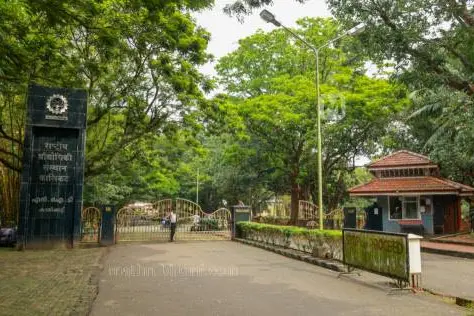
Angadipuram: The National Institute of Technology (NIT), Calicut has secured three patents for the production of eco-friendly concrete, developed by its civil engineering department.
The patent is given for Steel Fiber Reinforced Rubcrete Prestressed Concrete Railway Sleepers, Steel Fiber Reinforced Rubcrete Fencing Post, and Steel Fiber Reinforced Rubcrete Crash Barrier.The eco-friendly steel fiber-reinforced concrete developed through innovative technology will prove to be more useful for railways.
The concrete was developed by Kadungapuram native Dr. Anand Raj (postdoctoral researcher, Chulalongkorn University, Bangkok), Prof. Dr.Praveen Nagarajan (civil department, NIT, Kozhikode), and Ret. Prof. . Dr. A.P. Shashikala (civil department, NIT, Kozhikode).
Concrete reinforced with steel fibers is considered a game-changer in the manufacturing industry. 15 percent of powdered rubber is added to the sand used in the production of concrete. The rubber powder is produced from unusable tires acquired from tire retreading centers. This also reduces the pollution and waste formed by these retreading centers.
Steel fibers are also added to improve resistance to breakage and other damages. It also promises improved weatherproof technology that reduces damage caused by changing climatic conditions. With steel-reinforced rubber concrete sleepers, the railways use 14 tons of sand and 4 tons of powdered rubber per kilometer. 14 tons of powdered rubber and 0.5 sand per kilometer are used with the crash barrier. Even though the use of this concrete is considered expensive, it promises to be more efficient and long lasting.
Published: 20 Feb 2024, 03:05 pm IST
Related Topics
Disclaimer: Kindly avoid objectionable, derogatory, unlawful and lewd comments, while responding to reports. Such comments are punishable under cyber laws. Please keep away from personal attacks. The opinions expressed here are the personal opinions of readers and not that of Mathrubhumi.
