
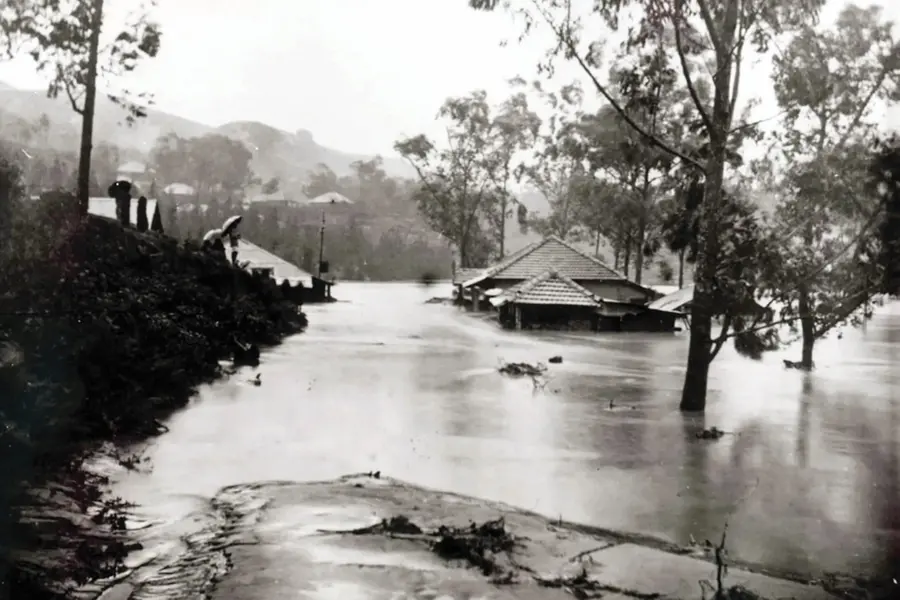
The year 2024 commemorates a hundred years since the catastrophic deluge of 1924, famously known as the 'Great Flood of '99' ( Malayalam calendar year 1099). Beginning on July 14, the relentless downpour persisted for several days, leaving an indelible mark on the region's history. Even prior to Kerala's statehood, the aftermath of this paradigm-shifting disaster remains a somber chapter, with losses and casualties that were never fully quantified.
Triggered by incessant rainfall over ten days and nights, the cyclonic conditions resulted in a staggering 64% surge in precipitation across Kochi, Travancore, and Malabar. These areas bore the brunt, witnessing hundreds of human fatalities, extensive structural damage, and the loss of countless livestock. Agricultural heartlands, including vital paddy fields and rice crops, suffered irreversible devastation.

Munnar, perched 1500 meters above sea level, recorded an unprecedented 487.5 cm of rainfall during this period, submerging the town. The iconic Kundala-Theni monorail, operational since 1902, succumbed completely to the elements. Although Munnar town was relocated a kilometre from its original site during reconstruction, the historic railway line was never reinstated.
Elsewhere, landslides wreaked havoc on the Kollam-Sengottai rail route, while the Kochi-Thrissur-Shornur road, severed in multiple places, necessitated over a month of extensive repairs.
As Kerala reflects on a century since the 'Great Flood of '99', the memories of this calamity echo through the generations, shaping enduring narratives of resilience and loss.
Published: 14 Jul 2024, 09:44 am IST
Related Topics
Disclaimer: Kindly avoid objectionable, derogatory, unlawful and lewd comments, while responding to reports. Such comments are punishable under cyber laws. Please keep away from personal attacks. The opinions expressed here are the personal opinions of readers and not that of Mathrubhumi.