
The government is likely to assign responsibility for the sand-removal process to local self-government institutions, following the system used earlier.
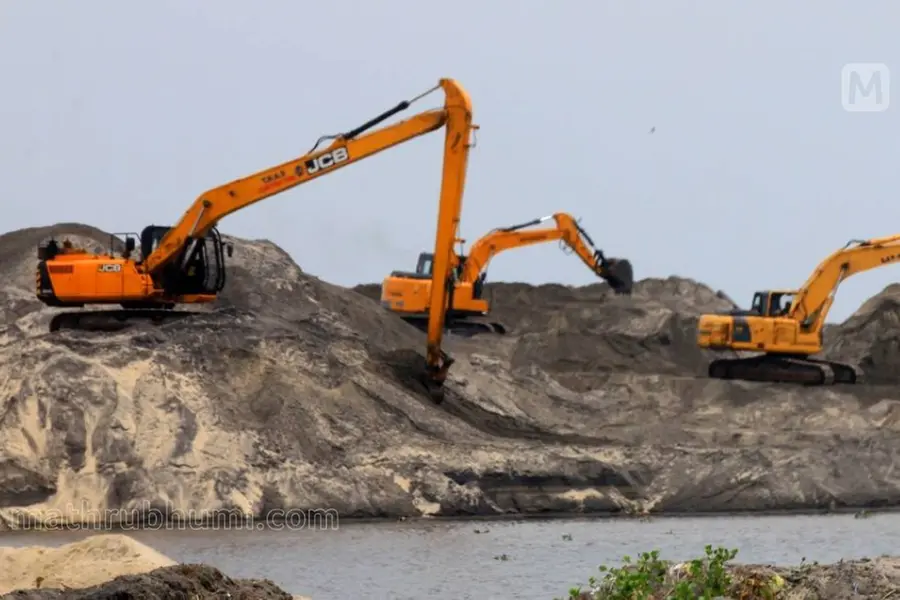
Thiruvananthapuram: The Kerala government is preparing to remove accumulated sand from 17 rivers across the state, with around 1.7 crore tonnes of sand identified as suitable for extraction in a sand audit.
The government intends to begin the process by December. Rivers flowing through Thiruvananthapuram, Alappuzha and Wayanad will not be included in the first phase. The remaining rivers that are not part of the first-phase list are expected to be considered in the next phase, as sand audits are currently being conducted there.
The government is taking up the sand-removal programme as excessive accumulation can obstruct the natural flow of rivers and reduce the depth of riverbeds. The move is also part of efforts to strengthen flood-prevention measures by anticipating the possibility of flooding.
The Revenue Department had conducted a study of sand deposits in the rivers. The proposed extraction is based on the sand audit conducted by the Council of Scientific and Industrial Research (CSIR).
The government will also have to obtain approval from the state Environment and Geology departments before the extraction begins.
The government is likely to assign responsibility for the sand-removal process to local self-government institutions, following the system used earlier.
Under the previous system, committees were formed at river ghats to oversee the extraction of sand. A decision on how the new process will be implemented is expected soon.
The government will issue detailed guidelines on the quantity of sand that can be removed and the criteria that must be followed.
Guidelines soon
Revenue Minister A.P. Anil Kumar said the guidelines would be strictly enforced.
The minister said the project was being expedited in the wake of the floods last month.
“Clear guidelines on how much can be removed and what criteria must be followed will be issued soon. Sand mining will not be allowed without following these guidelines.”
Sand deposits identified in the first phase
The figures below are based on the sand audit conducted in 2024. The first figure indicates the total sand deposit, while the figure in brackets indicates the quantity identified as suitable for extraction.
The audit found that the Achankovil River has a sand deposit of 9.42 lakh units, of which 29,742.9 cubic metres have been identified as suitable for extraction.
- The Pamba River has a total sand deposit of 42.9 lakh units, with 6.86 lakh cubic metres identified as extractable.
- The Muvattupuzha River has a sand deposit of 76.64 lakh units, while 1.75 lakh cubic metres have been identified for extraction.
- The Periyar River has a total sand deposit of 75.86 lakh units, of which 9.78 lakh cubic metres have been identified as suitable for extraction.
- The Chaliyar River has a sand deposit of 8.95 lakh units, with 5.40 lakh cubic metres identified as extractable.
- The Bharathapuzha has the largest reported sand deposit among the rivers listed, at 211.11 lakh units. Of this, 99.01 lakh cubic metres have been identified as suitable for extraction.
- The Valapattanam River has a sand deposit of 12.28 lakh units, with 58,306 cubic metres identified for extraction.
- The Sreekandapuram River has a sand deposit of 3.34 lakh units, while 85,174.60 cubic metres have been identified as extractable.
- The Perumba River has a reported deposit of 6,988.87 units, of which 9,639.74 cubic metres have been identified for extraction.
- The Chandragiri River has a sand deposit of 1.17 lakh units, with 20,019.24 cubic metres identified as suitable for extraction.
- The Uppala River has a total sand deposit of 7.82 lakh units, of which 96,751 cubic metres have been identified for extraction.
The audit has also identified a gravel deposit at Mogral.
Published: 03 Sept 2026, 08:13 am IST
Related Topics
Disclaimer: Kindly avoid objectionable, derogatory, unlawful and lewd comments, while responding to reports. Such comments are punishable under cyber laws. Please keep away from personal attacks. The opinions expressed here are the personal opinions of readers and not that of Mathrubhumi.
