
Yadav also said many protesters were aware that technologies such as facial recognition and drone surveillance could potentially identify those attending demonstrations, yet chose to participate regardless.
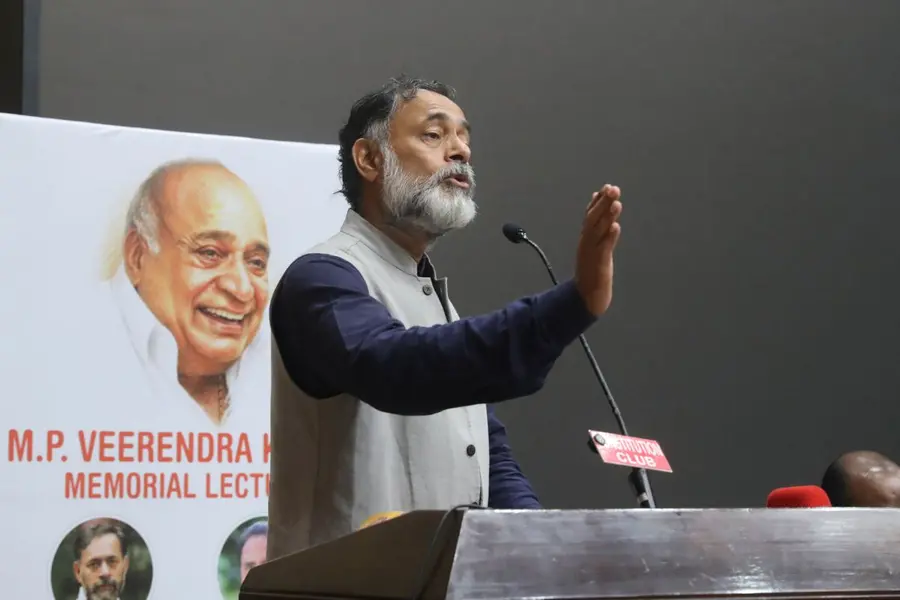
Political activist and analyst Yogendra Yadav on Wednesday described the ongoing protest at Delhi's Jantar Mantar as an "organic" and self-mobilised movement, arguing that its significance lay not in the size of the crowd but in the willingness of young people to participate despite potential risks.
His remarks came as the protest, which began on June 20 demanding Union Education Minister Dharmendra Pradhan's resignation over the alleged NEET question paper leak and other examination irregularities, entered another phase. The agitation, led by the Cockroach Janta Party (CJP) founded by Abhijeet Dipke, has continued to attract hundreds of protesters, most of them students.
https://cdn.jwplayer.com/players/usTRcwbz-dbzR9ypW.html
Yadav was delivering the keynote address at the M.P. Veerendra Kumar Memorial Lecture in New Delhi. The annual event, organised by the M.P. Veerendra Kumar Memorial Committee at the Constitution Club on Rafi Marg, was themed "Whither Opposition: From electoral politics to politics of resistance." Member of Parliament N.K. Premachandran attended as the chief guest.
ALSO READ | 'Three years ago this was impossible': Yogendra Yadav on anti-Modi anger at July 20 protest
'An organic, self-mobilised movement'
Referring to the ongoing protests at Jantar Mantar, Yadav said drone footage suggested participation had crossed one lakh people, but maintained that the character of the gathering mattered more than its size.
"This one lakh is more important than 10 lakh because these are unmobilised. This is organic. No one paid them a paisa. No one arranged buses for them," he said.
According to Yadav, most participants were young men and women who had travelled to Delhi at their own expense, with many not even informing their parents.
"This requires extraordinary self-mobilisation," he said.
Yadav also said many protesters were aware that technologies such as facial recognition and drone surveillance could potentially identify those attending demonstrations, yet chose to participate regardless.
He said the protest drew students from both elite and ordinary educational institutions across the country and highlighted the large participation of women.
"For me, that is a barometer. If you have a substantial number of women in any protest movement, then it has social acceptance," he said.
Yadav added that the movement reflected deep public sentiment, saying the anger expressed by participants towards Prime Minister Narendra Modi was unlike anything he had witnessed a few years ago.
He also noted what he described as a significant social dimension of the agitation, saying it was "led by a Dalit and inspired by an Adivasi".
Resistance beyond electoral politics
Speaking on the broader political context, Yadav said the movement should not be viewed solely through the lens of education or employment.
"We are looking at a movement which is not merely about education and employment. We are looking at the possibility of a movement which can puncture an authoritarian regime," he said.
Drawing parallels with authoritarian governments elsewhere, Yadav argued that such systems often enter a "negative spiral", where leaders become insulated from criticism, make flawed decisions and respond with increasing repression rather than acknowledging mistakes.
According to Yadav, attempts to suppress protests often produce the opposite effect by attracting greater public participation.
While he stopped short of calling the current situation the beginning of the end of what he termed "electoral autocracy", he said it illustrated the importance of the "politics of resistance" in reclaiming democratic institutions.
Published: 22 Jul 2026, 09:29 pm IST
Related Topics
Disclaimer: Kindly avoid objectionable, derogatory, unlawful and lewd comments, while responding to reports. Such comments are punishable under cyber laws. Please keep away from personal attacks. The opinions expressed here are the personal opinions of readers and not that of Mathrubhumi.
