
The Karnataka govt’s invite to Booker Prize-winning author Banu Mushtaq to inaugurate Mysuru Dussehra sparks political row as BJP questions her suitability.
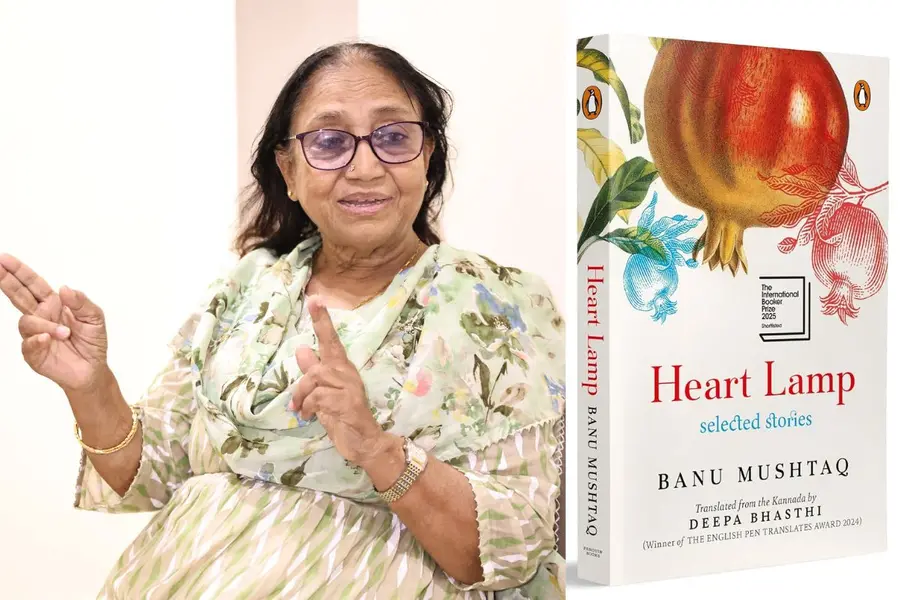
Bengaluru: The Karnataka government’s decision to invite International Booker Prize-winning author Banu Mushtaq to inaugurate the historic Mysuru Dussehra has triggered a sharp political row, with the BJP questioning her suitability for the role.
Speaking at the BJP state office in Bengaluru on Monday, state party president and MLA BY Vijayendra criticised Chief Minister Siddaramaiah’s announcement, saying, “If Banu Mushtaq accepts our Hindu culture, traditions and practices, and shows faith in them, we will welcome her”.
He argued that, along with Mushtaq, the government should also have invited Kodagu’s Deepa Bhashi, who translated her award-winning work and jointly received international recognition. “But, if she accepted our traditions, rituals or religious sentiments, it would have been a different issue. Earlier author Nisar Ahmad had inaugurated Dussehra,” Vijayendra said.
The BJP also circulated a 2023 video in which Mushtaq voiced criticism of equating Kannada with a goddess figure, claiming that such symbolism had long excluded her and her family. In the clip, she questioned, “Where should I stand? What should I look for? How should I be involved? The process of keeping me away is not a recent phenomenon; it started long ago.”
Karnataka Home Minister G. Parameshwara rejected the BJP’s objections, stressing that Mysuru Dussehra was “Nada Habba”, the festival of the land, and not confined to any religion. “Earlier, Nisar Ahmed inaugurated Dussehra. Sir Mirza Ismail served as Diwan of Mysuru. We don’t look at caste or religion while celebrating the festival. Why bring such divisions into it?” he said, adding that whether Mushtaq believed in Goddess Chamundeshwari was irrelevant.
Who is Banu Mushtaq?
Born in a small town in Karnataka, Banu Mushtaq grew up in a Muslim neighbourhood, beginning her education with Quranic studies before enrolling in a convent school where Kannada became the medium of instruction. The language later shaped her entire literary career.
She published her first short story at the age of 27, soon after her marriage. Domestic expectations, episodes of postpartum depression and personal struggles became recurring themes in her work. In interviews, she has spoken of moments of despair, including one instance of attempting self-immolation, which she later linked to postpartum depression.
Mushtaq went on to work as a journalist with a Kannada tabloid before training as a lawyer, while continuing to write. Her association with the 'Bandaya' (Rebel) literary movement gave her a strong voice against social and gender injustices. She drew attention to issues such as women’s right to pray in mosques and questioned conservative diktats within her community.
Her outspoken views drew backlash, and in 2000, she faced threats and a fatwa, as well as an attempted attack. Despite these challenges, she built a formidable literary career, winning the Karnataka Sahitya Academy Award and the Daana Chintamani Attimabbe Award, among others.
With 'Heart Lamp' winning the International Booker Prize, Mushtaq has not only brought global recognition to Kannada literature but also emerged as one of the most powerful contemporary voices on identity, gender and social justice.
(With inputs from IANS)
Published: 25 Aug 2025, 06:44 pm IST
Related Topics
Disclaimer: Kindly avoid objectionable, derogatory, unlawful and lewd comments, while responding to reports. Such comments are punishable under cyber laws. Please keep away from personal attacks. The opinions expressed here are the personal opinions of readers and not that of Mathrubhumi.
