
India’s SSBN programme both reflects and reinforces this environment, signaling strategic autonomy to partners, deters coercion, and gives New Delhi leverage in maritime security dialogues and Indian Ocean Region partnerships.
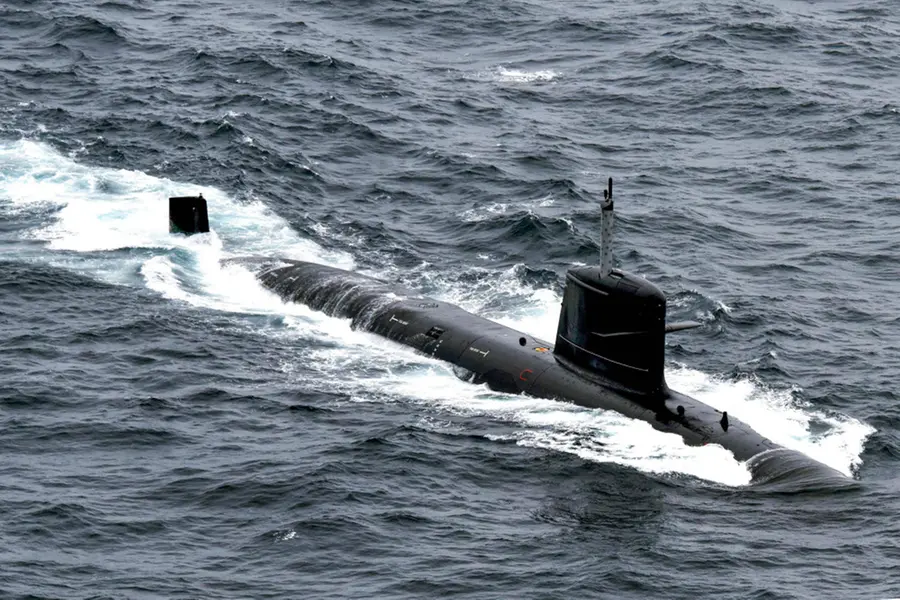
New Delhi: India is set to significantly enhance its maritime deterrence with the induction of the S5 SSBN, a next-generation, large-displacement nuclear-powered ballistic missile submarine designed to safeguard vital sea lanes amid growing regional security challenges, particularly from China and Pakistan.
The S5-class submarines mark a major leap in India’s sea-based nuclear deterrent, with each vessel expected to displace around 13,500 tonnes, substantially larger and more capable than the existing Arihant-class submarines.
According to reports, construction of the S5 programme began in late 2025, with plans to build at least four submarines. The fleet is intended to ensure continuous at-sea deterrence, allowing at least one SSBN to remain on patrol at all times by the early 2030s.
Part of the Indian Navy’s plan to expand its fleet significantly by 2035, the submarine is designed to provide a survivable sea‑based second‑strike and to underpin New Delhi’s blue‑water ambitions.
Beyond deterrence, S5s strengthen India’s blue water reach, complicating adversary naval planning and supporting maritime diplomacy across the Indian Ocean Region.
Blue water reach refers to the Indian Navy's capabilities to protect human, vessels, cargo, among other assets, beyond its shores, and can operate across the deep oceans beyond the Indian Ocean Region.
Thus, a blue water navy is capable of sustained operations across the open seas, which includes long-distance deployments, amphibious warfare, maritime strike capabilities, and global presence.
Indian Navy’s operational area is spread across the waters from the Persian Gulf to the Malacca Strait on one side, and from the Bay of Bengal to the Indian Ocean, up to Africa’s east coast.
A key concern in these parts is the combined naval capabilities of China and Pakistan. The submarines will feature advanced stealth technologies and a 190 MW Pressurised Water Reactor (PWR), developed indigenously by the Bhabha Atomic Research Centre (BARC).
These are expected to be armed with up to 12 K6 submarine-launched ballistic missiles, each capable of carrying multiple independently targetable reentry vehicles (MIRVs).
The submarines are currently being developed for the Indian Navy and this is a critical step towards future blue water navy allowing it to go head-to-head with China’s People’s Liberation Army Navy, even far from India’s coastlines.
South Asia’s diplomatic landscape has grown more securitised and multipolar. India’s expanding military capabilities, including S5 development, occur alongside shifting alignments, rising China‑Pakistan cooperation, and variable relations with other neighbours that have at times moved away from New Delhi’s orbit.
India’s SSBN programme both reflects and reinforces this environment, signaling strategic autonomy to partners, deters coercion, and gives New Delhi leverage in maritime security dialogues and Indian Ocean Region partnerships.
With a blue water navy, India can go deeper and further, unlike a green water navy that sticks closer to its home coast.
With a blue water navy, therefore, the country can operate far out in the open ocean, even over for long periods. Apart from underwater power, this means other additions to the Defence forces, including aircraft carriers, other naval vessels, and all the logistical support required to supply operational requirements on such long journeys. Essentially, it is an extension of India’s power across the vast waters, controlling key areas far from home. IANS
Published: 08 Jan 2026, 08:19 pm IST
Related Topics
Disclaimer: Kindly avoid objectionable, derogatory, unlawful and lewd comments, while responding to reports. Such comments are punishable under cyber laws. Please keep away from personal attacks. The opinions expressed here are the personal opinions of readers and not that of Mathrubhumi.
