
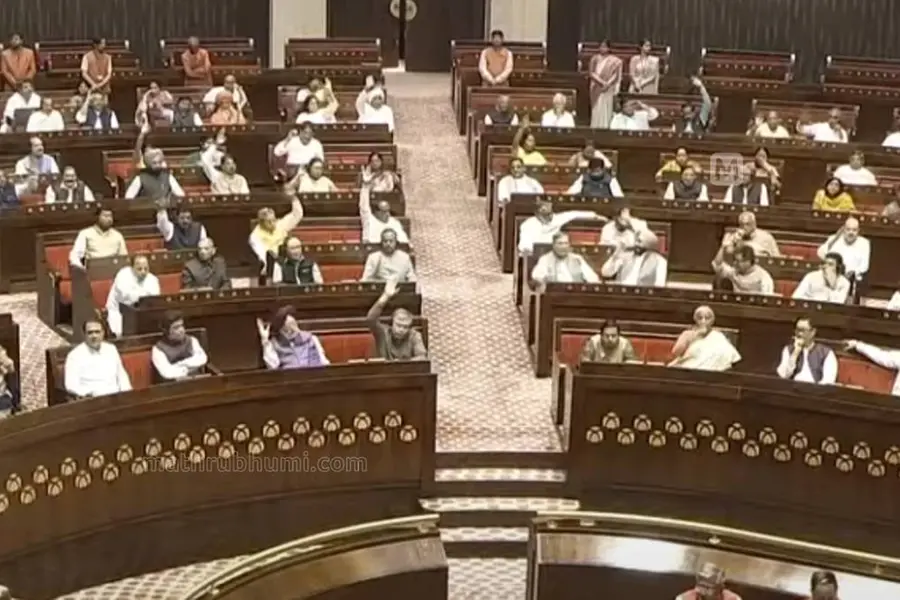
New Delhi: Parliament on Friday approved the Waqf (Amendment) Bill, 2025, following an intense debate of over 13 hours in the Rajya Sabha. The Bill, already passed in the Lok Sabha on Thursday, received 128 votes in favour and 95 against in the Upper House. In the Lower House, it was backed by 288 members while 232 opposed it.
Opposition parties described the legislation as “anti-Muslim” and “unconstitutional,” while the government maintained that it was a “historic reform” meant to benefit the minority community.
Parliament also passed the Mussalman Wakf (Repeal) Bill, 2025, which had previously been cleared by the Lok Sabha.
Government defends inclusion of non-Muslims on Waqf Board
Union Minority Affairs Minister Kiren Rijiju, participating in the debate, alleged that the Congress and other opposition parties were “scaring the Muslim community.” He said, “The Waqf Board is a statutory body and, as such, like all government bodies, it should be secular.”
Rijiju clarified that the inclusion of a few non-Muslims on the Board—four out of 22 members—would not alter its decisions but would “add value.” He added that the Bill incorporated several suggestions from the Joint Parliamentary Committee (JPC) and stakeholders.
He also accused opposition parties of having failed the Muslim community during their decades in power, stating, “For 60 years, the Congress and others ruled the country but did not do much for the welfare of Muslims, who continue to remain poor.”
Opposition slams Bill as anti-constitutional and discriminatory
Opposition parties under the INDIA bloc strongly opposed the legislation, alleging that it aimed to seize Muslim-owned properties and hand them over to corporations. They demanded the Bill's withdrawal, accusing the government of acting with “mala fide intentions.”
Congress president and Leader of Opposition Mallikarjun Kharge warned that the Bill could sow seeds of conflict and disturb communal harmony. “The legislation is unconstitutional and not good for Indian Muslims,” Kharge said.
Congress MP Syed Naseer Hussain called the Bill “unconstitutional” and claimed it was an attempt to polarise society. RJD’s Manoj Jha said the Bill reflects “dog whistle politics,” while Samajwadi Party’s Ram Gopal Yadav urged respect for all religions and warned against India turning into a “totalitarian state.”
Concerns over secularism and women's rights
CPI(M)’s John Brittas called the Bill “an attack on the Constitution,” alleging it violated the principles of secularism and equality. YSRCP’s Y V Subba Reddy echoed the sentiment, calling it “unconstitutional.”
Congress member Abhishek Singhvi said the legislation omits the concept of 'Waqf by user,’ thereby reducing protection for Waqf properties while increasing government control.
Independent MP Kapil Sibal argued that the Bill restricts non-Muslims from forming Waqf Boards, unlike earlier provisions. He also called for broader reforms, saying, “Bring a law to ensure that women have rights in bequeathing property.”
Mixed reactions from regional parties
BJD MP Muzibulla Khan acknowledged concerns about non-Muslim inclusion, while party colleague Sasmit Patra noted no whip was issued and MPs voted independently. DMK’s Tiruchi Siva categorically rejected the Bill, terming it “legally flawed, constitutionally indefensible and morally reprehensible.”
AAP MP Sanjay Singh alleged that the Bill seeks control over Muslim religious institutions and warned it could set a precedent for targeting other communities, including Sikhs, Christians, and Jains.
Shiv Sena (UBT) MP Sanjay Raut questioned the government’s motivations, saying, “Why is the government so worried about poor Muslims?” and accused the NDA of deflecting attention from international issues, notably US President Donald Trump's announcement of reciprocal tariffs on India.
Published: 04 Apr 2025, 06:08 am IST
Related Topics
Disclaimer: Kindly avoid objectionable, derogatory, unlawful and lewd comments, while responding to reports. Such comments are punishable under cyber laws. Please keep away from personal attacks. The opinions expressed here are the personal opinions of readers and not that of Mathrubhumi.
