
The Lok Sabha on Thursday passed the Viksit Bharat–Guarantee for Rozgar and Ajeevika Mission (Gramin) Bill, 2025, amid sharp Opposition protests, before adjourning proceedings till Friday.
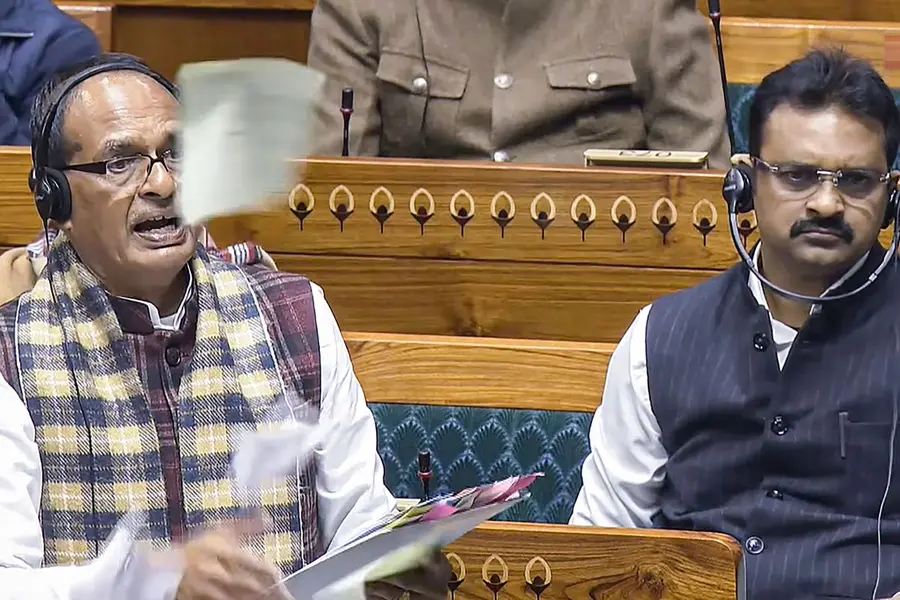
New Delhi: The Lok Sabha on Thursday passed the Viksit Bharat–Guarantee for Rozgar and Ajeevika Mission (Gramin) Bill, 2025 (VB–G RAM G Bill), marking a major restructuring of rural employment and livelihood programmes and effectively replacing the 20-year-old Mahatma Gandhi National Rural Employment Guarantee Act (MGNREGA).
The passage of the Bill followed a packed and contentious sitting of Parliament, with Opposition members staging protests and tearing copies of the legislation inside the House. Soon after the Bill was cleared, the Lok Sabha was adjourned till Friday, December 19.
Proceedings in both Houses of Parliament began at 11 am on Thursday, a day after an intense sitting in which multiple key Bills were passed amid sharp exchanges between the government and the Opposition.
While Thursday’s agenda included discussions on airline disruptions and air pollution, the focus in the Lok Sabha remained firmly on the VB–G RAM G Bill, which was taken up for consideration and passage.
The Bill was debated for more than eight hours, with the Lok Sabha sitting till midnight on Wednesday. Union Rural Development and Agriculture Minister Shivraj Singh Chouhan defended the proposed law, stating that it would guarantee 125 days of rural employment, strengthen livelihoods, and help make villages self-reliant.
Countering allegations of arbitrary renaming, Chouhan argued that employment guarantee schemes existed even before NREGA and claimed that Mahatma Gandhi’s name was added to the law ahead of the 2009 elections.
Chouhan also highlighted what he described as structural flaws in MGNREGA, alleging that several states spent disproportionately on wages while under-allocating funds for materials, affecting asset creation. The government maintained that the new framework would address these gaps while expanding employment opportunities in rural areas.
The Opposition, however, mounted a fierce attack on the Bill. Congress president Mallikarjun Kharge accused the Centre of diluting the Right to Work by ending the demand-driven nature of MGNREGA, alleging that the new law would allow the government to deny employment by claiming a lack of demand.
TMC MP Mahua Moitra and other Opposition leaders argued that the Bill dismantles a crucial social security net for rural India.
Congress MP KC Venugopal urged the Speaker to refer the Bill to a Standing Committee or a Joint Parliamentary Committee for detailed scrutiny. The Speaker declined the request, noting that the legislation had already been debated extensively.
As protests intensified, Opposition MPs raised slogans and tore copies of the Bill, prompting repeated interruptions before the government pushed it through.
Meanwhile, legislative activity continued on other fronts. Finance Minister Nirmala Sitharaman introduced the Securities Markets Code Bill, 2025, proposing to consolidate laws governing securities markets, even as Opposition MPs raised concerns over the concentration of powers.
Sitharaman said the government was open to referring the Bill to a Standing Committee.
Rajya Sabha:
In the Rajya Sabha, the Sustainable Harnessing and Advancement of Nuclear Energy for Transforming India Bill, 2025 (SHANTI Bill) remained listed for consideration, while discussions during Question Hour touched upon cancer care infrastructure, essential medicines, and vaccines.
Parliament is also set to take up a short-duration discussion on air pollution later in the day, amid growing concerns over deteriorating air quality in the national capital and adjoining regions. With the VB–G RAM G Bill now passed, attention is expected to shift to environmental and public health issues when the House reconvenes.
Published: 18 Dec 2025, 10:38 am IST
Related Topics
Disclaimer: Kindly avoid objectionable, derogatory, unlawful and lewd comments, while responding to reports. Such comments are punishable under cyber laws. Please keep away from personal attacks. The opinions expressed here are the personal opinions of readers and not that of Mathrubhumi.
