
Toxic froth blankets Delhi’s Yamuna at Kalindi Kunj, worsening water quality and threatening river ecology.
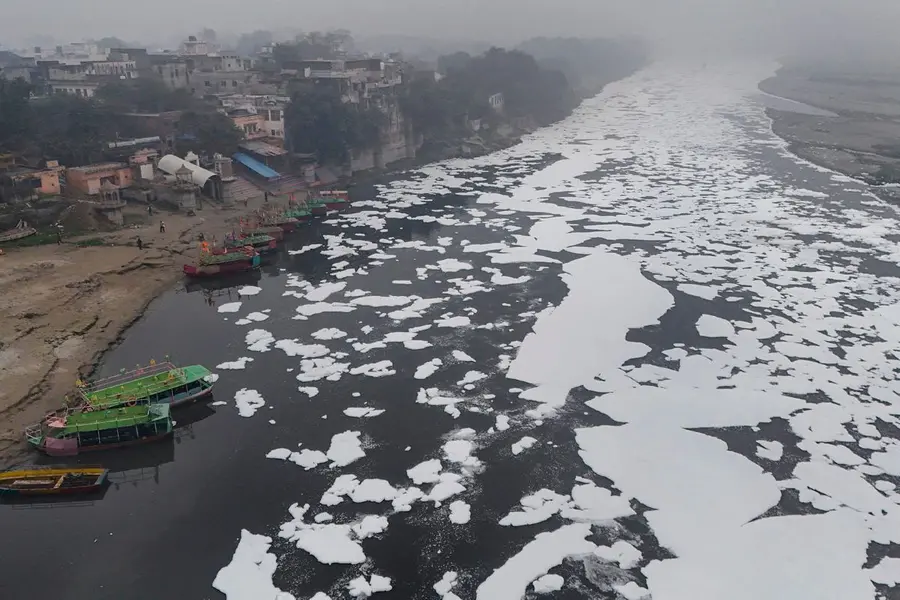
New Delhi: A dense layer of toxic froth has resurfaced along the Yamuna at Kalindi Kunj ghat in Delhi, covering large stretches of the river and affecting its visibility, experts said. The froth clings to boats along the riverbank and contains embedded dust particles, while garbage including plastics, discarded bottles, flowers, chopped hair and even blades litters the banks.
Environmentalist Pankaj Kumar, who organises weekly cleanliness drives at Kalindi Kunj, observed that water pollution has worsened in December and January compared to levels before the Chhath festival in October. "During the Chhath festival, there was a strong collective effort to clean the Yamuna river; had the government sustained that momentum, the condition of the river would've vastly improved in months," he told PTI.
The latest Delhi Pollution Control Committee (DPCC) report, based on samples collected on December 3, 2025, recorded Biological Oxygen Demand (BOD) levels at 25 mg/l at ITO Bridge, 24 mg/l at ISBT Bridge and 17 mg/l at Okhla Barrage, far exceeding the safe limit of 3 mg/l. Fecal coliform bacteria levels were also alarming, with 92,000 MPN at ISBT Bridge, 54,000 MPN at Nizamuddin Bridge and 35,000 MPN at ITO Bridge, against the desirable limit of 500 units per 100 ml.
The National Green Tribunal (NGT) highlighted that untreated and partially treated sewage discharged through various drains, particularly between Wazirabad Barrage and Asgharpur village, is the primary cause of the river’s pollution.
Volunteers and environmentalists warn that the froth poses health hazards and disrupts the river’s ecosystem. Vishwas Dwivedi of the 'Earth Warriors' group explained that the froth blocks sunlight, preventing aquatic plants from filtering pollutants naturally, which further deteriorates water quality.
Atul Kumar, another volunteer, noted that public awareness is low and government enforcement remains weak. He stressed that stricter monitoring and proper signage are urgently needed to prevent waste dumping into the river. While regulations exist and fines of Rs 5,000 are imposed under the "polluter pays" principle, violations continue largely unchecked.
PTI
Published: 12 Jan 2026, 08:40 am IST
Related Topics
Disclaimer: Kindly avoid objectionable, derogatory, unlawful and lewd comments, while responding to reports. Such comments are punishable under cyber laws. Please keep away from personal attacks. The opinions expressed here are the personal opinions of readers and not that of Mathrubhumi.
