
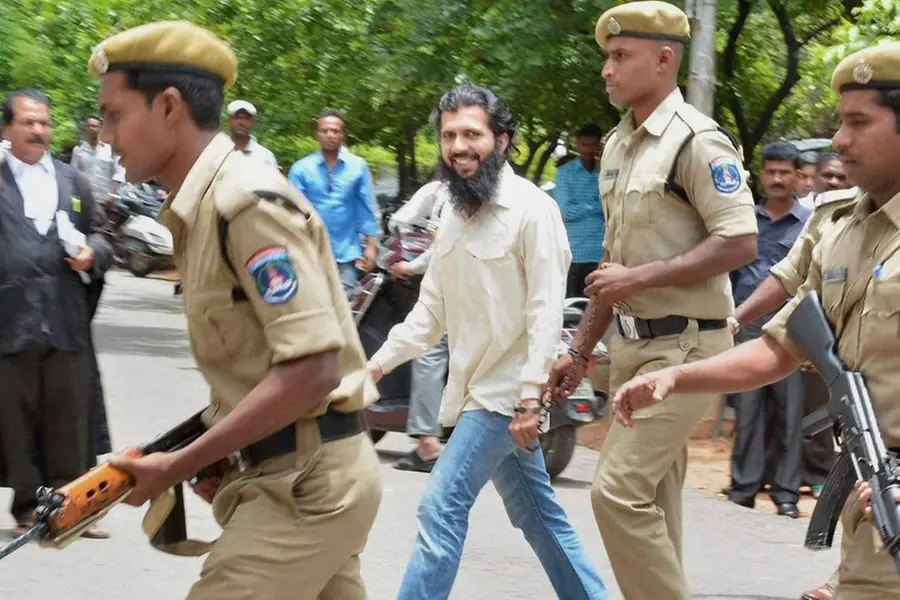
Hyderabad: The Telangana High Court on Tuesday upheld the death sentence handed down by a trial court to five individuals convicted for their role in the twin bomb blasts in Dilsukhnagar, Hyderabad, on 21 February 2013, which killed 18 people and injured 131 others.
In 2016, a special fast-track court of the National Investigation Agency (NIA) at Charlapalli jail had convicted the five accused and sentenced them to death by hanging under strict anti-terror laws. The five convicted men are Ahmad Siddibappa Zarar, alias Yasin Bhatkal; Asadullah Akhtar, alias Haddi; Tahseen Akhtar; Zia-ur-Rahman, alias Waqas; and Aijaz Shekh.
Yasin Bhatkal, the co-founder of the banned Indian Mujahideen (IM), was among those convicted. The prime suspect in the case, Mohammed Riaz Bhatkal, remains at large and is believed to be hiding in Pakistan. A red corner notice has been issued for his arrest.
The NIA court had found the crime to be one of the “rarest of rare” and sentenced the accused to death on 19 December 2016, following their conviction. The five individuals had challenged their convictions and filed a criminal appeal in the high court.
On Tuesday, a bench comprising Justice K. Laxman and Justice P. Srisudha upheld the NIA court’s verdict, citing the severity of the crime and the credibility of the evidence presented.
The blasts, which occurred at Dilsukhnagar, a busy area of Hyderabad, gained nationwide attention. The first blast, occurring near a roadside kiosk selling chilli bajjis at around 7 pm, was followed by a second explosion two minutes later at the nearby Dilsukhnagar bus stand. Both bombs, placed in tiffin boxes and hung from bicycles, were improvised explosive devices (IEDs).
CCTV footage from nearby traffic signals showed the movement of five individuals near the scene, although their faces were not clearly identifiable. Initial investigations were carried out by the Saroornagar and Malakpet police stations, but the cases were later transferred to the NIA at the request of the Union Ministry of Home Affairs.
At the time, then-Union Home Minister Sushil Kumar Shinde had revealed intelligence reports indicating that Pakistan-based terrorist groups could be involved, although no specific information about the location of the attacks was available.
The breakthrough in the case came after the arrests of Yasin Bhatkal and Asadullah Akhtar at the Bihar-Nepal border. Subsequently, their associates, Tahseen Akhtar and Zia-ur-Rehman, were arrested from the Bihar and Pakistan borders, respectively, in 2014. Aijaz Sheikh was arrested in Pune.
Yasin Bhatkal is currently serving time in Tihar Jail, Delhi, for his involvement in a 2008 blast in the capital. The other four convicted men were also identified as operatives of the Indian Mujahideen.
Notably, the Dilsukhnagar blasts occurred near the famous Saibaba temple, where a previous terrorist attack in 2002 had claimed two lives and injured 15 others.
Published: 09 Apr 2025, 05:52 pm IST
Disclaimer: Kindly avoid objectionable, derogatory, unlawful and lewd comments, while responding to reports. Such comments are punishable under cyber laws. Please keep away from personal attacks. The opinions expressed here are the personal opinions of readers and not that of Mathrubhumi.
