
Rapping interim applicants for speaking outside court, the Supreme Court has frozen its earlier Aravalli mining verdict and expert panel recommendations.
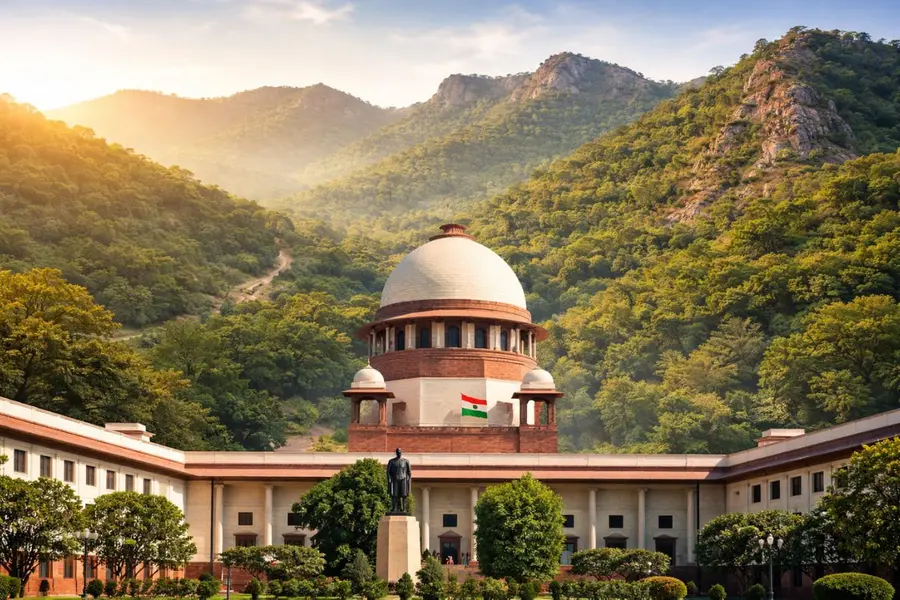
In a significant development in the Aravalli protection case, the Supreme Court on Monday stayed its earlier verdict that declined to impose a complete ban on mining in the Aravalli region, and placed the expert committee’s recommendations redefining the Aravalli Hills and Ranges in abeyance.
A three-judge Special Vacation Bench headed by Chief Justice of India Surya Kant took suo motu cognisance of the issue and made it clear that both the committee’s recommendations and the subsequent findings of the Supreme Court will remain in abeyance until further orders.
Making sharp oral observations during the hearing, the CJI expressed displeasure over the conduct of interim applicants.
“These IA people are filing IAs and then going out and speaking. We don’t appreciate this,” the Chief Justice remarked, adding that the order has now been kept in abeyance. Formally recording the direction, the bench said:
“We direct that the recommendations of the committee and the findings of the Supreme Court thereafter shall remain in abeyance till then.”
The court further ordered that the case will be taken up for detailed hearing on January 21, 2026, giving all stakeholders time to place their submissions on record.
The stay effectively halts the implementation of the November verdict, in which the apex court had accepted the recommendations of a committee constituted by the Ministry of Environment, Forest and Climate Change (MoEFCC). The panel had defined an ‘Aravalli Hill’ as any landform with an elevation of 100 metres or more above local relief, and an ‘Aravalli Range’ as two or more such hills located within 500 metres of each other.
Environmental groups had strongly opposed the ruling, warning that the height-based definition could exclude several ecologically crucial hillocks and forested areas, thereby weakening protections and enabling renewed mining activity in fragile zones across Rajasthan, Haryana, Gujarat and Delhi.
By keeping the verdict and expert panel recommendations in abeyance, the Supreme Court has effectively maintained status quo in the Aravalli region, signalling that the matter requires deeper judicial scrutiny due to its long-term environmental implications.
The January hearing is now expected to be crucial in determining whether stricter safeguards — including a comprehensive mining ban — are necessary to protect one of India’s oldest and most vulnerable mountain ecosystems.
Published: 29 Dec 2025, 12:44 pm IST
Related Topics
Disclaimer: Kindly avoid objectionable, derogatory, unlawful and lewd comments, while responding to reports. Such comments are punishable under cyber laws. Please keep away from personal attacks. The opinions expressed here are the personal opinions of readers and not that of Mathrubhumi.
