
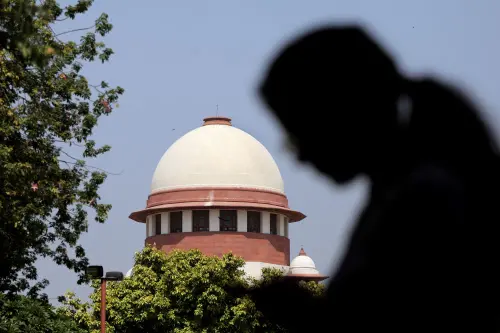
New Delhi: The Supreme Court, led by Chief Justice D Y Chandrachud, on Wednesday deferred the hearing on pleas challenging the immunity granted to husbands in cases of marital rape by four weeks. The CJI, who is set to retire on November 10, indicated that it would be difficult to conclude the case before his departure.
A bench comprising the CJI and Justices JB Pardiwala and Manoj Misra, which began hearing the case on October 17, asked the lawyers how much time they would need for their arguments. Senior advocate Gopal Sankaranarayanan, representing one of the parties, said he would require at least a day to complete his submissions due to the complexity of the issue.
Solicitor General Tushar Mehta, appearing for the Centre, and senior advocates Rakesh Dwivedi, representing Maharashtra, and Indira Jaising, representing a woman petitioner, also requested a day each to present their arguments.
With the Supreme Court set to close for the Diwali vacation on October 26 and reopening on November 4, the CJI noted that only five working days would be available before his retirement. Given the time estimates, the court acknowledged that it would not be possible to conclude the hearings within that timeframe and scheduled the case for further hearing before another bench in four weeks.
Sankaranarayanan expressed regret over the delay, stating, "We wanted to continue here." Solicitor General Mehta, meanwhile, argued that while marriage does not eliminate the concept of sexual consent, criminalising marital rape would require careful consideration of various perspectives.
Senior advocate Karuna Nundy, representing a petitioner, highlighted the urgency of the matter, stating that it affects millions of women across the country. She urged the CJI to proceed with the hearing, praising his legacy of delivering significant judgments.
On October 17, the bench had agreed to rule on the constitutional validity of the Indian Penal Code (IPC) and Bharatiya Nyaya Sanhita (BNS) provisions that grant immunity to husbands in cases of marital rape, as long as the wife is not a minor.
The CJI sought the petitioners' views on the Centre's argument that criminalising such acts could severely impact conjugal relationships and disrupt the institution of marriage.
Under the now-repealed IPC Section 375 exception, and the new BNS exception 2 to Section 63, a husband's sexual acts with his wife, provided she is not under 18, do not constitute rape. The Supreme Court had previously sought the Centre’s response on a batch of petitions challenging this provision, which protects husbands from prosecution for forced sexual intercourse with their adult wives.
One of the petitions originated from a split verdict delivered by the Delhi High Court on May 11, 2022. Justice Rajiv Shakdher, who headed the division bench, found the marital rape exception "unconstitutional" and called for its removal, stating that it would be "tragic" if a married woman's call for justice remained unheard after 162 years since the enactment of the IPC. However, Justice C Hari Shankar disagreed, deeming the exception constitutional based on intelligible differentia, a principle that distinguishes groups for legal purposes.
Another plea relates to a Karnataka High Court ruling from March 2022, which allowed the prosecution of a man accused of raping his wife. The court held that exempting husbands from rape and unnatural sex allegations violated Article 14 (equality before the law) of the Constitution.
These public interest litigations (PILs) challenge the constitutionality of the marital rape exception under Section 375 of the IPC, arguing that it discriminates against married women who are sexually assaulted by their husbands.
Published: 23 Oct 2024, 05:15 pm IST
Related Topics
Disclaimer: Kindly avoid objectionable, derogatory, unlawful and lewd comments, while responding to reports. Such comments are punishable under cyber laws. Please keep away from personal attacks. The opinions expressed here are the personal opinions of readers and not that of Mathrubhumi.
