
The controversy began after students at NALSAR wrote to the university protesting against the invitation extended to CJI Surya Kant to attend their convocation as chief guest
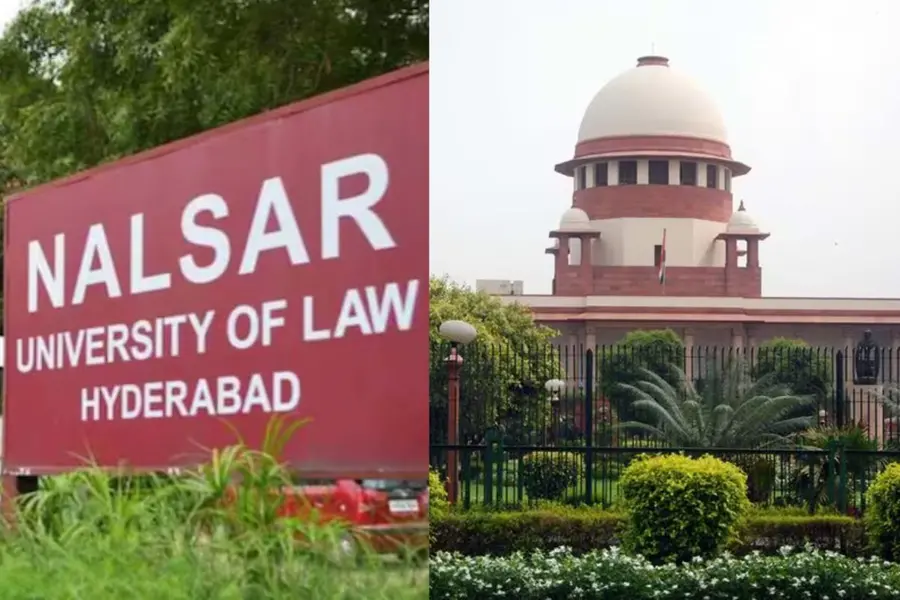
New Delhi: The Supreme Court on Thursday ruled that the Bar Council of India (BCI) has no legal authority to take disciplinary action against law students before they enrol as advocates.
A Bench comprising Chief Justice of India Surya Kant, Justice Joymalya Bagchi and Justice V Mohana made the observation while hearing a petition challenging the BCI's now-withdrawn decision to stop the 2026 batch of students at NALSAR University of Law, Hyderabad, from enrolling as advocates.
Also Read

The Court said the Advocates Act, 1961, which establishes the BCI, does not give the council the power to regulate or discipline students pursuing legal education.
"Such power is vested in the university or educational institution in which the students are enrolled," the Court said.
The BCI can prescribe and enforce standards of legal education within the limits of the law, the Court clarified. However, it cannot take disciplinary action against students.
Chief Justice Surya Kant said the BCI's authority over a law graduate begins only after the person enrols as an advocate.
"As far as the conduct of law students is concerned, the Bar Council of India has neither jurisdiction nor statutory competence," the CJI observed.
He said such matters fall within the domain of the university or educational institution.
"After a student graduates and registers himself or herself as an advocate, the Bar Council comes into the picture. It is then the statutory authority responsible for regulating advocates. But none of these students had enrolled as advocates," he said.
Justice Bagchi also pointed out that a university could, in certain circumstances, allow a student to continue their legal education even if they had been involved in an act involving moral turpitude.
"The Bar Council can certainly examine, at the stage of enrolment, whether the conditions precedent for enrolment have been satisfied," he said.
However, the judge made it clear that deciding whether a student should continue their legal education was a matter for the university.
"The Bar Council cannot impose a caveat in advance that the student will not be enrolled as an advocate upon graduation," Justice Bagchi said.
Court declares BCI action without jurisdiction
As the BCI had already withdrawn its circulars against the NALSAR students, the Supreme Court closed the matter. However, it declared that the original communication issued on August 13, 2026, and the subsequent modified communications were issued without jurisdiction.
The Court also made absolute its earlier direction that the BCI could not take punitive action against NALSAR, its students or faculty, or any other national law university.
The controversy began after students at NALSAR wrote to the university protesting against the invitation extended to CJI Surya Kant to attend their convocation as chief guest.
The students objected to the invitation over what they described as the CJI's alleged inaction in relation to claims of police brutality during recent protests at Jantar Mantar.
They said they were uncomfortable receiving their degrees from a dignitary whose recent public conduct, in their view, appeared dismissive of serious allegations of police brutality against protesters.
The students' representation referred to an incident on July 22, when a lawyer sought an urgent hearing before a Bench led by the CJI on the alleged police action.
The CJI had reportedly told the counsel, "Don't waste our time, and don't waste your time."
When the lawyer offered to show video evidence of the alleged police action, the CJI reportedly responded that the Court was not interested in watching videos.
The representation was initially signed by around 70 students from the outgoing 2026 batch. Around 380 students from the 2027 to 2031 batches later extended their support.
BCI initially threatened to block enrolment
Following the students' campaign, the BCI issued a circular stating that the entire 2026 NALSAR batch would be barred from enrolment as advocates.
The council also alleged that some academic staff had engaged in "groupism and dirty politics" and had misled and mobilised students.
Within hours, however, the BCI issued another circular reversing its decision to halt the students' enrolment. It retained a proposal to investigate those who had allegedly initiated, organised or mobilised the campaign against the CJI's invitation.
The BCI also sought an inquiry report from NALSAR.
NALSAR Vice-Chancellor Prof Srikrishna Deva Rao subsequently said the university would first examine whether such an inquiry was permitted under its governance regulations.
Following widespread criticism, the BCI eventually closed the proceedings and informed NALSAR that no further action was required.
Petitioners seek accountability
The circulars were later challenged before the Supreme Court.
Senior Advocate K Parameshwar, appearing for the petitioners, urged the Court to examine the circumstances in which the BCI communications were issued.
He questioned whether the BCI had held any meetings before issuing the circulars and asked who had authorised the decision and under what provision of law.
"This is a question of freedom of speech and expression in a university. It is not about just one student. It is about banning freedom of speech and expression across an entire university," Parameshwar submitted.
He also urged the Court to make clear that the BCI had no statutory power to regulate the conduct of students.
BCI Chairman and Senior Advocate Manan Kumar Mishra pointed out that the decision had already been withdrawn and the proceedings closed.
CJI Kant, however, observed that the withdrawal appeared to reflect a realisation that the BCI had made a mistake.
"We expect everyone to act responsibly," the CJI said, adding that the withdrawal suggested that "a mistake, if not a blunder, had been committed".
Parameshwar then requested a specific clarification that disciplinary authority over law students rests with their educational institutions.
The CJI agreed, while making it clear that students' freedom is not unlimited.
"Of course, students have freedom, but it cannot be unbridled freedom," CJI Kant said.
Published: 03 Sept 2026, 02:34 pm IST
ABOUT THE AUTHOR
Related Topics
Disclaimer: Kindly avoid objectionable, derogatory, unlawful and lewd comments, while responding to reports. Such comments are punishable under cyber laws. Please keep away from personal attacks. The opinions expressed here are the personal opinions of readers and not that of Mathrubhumi.