
The Supreme Court reiterated that “bail is the rule and jail is the exception,” linking it directly to constitutional protections under Articles 21 and 22
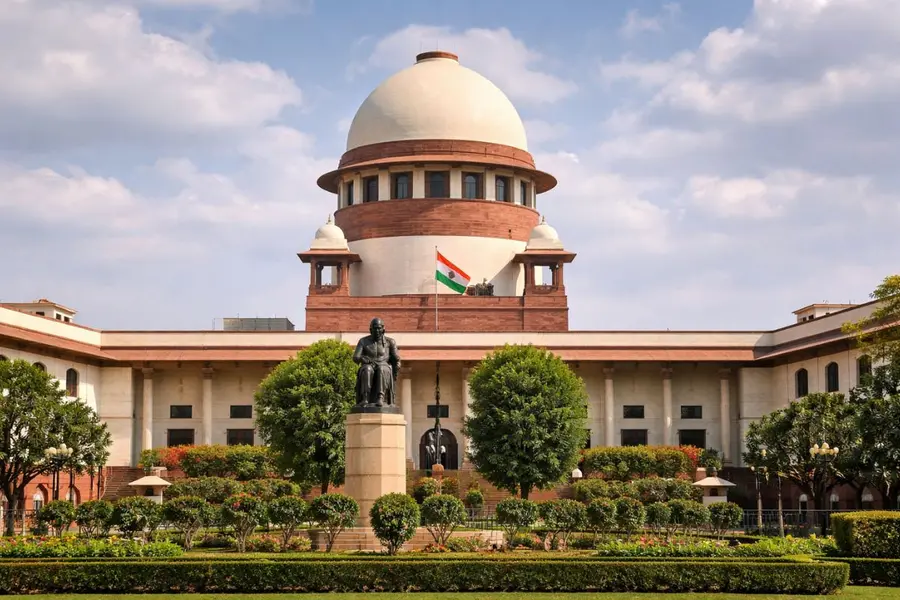
New Delhi: The Supreme Court on Monday underlined that the principle that “bail is the rule and jail is the exception” is not a mere statutory phrase, while also expressing reservations over its January 5 judgment that had denied bail to activists Umar Khalid and Sharjeel Imam in the 2020 Delhi riots conspiracy case.
‘Bail is rule, jail is exception’ not an empty slogan
A bench comprising Justices B V Nagarathna and Ujjal Bhuyan made the observation while granting bail to Handwara resident Syed Iftikhar Andrabi in a narco-terror case being investigated by the National Investigation Agency (NIA). The court said it had “serious reservations” about the reasoning adopted by another bench of the apex court in the earlier order.
On January 5, a separate bench of Justices Aravind Kumar and N V Anjaria had refused bail to Umar Khalid and Sharjeel Imam in the Delhi riots conspiracy case, while allowing them to move fresh bail applications after one year following the examination of protected witnesses.
Concerns over earlier judicial reasoning
In its order delivered on Monday, Justice Bhuyan criticised aspects of the January 5 ruling, particularly the restriction that prevented the accused from seeking bail for a year.
He noted that the earlier judgment did not properly apply the ruling in the K A Najeeb case, which recognised prolonged trial delays as a valid ground for granting bail under the Unlawful Activities (Prevention) Act (UAPA), even overriding statutory restrictions under Section 43D(5).
“We have serious reservations on various aspects of the judgment in the Gulfisha Fatima case, including foreclosing the right of the two appellants to seek bail for a period of one year,” the bench observed.
The court added that the interpretation of Najeeb in the earlier ruling appeared to limit its scope excessively, weakening its established legal effect.
Constitutional basis of bail jurisprudence
The bench reiterated that the principle of “bail is the rule and jail is the exception” flows from constitutional protections under Articles 21 and 22, and is rooted in the presumption of innocence, which it described as fundamental to a rule-of-law society.
“It is this hollowing out of the import of the observations in the Najeeb case that we are concerned with,” the court said, adding that while laws like the UAPA may regulate bail conditions in national security cases, they cannot overturn constitutional protections related to liberty.
It further clarified that the restrictions under Section 43D(5) of the UAPA must operate within the boundaries of constitutional guarantees and cannot be applied in a way that nullifies them.
“Even under the UAPA, ‘bail is the rule and jail is the exception’; of course, in an appropriate case, bail can be denied having regard to the facts of that particular case,” the bench stated.
Criticism of earlier Supreme Court precedent
The court also disapproved of a 2024 judgment in Gurwinder Singh vs Union of India, stating that it had failed to apply the principles laid down in the Najeeb case.
The bench emphasised that Najeeb is binding precedent and must be followed by all courts, including lower courts and smaller benches of the Supreme Court itself.
“In our view, the decision in the Gurwinder case, inasmuch as it refuses to be bound by Najeeb, is difficult to be followed by us as a matter of precedent,” it said.
It further stressed that judicial discipline requires that a bench of lesser strength either follows binding precedent or refers the matter to a larger bench in case of disagreement.
Background of Syed Iftikhar Andrabi case
Syed Iftikhar Andrabi had challenged a Jammu and Kashmir and Ladakh High Court order rejecting his bail plea. The High Court had noted that scrutiny of cellphone records suggested contact with terror operatives across the border.
According to the NIA, on June 11, 2020, police intercepted a vehicle belonging to Abdul Momin Peer at Kairo Bridge in Handwara. A search of the vehicle led to the recovery of Rs 20.01 lakh in cash and 2 kg of heroin, following which Peer was arrested.
Based on his disclosure, investigators later arrested Andrabi and Islam-Ul-Haq Peer.
The probe found that the accused were allegedly involved in cross-border smuggling and distribution of heroin in Jammu and Kashmir and other parts of the country, having sourced it from associates in Pakistan. The chargesheet further alleged that funds generated from the drug trade were used to support terrorist activities linked to Lashkar-e-Taiba.
It was also alleged that Andrabi and Abdul Momin Peer had travelled to Pakistan on multiple occasions during 2016–17 to meet operatives of terrorist organisations, including Lashkar-e-Taiba and Hizbul Mujahideen.
Agency inputs
Published: 18 May 2026, 08:36 pm IST
Related Topics
Disclaimer: Kindly avoid objectionable, derogatory, unlawful and lewd comments, while responding to reports. Such comments are punishable under cyber laws. Please keep away from personal attacks. The opinions expressed here are the personal opinions of readers and not that of Mathrubhumi.
