
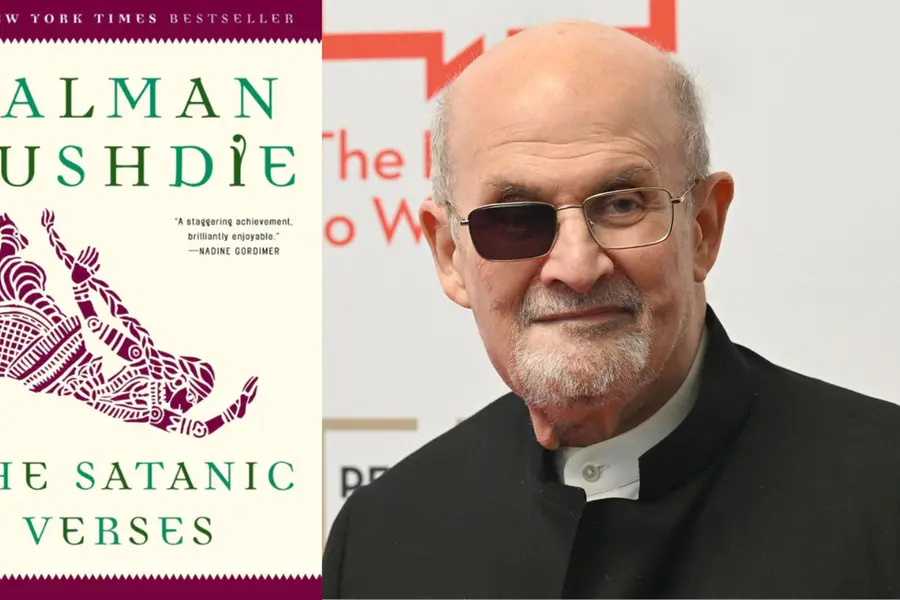
The Delhi High Court recently concluded proceedings in a long-standing petition challenging the 1988 ban on Salman Rushdie's novel ‘The Satanic Verses’. The court ruled that since the authorities could not produce the relevant notification, it has to be presumed that it does not exist. The case has once again brought the controversial novel into the spotlight, reigniting debates on censorship and the protection of free speech.
Salman Rushdie's ‘The Satanic Verses’ was first published in 1988 and quickly became one of the most talked-about books of the decade. The novel was Rushdie's fourth, and its mix of magical realism, political commentary, and controversial subject matter made it a significant literary achievement. Despite winning multiple awards, including the Whitbread Novel of the Year in 1988, the book drew intense criticism.
Why was ‘The Satanic Verses’ banned?
The controversy surrounding ‘The Satanic Verses’ stems primarily from its portrayal of Islam, which many Muslims considered blasphemous. The novel includes a fictional retelling of the life of the Prophet Muhammad. Rushdie, who was born into a Muslim family, defended his work as a piece of literary fiction, arguing that his goal was to reflect on the birth of religion, not to disparage it.
Despite this defense, the book was seen as an affront to Islamic beliefs. This prompted violent protests and strong reactions from various governments, including a fatwa calling for Rushdie’s death.
India’s government ban on ‘The Satanic Verses’
In India, ‘The Satanic Verses’ was banned in 1988, following pressure from Islamic groups who were outraged by the book’s content. The country’s then-Prime Minister, Rajiv Gandhi, faced calls for action after the book sparked protests and violence in various parts of the country. K Natwar Singh, a senior official in Gandhi's government, later defended the ban, stating that it was implemented solely to maintain law and order in the country. He explained that while he had always opposed book bans, the situation warranted the decision due to the potential for violence.
The Indian government justified the ban by citing concerns over communal harmony. Protests in the country had turned violent, particularly in Kashmir, with demonstrators attacking bookstores and confronting law enforcement. Singh asserted that the book could cause serious unrest, and the government's decision to ban its import was a precautionary measure to avoid further escalation.
Protests and violence
The backlash against ‘The Satanic Verses’ was not limited to India. Protests broke out across the globe, with violent clashes in several countries. In Pakistan, mobs attacked the American Cultural Center in Islamabad, and in Turkey, 37 people were killed in a fire set by radical Islamists at a literary festival after they targeted participants associated with the book.
In India, protests became particularly violent, with deadly incidents reported. On February 13, 1989, anti-Rushdie riots erupted in Srinagar, Jammu and Kashmir, where one person was killed and more than 100 were injured. In Mumbai, 12 people died in police firing during protests, with violence erupting near the British Consulate.
The fatwa issued by Iran’s Ayatollah Khomeini in 1989 further fueled tensions. The fatwa called for Rushdie’s assassination, which led to years of threats, violence, and public calls for the writer’s death. It prompted Rushdie to go into hiding, under police protection, for nearly a decade.
On Aug. 12, 2022, Salman Rushdie, was attacked while preparing to speak at the Chautauqua Institution in New York. A 26-year-old man, Hadi Matar, rushed the stage and stabbed Rushdie multiple times in the neck and abdomen before being subdued by audience members. The assault is believed to be motivated by a 1989 fatwa issued by Iran’s former leader Ayatollah Khomeini, condemning Rushdie’s work as blasphemous.
About the author
Salman Rushdie, born in India on June 19, 1947, is a British-based writer known for his explorations of cultural, political, and religious themes. His works often push the boundaries of literary conventions, which has led to both critical acclaim and public outrage. ‘The Satanic Verses’ is perhaps his most famous and controversial work, and its publication has defined much of his career.
Rushdie’s defense of artistic freedom and free speech, particularly in relation to the ban on his book, has made him a prominent figure in the ongoing debate on censorship. Despite living under threat for many years, Rushdie continued to write and speak out on issues of free expression. In 1998, the Iranian government distanced itself from the fatwa, though it has never officially been revoked.
Rushdie’s literary career spans decades, with over 30 books to his name. His memoir, ‘Joseph Anton’, recounts his years in hiding under the alias he used during the fatwa period. He was knighted by Queen Elizabeth II in 2008 for his services to literature.
(With inputs from PTI)
Published: 08 Nov 2024, 10:01 am IST
Related Topics
Disclaimer: Kindly avoid objectionable, derogatory, unlawful and lewd comments, while responding to reports. Such comments are punishable under cyber laws. Please keep away from personal attacks. The opinions expressed here are the personal opinions of readers and not that of Mathrubhumi.
