
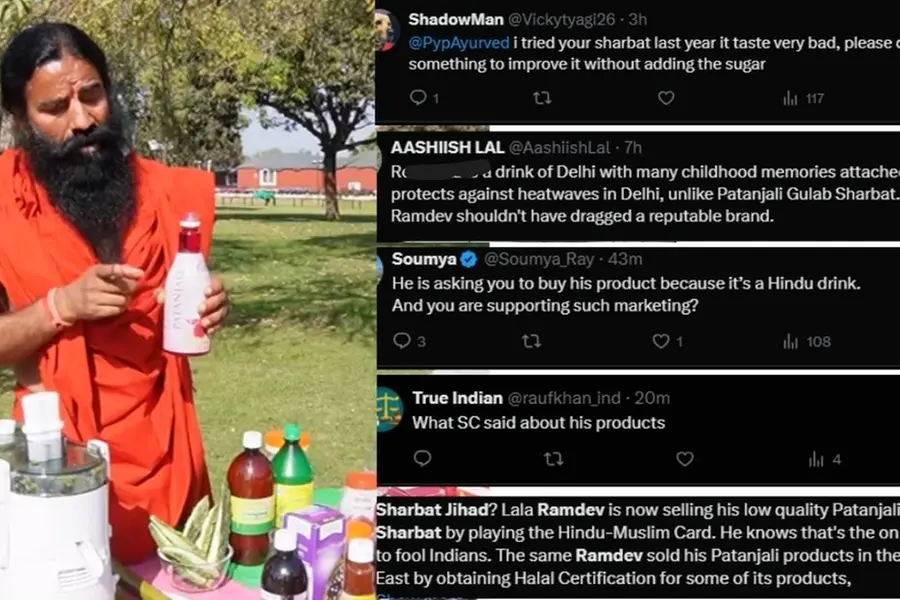
New Delhi: Yoga guru Ramdev has triggered fresh controversy with a video in which he labels soft drinks and a popular summer beverage as part of “sharbat jihad”, suggesting that money from the product's sales is being used to fund mosques and madrasas.
His remarks have sparked a wave of condemnation on social media, with users accusing him of spreading communal hatred for commercial gain.
The viral video and controversial claim
In a video posted on the Facebook page of Patanjali Products, Ramdev is seen denouncing cold drinks as “toilet cleaner” and going further to accuse a particular brand of sharbat of using its revenue to build religious institutions such as mosques and madrasas. He then contrasts this by promoting Patanjali’s rose sharbat, claiming it funds gurukuls, Patanjali University, and the Bharatiya Shiksha Board.
Ramdev coined the term “sharbat jihad” in the same breath as “love jihad” and “vote jihad”, stating, “Just like there is love jihad and vote jihad, there is also sharbat jihad. People must protect themselves from this.”
This statement quickly went viral, attracting over 37 million views and generating sharp criticism from a cross-section of social media users, journalists, and activists.
Social media backlash
The online reaction has been swift and overwhelmingly negative. Many users called out Ramdev for injecting communal bias into a simple consumer product. One user remarked, “Sell products based on worth, not hate.” Another commented, “Yog se dhanda, dhande se danga, aur dange se deshbhakti ka sharbat bechne ka natak.”
Another post read: “This is regressive nonsense. Sharbat is Urdu, you swadeshi poser. Coronil flopped, and now you're playing the religion card.”
Critics also drew attention to Ramdev’s previous controversies, including misleading health claims. One user wrote, “He recently begged the Supreme Court for misleading ads. Now this?” Another pointed out that “This isn't marketing; this is communal provocation disguised as business.”
Some users directly questioned regulatory bodies like the Advertising Standards Council of India (ASCI) and the Food Safety and Standards Authority of India (FSSAI) over the legality and ethics of such statements in product promotion.
A dangerous trend in rising hate marketing
Ramdev’s statement comes amid an observable trend in India where religious identity is increasingly being used in commercial, political, and cultural narratives to divide communities. The usage of terms like “love jihad”, “land jihad”, “vote jihad”, and now “sharbat jihad” points to a deepening communal vocabulary being normalised in public discourse.
Critics argue that this marks a clear deviation from the principles of secularism enshrined in the Indian Constitution. While India is constitutionally committed to religious neutrality, the state machinery and regulatory bodies have often remained silent or inactive in the face of such statements, thereby raising concerns about selective accountability.
Social media users have echoed this worry, with one stating, “The government is focused on comedians, but hate speech like this goes unchecked.” Another added, “This is what hatred looks like – targeting even sharbat with communal spin. Where are the regulators?”
The “sharbat jihad” controversy reflects a larger crisis in India’s democratic ethos, where commercial rivalry is being conflated with communal identity. The lack of timely intervention by authorities like ASCI, FSSAI, or even the Ministry of Information and Broadcasting signals a worrying tolerance of religiously polarising speech, particularly when backed by influential business figures.
Published: 10 Apr 2025, 12:21 pm IST
Related Topics
Disclaimer: Kindly avoid objectionable, derogatory, unlawful and lewd comments, while responding to reports. Such comments are punishable under cyber laws. Please keep away from personal attacks. The opinions expressed here are the personal opinions of readers and not that of Mathrubhumi.
