
Declassified CIA documents reveal that the US closely tracked Dr Rajendra Prasad’s constitutional interventions during the 1957 Kerala Education Bill crisis
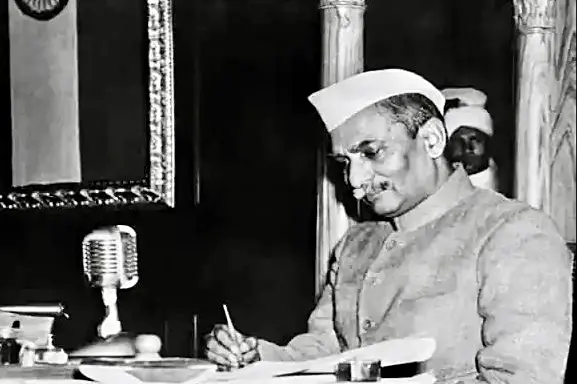
India marks Rajendra Prasad Jayanti on December 3 to celebrate the birth anniversary of Dr Rajendra Prasad -- the first President of India, a distinguished freedom fighter, and a crucial figure in the framing of the nation's Constitution and the shaping of its early democracy.
In the years post independence, the United States Central Intelligence Agency (CIA) kept a hawk eye on the Indian leadership. The US view of Dr Prasad, particularly within intelligence and policy circles during the critical early years of the Cold War, was primarily that of a critical, stabilizing institutional figure who provided essential democratic resilience within India.
Also Read

While US intelligence gathering (specifically the CIA) focused heavily on the executive authority of Prime Minister Jawaharlal Nehru, who was seen as the "creator and chief exponent of India’s foreign policy," the few documents that mention President Prasad confirm his strategic importance when India faced domestic or geopolitical crises.
The CIA tracked Dr Prasad as a crucial non-executive stabilizer and an institutional safeguard against the expansion of domestic communism. Especially, Dr Prasad's actions during the 1957–1958 crisis over the Kerala Education Bill were viewed as decisive.
The Communist Party of India (CPI) government in Kerala pushed through the bill, which the CIA assessed as a deliberate and subversive effort designed "to convert the entire school system into a Communist propaganda outlet and training centre
Dr Prasad halted the bill's implementation by invoking his constitutional authority to refer it to the Supreme Court. The court subsequently decided that certain clauses violated minority rights. The CIA's detailed documentation of this process confirmed that it was perceived as a critical action of institutional resilience.
According to declassified US documents, this application of judicial review demonstrated to Washington the robust nature of the Indian Constitution and its ability to "resist Communist imperialism" through peaceful means, thereby securing India’s strategic viability as a non-Communist anchor in Asia
Why CIA monitored Kerala Education Bill
A declassified CIA report meticulously detailed the controversial legislative process surrounding the Kerala Education Bill. The intelligence community noted that the Communist regime employed "typical rough-shod Communist tactics" to push the bill through the legislature, allowing only thirteen hours of debate across all stages and hearing testimony from merely 38 of the 1,400 persons who sought to testify.
The CIA assessment focused heavily on two major provisions: the requirement that all teachers be selected from government-prepared lists, and the state’s power to nationalize any government-aided private school on proof of "mismanagement," with no appeal permitted to the courts.
The intelligence conclusion on the CPI's objective was unambiguous: the measures were designed "to convert the entire school system into a Communist propaganda outlet and training center". This confirms that the US intelligence community viewed the bill not merely as educational reform, but as a deliberate and subversive effort to indoctrinate a generation of students and dismantle existing educational institutions, particularly those run by minority groups.
The US intelligence report specifically highlighted Dr Prasad's role in halting the bill's immediate implementation. The document observed that "Fortunately for the bill's opponents, the bill had to be signed by Indian President Rajendra Prasad before becoming law".
Upon receiving the bill, Dr Prasad invoked his constitutional authority and referred it to the Supreme Court to ascertain its constitutionality. The Court subsequently decided on May 22, 1958, that certain clauses violated minority rights guaranteed by the Constitution.
Published: 03 Dec 2025, 11:13 am IST
Related Topics
Disclaimer: Kindly avoid objectionable, derogatory, unlawful and lewd comments, while responding to reports. Such comments are punishable under cyber laws. Please keep away from personal attacks. The opinions expressed here are the personal opinions of readers and not that of Mathrubhumi.