
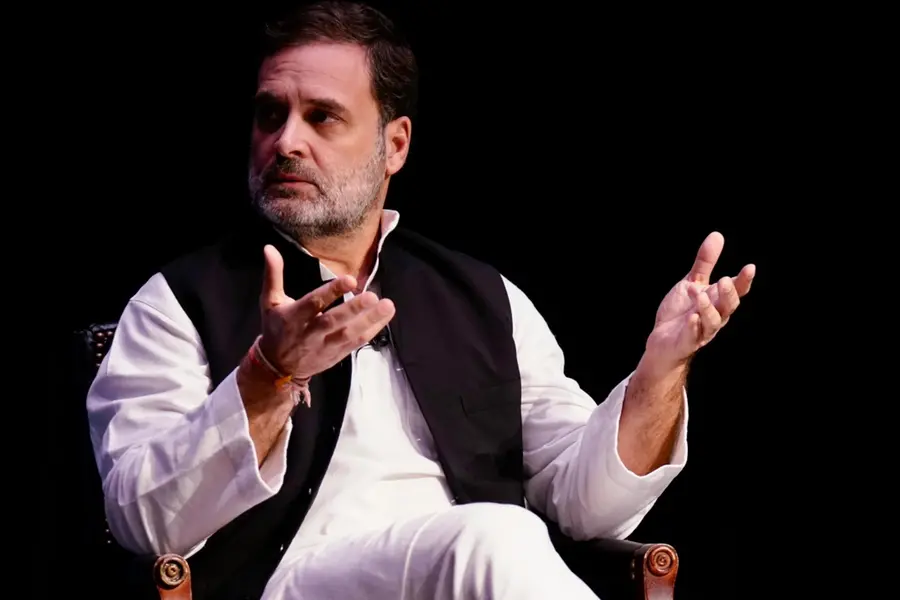
Washington: Leader of Opposition Rahul Gandhi has expressed that the Congress party aligns with the ruling BJP, led by Prime Minister Narendra Modi, on key foreign policy issues, including relations with the US, maintaining a hard stance on Pakistan until terrorism ceases, concerns about extremist activities in Bangladesh, and the country's stance on Israel. However, Gandhi, 54, disagrees with Modi's approach toward China, accusing the government of allowing Chinese troops to occupy Indian territory in Ladakh equivalent to the size of Delhi.
Gandhi criticised Modi's handling of China, pointing out the occupation of Indian territory by Chinese troops in Ladakh, which he described as a significant failure. He compared the situation to a hypothetical scenario in the US, questioning how any leader could be seen as managing a conflict well when faced with foreign occupation of national territory.
We need a long-term strategic vision: Rahul Gandhi
Rahul Gandhi, addressed the growing influence of China and its implications for India. Gandhi emphasized the rapidly changing global landscape, noting the significant increase in China's power and its impact on geopolitical dynamics.
“The world is changing. There’s a huge increase in China’s power,” Gandhi stated, highlighting the strategic position India occupies as it navigates these shifts. He stressed that India must develop a long-term strategic vision rather than relying on short-term tactical moves. According to Gandhi, this approach is crucial for effectively managing the evolving geopolitical environment, particularly given India’s proximity to China and its ongoing relationship with the United States.
"...So we are right in the middle of all this geopolitical change...We have to have a long-term vision and strategic vision, and it shouldn't be one tactical move after another tactical move. It should be okay. This is how we're thinking about it for the long term. This is the basic foundation, and we're going to walk on this path...," he said.
Gandhi underscored the importance of leveraging India’s democratic values as a cornerstone of its strategy. “We have to have a long-term vision and strategic vision,” he said, emphasizing that India’s democracy is not only a national asset but a global one. He warned against undermining this asset, as it is vital for India’s strategic posture and its role on the global stage.
In his remarks, Gandhi also touched on the need for India to remain true to its pluralistic and open nature. He cautioned against adopting a rigid or single-minded approach, which could lead to strategic difficulties. “India is no one idea. India has multiple ideas,” Gandhi said, reflecting on the country’s diverse and dynamic nature. He stressed that any strategic vision must account for and protect this pluralism, which he believes is central to India’s strength and global significance.
Gandhi's take on US relations, Pakistan, and Israel
At a press conference on Tuesday at the National Press Club, Gandhi voiced support for Modi's policies on Pakistan, stating that Pakistan’s support of terrorism is a major obstacle between the two countries. He asserted that as long as terrorism persists, dialogue with Pakistan would be hindered. When asked if the Kashmir issue was preventing dialogue, Gandhi simply responded, "No."
Regarding the India-US relationship, Gandhi highlighted its bipartisan support in both nations and noted that he does not see much deviation in Modi's approach from Congress's traditional stance. He emphasised that the India-US relationship is crucial for both countries and anticipated continuity in its trajectory.
Gandhi was clear in stating that the internal affairs of India, particularly the fight for democracy, should remain solely within the hands of Indian citizens, without external interference. He stressed the global significance of Indian democracy, given its scale and impact on the broader democratic vision worldwide.
On Israel, Gandhi criticised the ongoing conflict, condemning the violence on both sides, including Israel's actions that harm civilians. He underscored his stance against any form of violence and expressed concern that Israel's actions might be detrimental to its own interests.
Addressing concerns about Bangladesh, Gandhi acknowledged worries over extremist elements but expressed optimism that stability would return. He affirmed the importance of maintaining a relationship with Bangladesh, regardless of its government's composition. Earlier, during a meeting with US lawmakers at the Capital, Gandhi discussed the situation in Bangladesh and stressed the need for both Indian and Bangladeshi governments to take responsibility for ending violence. PTI
Published: 11 Sept 2024, 06:35 am IST
Related Topics
Disclaimer: Kindly avoid objectionable, derogatory, unlawful and lewd comments, while responding to reports. Such comments are punishable under cyber laws. Please keep away from personal attacks. The opinions expressed here are the personal opinions of readers and not that of Mathrubhumi.
