
Officials attribute the sharp decline to the delayed paddy harvest as well as intensified field monitoring and awareness campaigns informing farmers about the harmful effects of stubble burning.
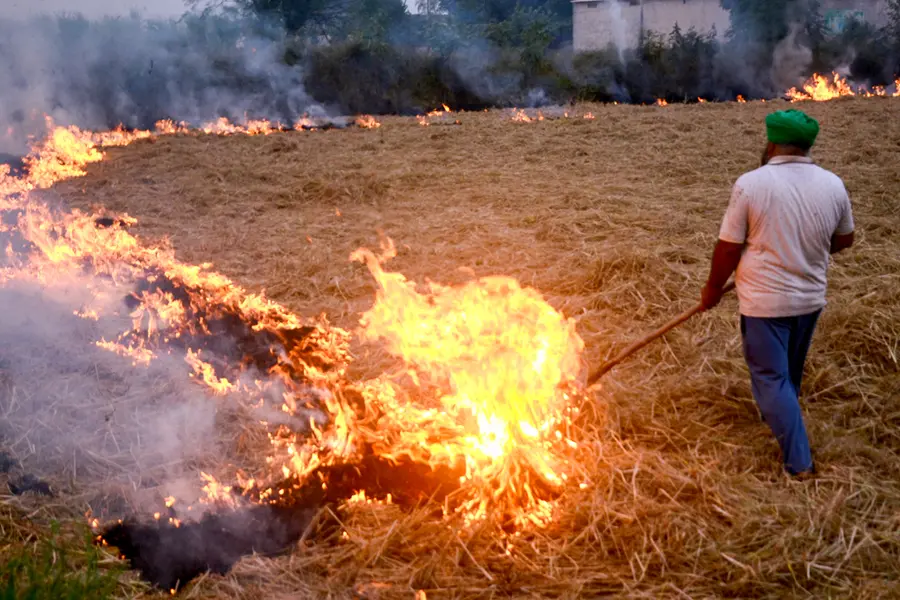
Patiala: The number of farm fire incidents in Punjab dropped dramatically to 415 between September 15 and October 21 this year, compared with 1,510 during the same period last year, according to data from the Punjab Pollution Control Board (PPCB).
In the equivalent period of 2023, the number stood at 1,764, the board’s figures show.
Officials attribute the sharp decline to the delayed paddy harvest, caused by continued rains until the first week of October and flood‑related crop damage in some areas, as well as intensified field monitoring and awareness campaigns informing farmers about the harmful effects of stubble burning.
Harvest status and regional breakdown
This year, Punjab’s total area under paddy cultivation was 31.72 lakh hectares. By October 21, just 32.84 per cent of the area had been harvested. The figures vary significantly by district as shown below.
- Tarn Taran: 67.95 per cent harvested
- Amritsar: 70 per cent
- Barnala: 8.10 per cent
- Moga: 8 per cent
- Sangrur: 17 per cent
The majority of farm fires occurred in Tarn Taran (136 incidents) and Amritsar (120), followed by Ferozepur (41), Patiala (27), Gurdaspur (16) and Sangrur (14).
Between October 11 and 23 alone, stubble‑burning incidents rose from 116 to 415.
The PPCB reports that environmental compensation fines totalling ₹9.40 lakh have been imposed in 189 cases, of which ₹6.25 lakh has so far been recovered. Additionally, 170 FIRs have been lodged under Section 223 (disobedience of orders by a public servant) of the Bharatiya Nyaya Sanhita; these include 61 cases in Tarn Taran and 50 in Amritsar.
Decline observed in recent years
Punjab’s farm fire incidents have seen a steep decline over recent years: 10,909 in 2024 and 36,663 in 2023, representing a 70 per cent drop compared with 2022’s 49,922. Earlier years recorded higher numbers: 71,304 in 2021, 76,590 in 2020, 55,210 in 2019 and 50,590 in 2018.
As paddy harvesting gains pace in most districts and the wheat‑sowing season approaches, officials are closely watching whether the reduced incident rate can be sustained through the next phase of the agricultural cycle.
PTI
Published: 22 Oct 2025, 03:44 pm IST
Related Topics
Disclaimer: Kindly avoid objectionable, derogatory, unlawful and lewd comments, while responding to reports. Such comments are punishable under cyber laws. Please keep away from personal attacks. The opinions expressed here are the personal opinions of readers and not that of Mathrubhumi.
