
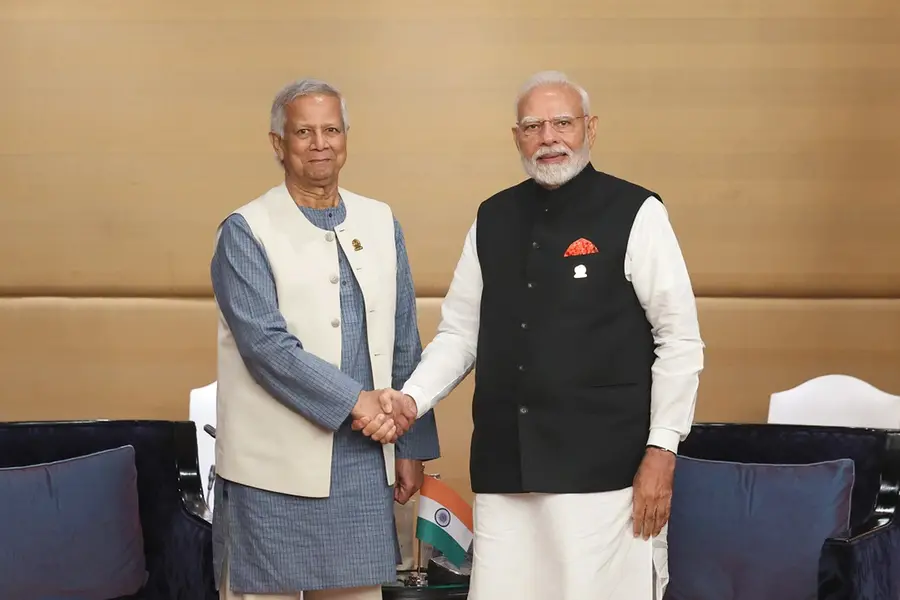
Bangkok: Prime Minister Narendra Modi met Bangladesh's Chief Adviser Muhammad Yunus in Bangkok on Friday, their first interaction since the removal of Sheikh Hasina as Bangladesh’s prime minister in August last year. The meeting, which took place on the sidelines of the Bay of Bengal Initiative for Multi-Sectoral and Technical Cooperation (BIMSTEC) summit, comes at a crucial time when diplomatic tensions have strained ties between Delhi and Dhaka.
External Affairs Minister S. Jaishankar and National Security Advisor Ajit Doval were also present at the meeting. Bangladesh is set to assume the BIMSTEC chairmanship.
Diplomatic concerns and security of minorities
Relations between India and Bangladesh have become tense since the interim government, led by Yunus, assumed power. New Delhi has expressed concerns over violence targeting Hindus and the growing influence of hardline Islamist forces in Bangladesh.
The discussions were expected to address these security concerns, as well as Hasina’s prolonged stay in India. The meeting was closely watched for its potential impact on regional stability, especially in light of Yunus’s recent remarks in Beijing regarding the northeastern region of India, Bhutan, Nepal, and Bangladesh as a possible "extension of the Chinese economy."
China’s growing role in South Asia
Yunus’s visit to China earlier this week has raised concerns in Delhi. His statement that India’s northeastern states could integrate economically with China has been interpreted as a shift in Bangladesh’s strategic positioning. Given India’s long-standing apprehensions about Chinese influence in South Asia, Modi’s meeting with Yunus was expected to provide an opportunity to seek clarifications and reaffirm India’s regional interests.
India has been actively countering China’s growing influence by strengthening partnerships with BIMSTEC nations. Modi’s engagement with Yunus follows his bilateral talks with Thai Prime Minister Paetongtarn Shinawatra, where India and Thailand upgraded their relationship to a "Strategic Partnership," signing agreements on digital technology, industrial cooperation, and development projects in India’s northeastern states.
BIMSTEC summit’s regional implications
The BIMSTEC summit has emerged as a crucial platform for India to reaffirm its strategic role in the Bay of Bengal region. Modi’s consecutive meetings with regional leaders, including Nepal’s KP Sharma Oli, Bhutan’s Tshering Tobgay, and Sri Lanka’s Harini Amarasuriya, signal India’s commitment to maintaining strong regional ties amid evolving geopolitical alignments.
A major development is Modi’s scheduled meeting with Myanmar’s military leader, General Min Aung Hlaing, marking India’s first high-level engagement with Myanmar’s junta since it seized power in 2021. India’s recent Operation Brahma, which provided humanitarian aid to Myanmar following a devastating earthquake, underscores its focus on regional stability.
BIMSTEC’s role in India’s regional strategy
Established in 1997, BIMSTEC serves as a crucial bridge between South Asia and Southeast Asia. With India’s northeastern states playing a central role in its regional strategy, Modi’s participation in the summit highlights the significance of connectivity projects such as the India-Myanmar-Thailand trilateral highway, which External Affairs Minister S. Jaishankar has termed a “game-changer” for regional integration.
Published: 04 Apr 2025, 11:45 am IST
Related Topics
Disclaimer: Kindly avoid objectionable, derogatory, unlawful and lewd comments, while responding to reports. Such comments are punishable under cyber laws. Please keep away from personal attacks. The opinions expressed here are the personal opinions of readers and not that of Mathrubhumi.
